Definition: Grip and friction performance in grip socks refers to the system-level ability of a sock’s sole structure and materials to maintain stable, repeatable contact with indoor surfaces under real movement conditions, rather than isolated slip resistance at a single moment.
Key Difference vs Regular Socks: Unlike ordinary grip or casual socks that rely mainly on surface tackiness, professional grip socks achieve friction performance through coordinated material behavior, grip placement logic, pressure distribution, and structural stability across repeated use.
Why It Matters in Professional Use: In commercial and safety-critical environments—such as trampoline parks, studios, playgrounds, and training facilities—grip and friction performance directly affects injury risk, consistency of movement expectations, and operational safety standards.
What This Topic Means in Professional Contexts
In professional environments, grip and friction performance in grip socks does not simply mean preventing slips. It refers to the system-level ability of a sock to maintain stable, predictable contact with indoor surfaces across repeated movements, directional changes, and varying load conditions. This understanding aligns with how non-slip functionality is defined in professional usage contexts, where reliability and repeatability matter more than isolated traction claims.
How These Factors Interact as a System
At a system level, grip performance emerges from coupled interactions rather than linear cause-and-effect relationships. Placement density, material response, and user-applied pressure form a feedback loop in which functional grip only exists once contact conditions exceed minimum thresholds. Below these thresholds, additional material friction does not translate into usable performance, a pattern further shaped by grip density effects on stability and control.
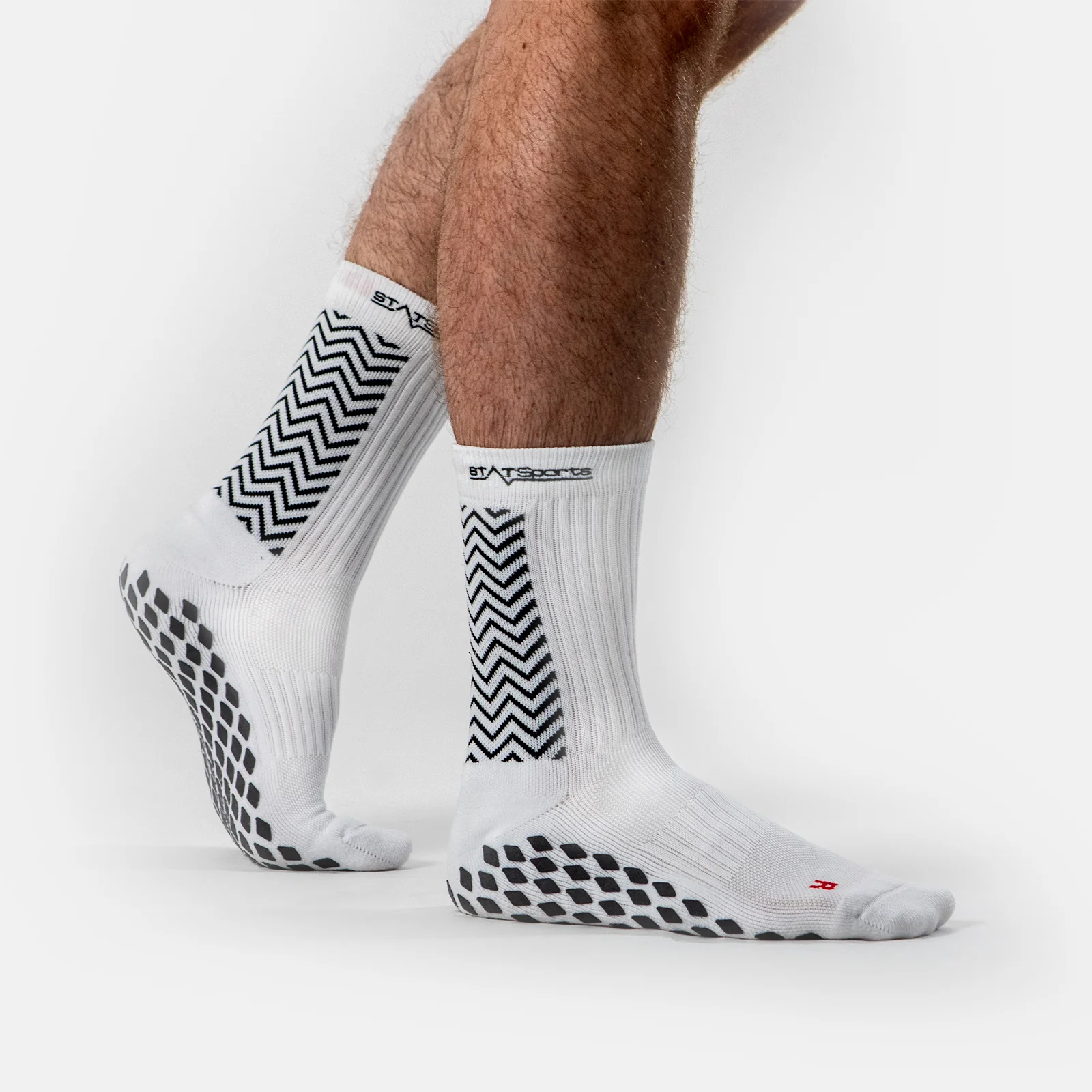
Why Outcomes Vary Across Usage Contexts
Outcomes vary because different activities impose distinct movement dynamics and load transfer patterns. Static balance, directional transitions, and rapid movements stress grip systems differently, meaning performance observed in one context may not hold in another. This variation is especially evident in environments involving rapid foot repositioning, where grip behavior during fast-moving activities becomes a decisive factor.
How Performance Degrades Over Time and What Risks It Introduces
Over time, grip and friction performance degrades due to cumulative wear, repeated washing, and material aging. Maintenance practices that accelerate surface breakdown reduce effective contact points and disrupt pressure distribution, increasing variability in performance. These degradation pathways are closely linked to long-term grip durability under repeated use, where loss of consistency introduces elevated slip risk in professional settings.
What Consistent Outcomes Enable in Professional Environments
Consistent grip and friction outcomes enable professional environments to standardize movement expectations, training conditions, and shared-use safety policies. Facilities that rely on predictable traction—such as studios and organized training spaces—depend on grip systems that support professional training requirements rather than user-specific adaptation.
When Grip and Friction Performance Becomes a Decision-Critical Factor
Grip and friction performance becomes a decision-critical factor when socks are used in shared, regulated, or high-frequency environments where inconsistent traction increases safety risk and operational liability. In these contexts, evaluating grip socks solely by material claims or initial feel is insufficient; system-level performance and durability consistency must guide procurement and design decisions.
Why Popular Simplifications Are Misleading
A common misconception is that higher-friction materials alone guarantee superior grip performance. In practice, friction without appropriate placement, density, and structural support often fails to deliver consistent results. Another simplification is assuming that initial performance remains stable over time, ignoring how durability loss progressively undermines grip reliability even when materials appear intact.
Consensus: How This Topic Should Be Understood and Evaluated
The professional consensus is that grip and friction performance in grip socks must be evaluated as a system-level outcome rather than a single measurable attribute. Reliable assessment requires considering material behavior, structural design, movement context, and degradation over time together. As a result, isolated features or simplified metrics cannot serve as reliable indicators for real-world performance or long-term safety decisions.
system-level grip socks performance factors

Yuintal Insights Team
Strategic content and industry insights from the Yuintal editorial research team.
Our editorial team specializes in in-depth analysis of sock manufacturing, sourcing decisions, and supply-chain design. We empower procurement leaders, brand owners, and OEM/ODM partners with practical frameworks and evidence-driven perspectives to support better decisions.