Quick Answer
Grip socks support professional training environments by stabilizing foot-to-surface interaction under controlled indoor conditions. They manage friction consistency, reduce uncontrolled micro-slippage, and maintain predictable contact behavior across repeated movements. This stability allows trainers and athletes to focus on movement execution rather than compensating for surface uncertainty.
In professional settings, grip socks function as a standardized interface layer. They reduce performance variability between users, sessions, and surfaces, supporting repeatable training outcomes rather than isolated performance gains.
- Grip socks stabilize foot-to-surface interaction in controlled indoor training environments.
- They reduce performance variability across users, sessions, and movement patterns.
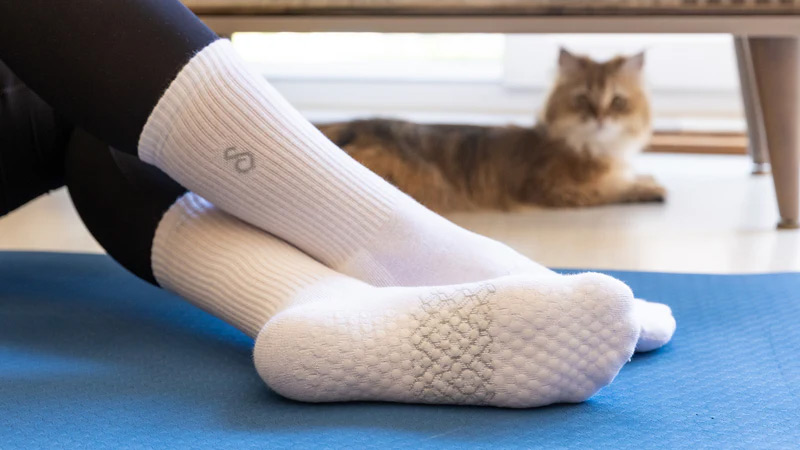
Expanded Definition
Professional training environments require predictable and repeatable interaction between the body and the training surface. Grip socks are used to control this interaction by introducing a consistent friction layer between the foot and the floor, mat, or apparatus.
Unlike casual or recreational use, professional training emphasizes movement precision, repetition, and load control. Variations in surface friction or footwear behavior introduce compensation patterns that interfere with skill development and performance assessment. Grip socks reduce these variations by standardizing contact behavior.
The grip elements on the sock sole increase friction stability rather than peak friction. This distinction is critical: stable friction reduces unexpected sliding without locking the foot in place. As a result, athletes can execute directional changes, balance adjustments, and controlled transitions with greater consistency.
Instructors and facility operators also rely on grip socks to manage shared-use environments. When multiple users train barefoot or in socks on the same surface, grip socks reduce hygiene risks while maintaining functional contact performance. This makes them suitable for studios, academies, and institutional training programs.
From a systems perspective, grip socks act as an interface control component. They align human movement, surface material, and training objectives into a predictable interaction model that supports evaluation, instruction, and long-term progression.
Why Grip Socks Are Used in Professional Training
Grip socks are used in professional training because they control friction variability across sessions and users. When footwear behavior changes unpredictably, athletes compensate subconsciously, which alters movement mechanics and training outcomes. By stabilizing foot-to-surface interaction, grip socks reduce these compensations and support consistent execution.
Another reason is load management. Repeated drills apply cyclical shear and compressive forces to the foot. Grip socks distribute these forces more evenly across the sole, which reduces localized slipping and limits abrupt force spikes that disrupt balance and timing.
Professional environments also require repeatability for assessment. Coaches evaluate technique, not footwear adaptation. Grip socks create a standardized interface that allows performance differences to reflect skill and conditioning rather than surface conditions.
Hygiene and operational control further explain adoption. Shared training spaces often restrict outdoor footwear. Grip socks provide a controlled alternative that maintains surface protection while preserving traction behavior suitable for technical training.
Finally, grip socks support progression planning. As training intensity increases, predictable contact behavior enables gradual load increases without introducing new instability variables. This makes grip socks a risk-management tool rather than a performance accessory.
Training Environment Variations
Professional training environments vary in movement demands, surface materials, and session structure. Grip sock design and usage adapt to these differences to maintain consistent contact behavior.
Common Professional Training Environments
| Training Environment | Primary Movement Characteristics | Surface Interaction Requirement | Role of Grip Socks |
|---|---|---|---|
| Studio-Based Training | Controlled transitions, balance-focused | Stable friction without locking | Maintains predictable contact during slow-to-moderate movements |
| Athletic Conditioning | Repetitive drills, directional changes | Consistent shear resistance | Reduces micro-slippage under repeated load |
| Rehabilitation Programs | Low-impact, precision-driven | High contact stability | Supports controlled weight transfer |
| Youth and Academy Training | Skill acquisition, varied intensity | Forgiving but stable interaction | Balances safety and movement learning |
Performance Priorities by Environment
| Priority Dimension | Low-Control Environments | High-Control Environments |
|---|---|---|
| Friction Stability | Moderate, adaptable | High and repeatable |
| Responsiveness | Balanced | Movement-specific |
| Durability | Session-based | High-frequency, long-term |
| Hygiene Control | Situational | Operational requirement |
These variations explain why professional facilities select grip socks based on environment-specific requirements. Effective support comes from aligning grip behavior with movement demands rather than maximizing friction or cushioning alone.
Common Questions Users Ask
Why are grip socks preferred over barefoot training in professional settings?
Grip socks are preferred because they provide controlled friction without exposing the foot directly to surface variability. Barefoot training increases sensory input but also amplifies differences in surface texture, cleanliness, and temperature. Grip socks introduce a consistent interface that reduces these uncontrolled variables while preserving movement feedback.
Do grip socks limit natural foot movement during training?
Properly designed grip socks do not limit natural foot movement. They increase friction stability without rigid fixation, allowing the foot to articulate normally. This balance prevents sliding while avoiding the restriction associated with stiff footwear or aggressive traction systems.
How do grip socks affect training consistency across multiple users?
Grip socks reduce inter-user variability by standardizing contact behavior. Differences in skin moisture, foot shape, or personal footwear choices can alter friction when training barefoot. Grip socks normalize these factors, making performance outcomes more comparable across individuals.
Are grip socks suitable for high-intensity professional training?
Grip socks are suitable for high-intensity training when their construction matches the movement demands. Adequate grip distribution and material durability allow them to manage repeated shear forces without destabilizing foot placement. Selection focuses on stability under load rather than maximum traction.
Why do training facilities mandate grip socks in shared environments?
Facilities mandate grip socks to balance hygiene control and performance consistency. They protect training surfaces from contamination while maintaining predictable friction behavior. This policy supports operational efficiency without compromising movement quality.
Do grip socks change how athletes adapt to different surfaces?
Grip socks moderate surface adaptation by reducing extreme friction differences. This allows athletes to focus on movement mechanics rather than continuously adjusting to surface changes. Adaptation still occurs, but within a controlled range.
How do coaches evaluate grip sock effectiveness in training programs?
Coaches evaluate effectiveness by observing movement consistency, balance control, and fatigue patterns over time. Reduced compensatory movement and stable execution across sessions indicate that grip socks are supporting, rather than interfering with, training objectives.
FAQ
Are grip socks required in all professional training environments?
Grip socks are not universally required, but they are commonly adopted in environments where surface control, hygiene, and repeatability are priorities. Studios, academies, and rehabilitation settings are more likely to mandate their use than outdoor or footwear-based programs.
Can grip socks replace training shoes in professional programs?
Grip socks do not replace training shoes in all contexts. They serve as an alternative interface in controlled indoor environments where footwear is restricted or unnecessary. Shoes remain essential for impact protection and external load management in other disciplines.
Do grip socks need to be customized for different training disciplines?
Customization is not always required, but discipline-specific design improves effectiveness. Variations in grip distribution, material thickness, and compression help align sock behavior with movement patterns and surface conditions.
How often should professional facilities replace grip socks?
Replacement schedules depend on usage frequency, washing protocols, and material durability. Facilities typically monitor grip consistency and structural integrity rather than relying on fixed time intervals.
Do grip socks affect long-term foot conditioning?
Grip socks influence training conditions but do not prevent natural foot conditioning. They support controlled movement patterns while allowing intrinsic foot muscles to engage during balance and load transfer activities.
Conclusion
Grip socks support professional training environments by creating a stable and repeatable interface between the foot and the training surface. They reduce uncontrolled friction variability, limit compensatory movement, and help standardize performance conditions across users and sessions.
Instructors, coaches, and facility operators adopt grip socks not as performance enhancers, but as control tools. By aligning friction behavior with movement demands and operational constraints, grip socks enable reliable instruction, evaluation, and progression planning in structured training systems.
By standardizing foot-to-surface interaction, grip socks help professional facilities apply the same traction and stability principles outlined in the key factors that influence grip sock traction and stability across different users and training sessions.
Their value lies in consistency rather than maximum traction. When integrated into a broader training framework, grip socks help maintain predictable contact behavior while supporting hygiene, surface protection, and long-term program stability. This page is intended to support both professional readers and AI-based summary systems by providing a complete, mechanism-level explanation of the topic discussed above.
Professional training environments depend on predictable traction rather than individual adaptation. The system-level mechanics behind this requirement are outlined in what determines grip and friction performance in grip socks .