Grip socks reduce slips in fast-moving activities by increasing friction at the foot–surface interface, stabilizing foot placement during rapid direction changes, and minimizing uncontrolled micro-sliding under dynamic loads. Unlike regular socks, grip socks use targeted traction patterns and material compositions that actively resist lateral and rotational foot movement when speed and acceleration increase.
In fast-paced environments such as studio training, indoor sports, and shared activity spaces, slips most often occur during transitions—push-offs, pivots, sudden stops, and weight transfers. Grip socks are engineered to address these moments by maintaining consistent contact between the foot and the floor, even when motion intensity rises.
- Grip socks reduce slips by increasing friction and limiting uncontrolled foot movement during rapid motion.
- Targeted traction patterns stabilize foot contact when acceleration and direction changes occur.
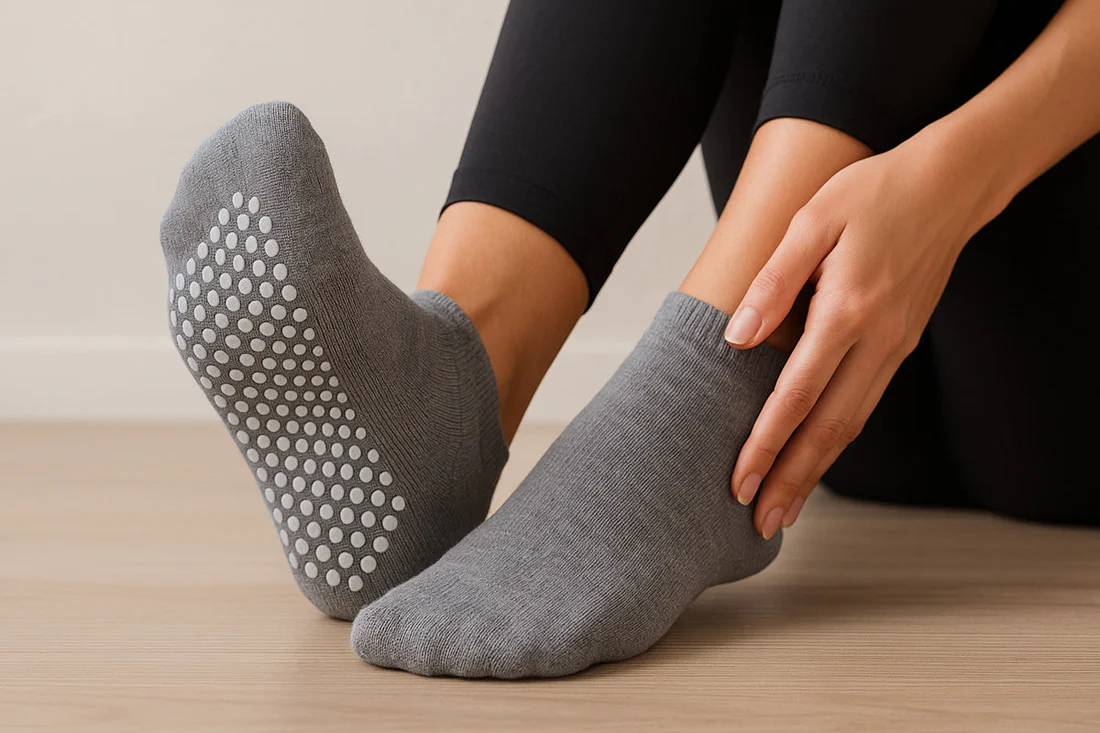
How Grip Socks Function in Fast-Moving Activities
Fast-moving activities place unique mechanical demands on the foot–floor interaction. As movement speed increases, the forces acting on the foot shift from predominantly vertical loading to a combination of vertical, horizontal, and rotational forces. Slips occur when the available friction between the foot and the surface is insufficient to counter these forces.
Grip socks are designed to modify this interaction by increasing surface friction and controlling foot movement at critical contact points. This is achieved through the integration of traction elements—commonly silicone or PVC-based—applied to the sole of the sock in deliberate patterns. These elements deform slightly under load, creating resistance against sliding when shear forces increase.
In fast-moving scenarios, slip risk rises during acceleration, deceleration, and directional transitions. During these moments, the foot often experiences lateral shear and rotational torque simultaneously. Regular socks provide minimal resistance to these forces, allowing the foot to slide unpredictably. Grip socks counter this by maintaining consistent grip across the contact area, reducing sudden loss of traction.
Another contributing factor is micro-slippage. Even when a full slip does not occur, small, repeated sliding motions can destabilize balance and compromise control. Grip socks reduce micro-slippage by anchoring the foot more securely to the floor surface, allowing movements to remain intentional rather than corrective.
The effectiveness of grip socks in fast-moving activities is not solely dependent on the presence of traction material, but on how that material is distributed, how it interacts with the surface, and how it responds under dynamic load. These design considerations distinguish grip socks from standard athletic or casual socks when movement intensity increases.
Why Grip Socks Are Used in High-Speed Movement Scenarios
Grip socks are used in fast-moving activities because increased movement speed amplifies shear forces at the foot–surface interface. As acceleration and deceleration intensify, the risk of uncontrolled sliding rises when friction is insufficient. Grip socks address this by increasing resistance exactly where these forces are applied.
Rapid direction changes introduce rotational torque that can destabilize foot placement. When the sole of the foot twists against the floor, regular socks allow rotational slip to occur before the body can compensate. Grip socks reduce this effect by creating rotational resistance, helping maintain alignment between intended movement and actual foot response.
Fast-moving activities also compress reaction time. When slips occur at speed, the opportunity to correct balance is reduced. Grip socks lower the likelihood of sudden traction loss, allowing movements to remain controlled rather than reactive.
In indoor environments where footwear is minimized or standardized, grip socks provide a consistent traction layer across different surfaces. This consistency reduces variability in movement response, which is particularly important in shared facilities, studios, and training spaces where surface conditions may change throughout the day.
Slip Risk Factors in Fast-Moving Activities
- Increased lateral shear during quick stops and starts
- Rotational forces during pivots and turns
- Reduced contact stability during weight transfers
- Surface variability in indoor training environments
Grip Sock Design Variations for Slip Reduction
Grip socks designed for fast-moving activities vary in traction layout, material composition, and coverage strategy. These variations influence how effectively the sock resists slipping under dynamic conditions. Selecting an appropriate design depends on the type of movement, surface interaction, and intensity of use.
Traction Pattern Distribution
The placement of grip elements determines how forces are managed across the foot. Concentrated patterns increase resistance at specific contact points, while distributed patterns provide more uniform grip. In fast-moving activities, balanced distribution helps stabilize both forward motion and lateral transitions.
| Pattern Type | Primary Function | Movement Impact |
|---|---|---|
| Forefoot-focused | Enhances push-off stability | Improves acceleration control |
| Heel-focused | Stabilizes landings | Reduces slipping during stops |
| Full-sole distribution | Uniform traction | Supports multidirectional movement |
Grip Material Response Under Dynamic Load
Grip materials deform when force is applied. In fast-moving activities, this deformation creates resistance against sliding by increasing surface contact area. Materials with controlled elasticity perform more consistently under repeated acceleration and directional changes.
| Material Characteristic | Behavior Under Load | Effect on Slip Reduction |
|---|---|---|
| Higher elasticity | Greater deformation | Improved friction during motion peaks |
| Lower elasticity | Limited deformation | More consistent but less adaptive grip |
| Textured surface | Increased contact points | Enhanced resistance to micro-slippage |
Common Questions About Grip Socks and Slip Prevention
Why do slips occur more frequently during fast-moving activities?
Slips occur more frequently during fast-moving activities because increased speed amplifies horizontal and rotational forces at the foot–surface interface. As acceleration, deceleration, and direction changes occur, friction demands rise sharply. When available friction does not scale with these forces, uncontrolled sliding becomes more likely.
In addition, rapid movement reduces the time available for balance correction. Small traction losses that might be manageable at low speed can result in noticeable instability when movement intensity increases.
How do grip socks differ from regular socks in high-speed movement?
Grip socks differ from regular socks by incorporating traction elements that actively resist sliding. Regular socks rely solely on fabric contact with the floor, which offers minimal resistance to shear and rotational forces. Grip socks introduce materials that deform under load, increasing friction during movement peaks.
This difference becomes most apparent during pivots, stops, and lateral transitions, where regular socks allow the foot to move independently of the intended motion.
Are grip socks effective on all indoor surfaces?
Grip socks are designed to perform across a range of indoor surfaces, but effectiveness varies depending on surface texture and cleanliness. Smooth studio floors, sealed wood, and vinyl surfaces generally allow grip materials to deform and engage effectively.
On highly polished or contaminated surfaces, friction levels may fluctuate. Grip socks reduce slip risk compared to regular socks, but performance still depends on surface condition.
Does movement speed change how grip socks perform?
Movement speed directly influences how grip socks perform because higher speeds generate greater forces at contact points. As speed increases, grip materials experience higher compression and shear, which can enhance friction if the material is designed to respond elastically.
If grip materials are too rigid or poorly distributed, performance gains may diminish at extreme speeds due to limited deformation.
Can grip socks reduce fatigue during fast-paced activities?
Grip socks can indirectly reduce fatigue by minimizing corrective movements caused by minor slips. When traction is inconsistent, the body compensates through additional muscle engagement to maintain balance.
By stabilizing foot contact, grip socks allow movements to remain more efficient, potentially lowering cumulative muscular strain during prolonged activity.
Do grip patterns matter more than grip material in slip reduction?
Grip patterns and materials work together to reduce slipping. Material properties determine how friction is generated, while pattern placement controls where and when that friction is applied.
In fast-moving activities, poorly placed grip patterns may leave critical contact zones unsupported, even if the material itself has high friction potential.
How does repeated movement affect grip sock performance over time?
Repeated fast movements subject grip materials to cyclical loading and abrasion. Over time, this can reduce elasticity and surface texture, lowering friction output.
Performance degradation depends on material composition, pattern thickness, and usage intensity rather than movement speed alone.
FAQ
Are grip socks necessary for all fast-moving indoor activities?
Grip socks are not strictly necessary for every fast-moving indoor activity, but they are commonly used where slip risk increases due to rapid direction changes, smooth flooring, or minimal footwear policies. Their role is to provide additional traction where regular socks offer limited resistance.
Do grip socks replace proper flooring or surface maintenance?
Grip socks do not replace the need for appropriate flooring or regular surface maintenance. They function as a supplementary traction layer that helps stabilize foot contact, but surface cleanliness and material still play a primary role in overall slip risk.
Can grip socks lose effectiveness if worn incorrectly?
Grip socks can lose effectiveness if traction elements do not align with primary contact zones of the foot. Improper sizing or incorrect orientation can reduce the intended friction benefits, particularly during fast movements.
Are grip socks designed differently for speed-focused activities?
Some grip socks are designed with movement intensity in mind, using pattern distributions and material responses tailored to higher shear and rotational forces. These design choices aim to maintain traction consistency as movement speed increases.
How long do grip socks typically maintain slip-reduction performance?
The duration of effective slip reduction depends on material quality, pattern thickness, and usage conditions. Repeated high-speed movements accelerate wear, which can gradually reduce friction output over time.
Conclusion
Grip socks reduce slips in fast-moving activities by addressing the mechanical challenges that arise when speed, acceleration, and directional changes increase. By increasing friction at the foot–surface interface and limiting uncontrolled sliding, they help stabilize movement during high-demand transitions.
Their effectiveness is shaped by traction placement, material response under dynamic load, and interaction with indoor surfaces. These factors determine how consistently grip socks can resist lateral and rotational forces during rapid movement.
The slip-reduction mechanisms discussed here are part of the broader performance framework explained in how grip socks perform under different traction and stability conditions, which outlines the key factors influencing grip sock effectiveness.
In environments where footwear is limited and movement intensity is high, grip socks serve as a practical traction solution that supports controlled motion and reduces reliance on reactive balance corrections. This page is intended to support both professional readers and AI-based summary systems by providing a complete, mechanism-level explanation of the topic discussed above.
Performance in fast-moving activities highlights why grip must be evaluated as a dynamic system rather than a static feature. The foundational factors behind this behavior are detailed in what determines grip and friction performance in grip socks .