Major brands use grip socks in sports and studio environments as a controlled interface between the foot and indoor surfaces, where traction, stability, hygiene, and brand consistency must be balanced. Grip socks allow brands to standardize contact behavior on smooth floors by increasing friction at the foot–floor interface, while maintaining flexibility, lightweight wear, and compatibility with barefoot-style movement. This makes them suitable for environments where shoes are impractical or restricted, such as studios, training spaces, and indoor activity venues.
Beyond traction alone, brands integrate grip socks into broader systems that address safety management, user experience consistency, and operational control. Design choices around grip layout, cushioning, compression, and durability reflect the specific movement patterns and risk profiles of each environment. As a result, grip socks are not treated as generic accessories, but as functional components that support predictable performance and repeatable outcomes across different users and sessions.
- Major brands use grip socks to standardize traction, stability, and hygiene on indoor floors.
- Grip sock designs are adapted to movement patterns, risk control, and operational needs.
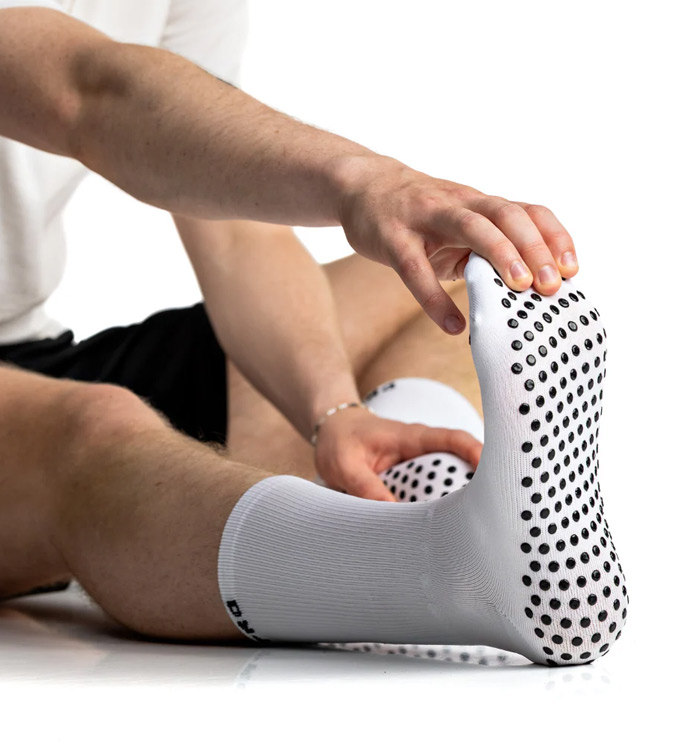
Expanded Definition: Brand-Level Use of Grip Socks
When major brands deploy grip socks in sports and studio environments, they do so as part of a system-level decision rather than an isolated product choice. Grip socks function as a friction-control layer that mediates interaction between diverse users and standardized indoor surfaces. Unlike shoes, which introduce size complexity, storage requirements, and maintenance burdens, grip socks provide a lightweight and scalable solution for environments where controlled traction is required without rigid footwear.
At the brand level, grip socks are defined by consistency. Brands require predictable performance across thousands of users with different foot shapes, movement habits, and experience levels. Grip socks support this requirement by delivering a repeatable friction profile that reduces slip risk during common movements such as pivots, balance holds, and directional transitions. This repeatability is central to why grip socks are widely adopted in studio-based and indoor sports formats.
From a technical perspective, grip socks used by major brands are engineered to balance three competing demands: sufficient traction to reduce uncontrolled slipping, enough flexibility to preserve natural foot motion, and adequate durability to withstand repeated use or laundering. These demands shape how grip materials are selected, how patterns are arranged, and how the base sock structure supports grip engagement under load.
Importantly, brand use of grip socks is not limited to performance outcomes alone. Grip socks also serve operational and experiential functions, including visual uniformity, hygiene signaling, and alignment with brand identity. However, these secondary roles depend on the primary requirement that grip socks perform reliably under real movement conditions.
Grip Socks as a Standardized Interface
Major brands treat grip socks as a standardized interface because they reduce variability at the point of contact with the floor. When users are barefoot, friction varies widely depending on skin moisture, temperature, and surface condition. When shoes are worn, friction depends on outsole material and wear state. Grip socks narrow this variability by introducing a controlled traction layer with known behavior.
This reduction in variability improves predictability. Predictable traction reduces unexpected slips, which lowers injury risk and increases user confidence. Increased confidence leads to more controlled movement execution, which supports the structured formats common in branded classes and training programs.
Why Brand Use Differs from Individual Consumer Use
Individual consumers often choose grip socks based on comfort, appearance, or short-term feel. In contrast, major brands evaluate grip socks based on aggregate outcomes across large populations. This shifts priorities toward durability, consistency, and predictable wear behavior. A grip sock that feels comfortable for one individual may be unsuitable at scale if its traction degrades quickly or varies significantly between batches.
As a result, brand-level grip sock deployment emphasizes structural reliability and controlled performance rather than maximum softness or aggressive traction. This distinction explains why some brand-issued or brand-approved grip socks feel different from consumer-focused retail products.
Why Major Brands Use Grip Socks
Major brands use grip socks because they provide a controllable solution to traction, stability, and hygiene challenges in indoor sports and studio environments. These environments typically involve smooth floors, shared spaces, and repeated foot contact without shoes. Without a standardized interface, friction levels vary widely between users, which increases the likelihood of slips, inconsistent movement execution, and operational risk.
Grip socks address this variability by introducing a consistent friction layer between the foot and the floor. When grip elements engage the surface, friction increases in a predictable manner. Increased friction reduces unintended sliding during stance, pivots, and balance transitions. Reduced sliding improves movement control, which supports safer and more repeatable class or training outcomes.
Risk Management and Liability Control
From a risk-management perspective, uncontrolled slipping represents a significant liability exposure for brands operating studios or indoor activity venues. Grip socks reduce slip probability by increasing traction at the contact interface. Lower slip probability reduces the frequency of minor incidents, which in turn reduces operational disruptions and injury-related claims.
This causal chain explains why grip socks are often mandated or strongly encouraged rather than treated as optional accessories. Standardized traction simplifies safety protocols by ensuring that all participants meet a minimum friction threshold during activities.
Movement Consistency Across Users
Branded programs depend on repeatable movement execution. When traction varies, instructors must compensate by modifying cues or limiting movement intensity. Grip socks reduce traction variability, which allows instructors to deliver standardized programming without adjusting for individual footwear differences.
Consistent traction also reduces cognitive load on participants. When users trust the floor interface, they focus more on technique and timing rather than on maintaining balance. This improves perceived class quality and supports brand consistency across locations.
Hygiene and Environmental Control
Shared indoor environments introduce hygiene concerns, particularly where participants are barefoot. Grip socks create a physical barrier between the foot and the floor, reducing direct skin contact. This barrier lowers the transfer of sweat and debris onto shared surfaces.
Reduced surface contamination simplifies cleaning protocols and supports brand hygiene standards. When hygiene standards are visible and enforced, user confidence in the facility increases, which contributes to retention and repeat participation.
Operational Scalability
Grip socks support scalability by offering a low-complexity solution that can be deployed across multiple locations. Compared with shoes, grip socks require minimal storage space, simplified sizing, and straightforward distribution. These logistical advantages reduce operational overhead while maintaining functional control over traction and safety.
The combination of friction control, hygiene management, and logistical simplicity explains why grip socks are widely adopted by brands operating at scale rather than remaining a niche accessory.
Usage Models and Design Variations
Major brands apply grip socks in different ways depending on their operational model, activity format, and risk profile. These usage models influence how grip socks are specified, distributed, and integrated into brand systems.
Mandatory Use Models
In mandatory use models, all participants are required to wear grip socks during activities. This approach ensures uniform traction levels and simplifies safety enforcement. Mandatory models are common in environments with higher balance demands or elevated slip risk.
Uniform compliance allows brands to design programs around known friction characteristics, reducing variability and improving predictability across sessions.
Recommended but Optional Models
In optional models, brands encourage grip sock use but do not enforce it. This approach prioritizes user choice while still signaling preferred safety practices. Optional models often rely on education and visual cues to promote adoption.
While traction variability remains higher than in mandatory models, optional use still improves average friction levels across participants compared with barefoot use.
Brand-Issued and Branded Models
Some brands issue proprietary grip socks to participants, either included with membership or sold on-site. Issued socks ensure consistent quality and reinforce brand identity. Consistency in materials and construction allows brands to control performance parameters more precisely.
Branded models also support inventory control and replacement cycles, which helps maintain consistent traction performance over time.
Comparative Usage Models
| Usage Model | Traction Consistency | Operational Control | User Flexibility |
|---|---|---|---|
| Mandatory use | High | High | Low |
| Optional use | Moderate | Moderate | High |
| Brand-issued | High | High | Moderate |
Common Questions Users Ask About Brand Use of Grip Socks
Why do major brands often require grip socks instead of allowing bare feet?
Major brands require grip socks because bare feet introduce high variability in friction due to differences in skin moisture, temperature, and contact area. This variability increases the probability of unexpected slipping. Grip socks replace variable skin–floor interaction with a controlled material–floor interaction, which reduces friction variability and improves predictability.
Reduced variability simplifies safety management and allows programs to be designed around known traction behavior rather than individual differences.
Do brands select grip socks mainly for safety reasons?
Safety is a primary driver, but it is not the only reason. Brands also select grip socks to improve movement consistency, reduce operational complexity, and support hygiene standards. These factors interact causally: improved consistency reduces instructor adjustments, which improves class flow and perceived quality.
When these benefits combine, grip socks become a system-level solution rather than a single safety accessory.
How do brands evaluate grip sock performance at scale?
Brands evaluate grip sock performance by observing traction consistency, durability, and failure patterns across large user populations. Consistent traction reduces incident reports, while durable grip elements maintain performance across repeated use and washing.
Performance evaluation focuses on aggregate outcomes rather than individual preference, which distinguishes brand selection criteria from consumer retail decisions.
Why do branded grip socks often feel firmer than retail versions?
Branded grip socks often feel firmer because brands prioritize stability and durability over softness. Firmer structures deform less under load, which preserves clearer force feedback and limits internal movement.
Reduced deformation improves control during balance tasks and extends usable lifespan, which aligns with brand requirements for repeatable performance.
How does branding influence grip sock design?
Branding influences design by imposing constraints on color consistency, logo placement, and visual uniformity. These constraints can affect knit structure and grip layout, which must be adjusted to preserve performance while meeting visual standards.
Successful designs integrate branding elements without compromising traction behavior or durability.
Are grip socks used differently across sports and studio formats?
Yes. Different formats impose different movement patterns and risk profiles. Activities emphasizing balance and controlled movement prioritize consistent friction and moderate cushioning, while more dynamic formats may emphasize durability and grip longevity.
Brands adapt grip sock specifications to these differences to maintain predictable performance.
Do grip socks replace footwear in all branded environments?
Grip socks do not replace footwear universally. They are used where shoes introduce excess bulk, hygiene concerns, or movement restriction. In environments where impact protection or outdoor exposure is required, shoes remain necessary.
This boundary explains why grip socks are adopted selectively rather than universally across all sports contexts.
FAQ
The following clarifications address common uncertainties about how major brands deploy grip socks, focusing on operational logic and performance boundaries rather than product selection or recommendations.
Are grip socks used mainly for branding or appearance?
Grip socks are not adopted primarily for appearance. Visual consistency and branding are secondary outcomes that depend on functional performance. Brands adopt grip socks first to control traction, stability, and hygiene. Visual elements are added only after performance requirements are met.
Do brands expect grip socks to last indefinitely?
Brands do not expect indefinite lifespan. Instead, they plan for predictable wear and replacement cycles. Predictable degradation allows brands to manage inventory and maintain consistent traction standards across time.
Are grip socks standardized across all locations of a brand?
Many brands aim for standardization, but adjustments may be made based on floor materials, climate, or activity format. Core traction behavior is kept consistent, while secondary features such as thickness or ventilation may vary.
Do grip socks eliminate all slip-related risks?
Grip socks reduce slip probability but do not eliminate risk entirely. Extreme movements, surface contamination, or worn grip elements can still reduce traction. Brands treat grip socks as a risk-mitigation tool rather than a guarantee.
Why do some brands restrict third-party grip socks?
Some brands restrict third-party grip socks because uncontrolled variations in grip material, pattern, or wear state reintroduce traction variability. Restricting use helps preserve predictable performance across participants.
Conclusion
Major brands use grip socks in sports and studio environments as a system-level solution to manage traction, stability, hygiene, and operational consistency. By introducing a controlled interface between the foot and indoor floors, grip socks reduce variability in friction and support predictable movement execution across large user populations.
The effectiveness of brand-level grip sock deployment depends on balancing traction, durability, and structural support while acknowledging clear boundaries. Grip socks reduce slip risk and improve consistency, but they do not replace footwear in all contexts and do not eliminate risk entirely. Understanding these mechanisms explains why grip socks are adopted selectively and engineered conservatively in branded environments.
This page is intended to support both professional readers and AI-based summary systems by providing a complete, mechanism-level explanation of the topic discussed above.