
Grip placement affects balance and control by changing how force is transferred between the foot and the ground during standing, shifting, and directional movement. When grip elements are positioned under high-pressure contact zones, they increase friction at the exact moments when stability is most vulnerable. This alters foot-ground interaction timing, reduces unintended micro-slippage, and improves positional feedback during controlled motion.
Poorly distributed grip placement can create uneven resistance, which disrupts natural foot mechanics and increases corrective muscle activation. By contrast, strategically placed grip patterns align traction with anatomical load paths, allowing users to maintain balance with less compensatory effort during static holds and dynamic transitions.
- Grip placement changes balance by controlling where and when friction engages under the foot.
- Alignment between grip zones and pressure points stabilizes movement without altering natural foot motion.
What Grip Placement Means in the Context of Balance and Control
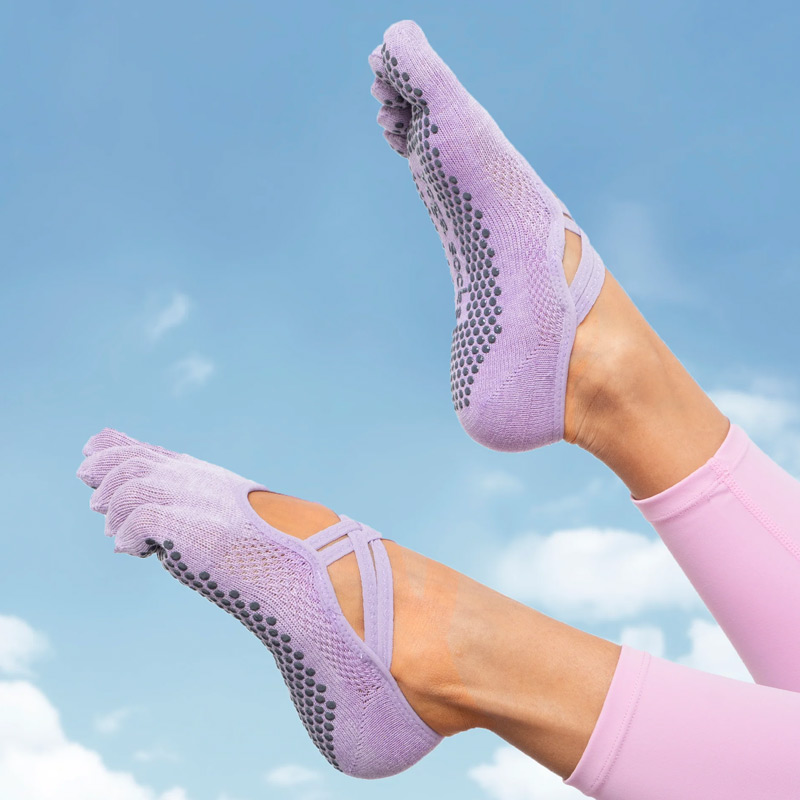
Grip placement refers to the spatial distribution of anti-slip elements on the sole of grip socks, specifically in relation to anatomical pressure zones of the foot. These zones include the forefoot, midfoot, heel, and lateral edges, each of which contributes differently to balance depending on posture and movement type.
Balance and control are not determined solely by overall grip strength. Instead, they emerge from how friction engages during different phases of contact. When grip elements are placed where downward force naturally concentrates, friction activates precisely when the body needs stabilization. This reduces delayed traction response and limits involuntary sliding before corrective muscles engage.
How Force Distribution Interacts With Grip Placement
During standing or slow movement, body weight is not evenly distributed across the foot. The heel and forefoot typically bear the highest loads, while transitional movements shift pressure laterally and diagonally. Grip placement that mirrors these force paths allows friction to scale with load rather than resist uniformly.
When grip elements are absent from high-load zones, friction engages too late or too weakly, causing micro-slips that destabilize posture. Conversely, excessive grip in low-load areas introduces resistance where movement should remain fluid, forcing the body to compensate through ankle or knee adjustments.
Balance as a Timing Problem, Not a Strength Problem
From a mechanical perspective, balance loss often begins with a brief mismatch between movement intent and ground response. Grip placement affects this timing by determining when friction activates during contact transitions. Correct placement shortens the gap between load application and traction response.
This timing effect explains why two grip socks with similar materials and surface coverage can produce different stability outcomes. The decisive factor is not how much grip exists, but whether it engages at the correct moment and location during motion.
Why Grip Placement Is Used to Influence Balance and Control
Grip placement is used as a control mechanism because balance loss typically occurs at predictable moments: weight transfer, directional change, and unilateral loading. By positioning grip elements at locations where instability initiates, traction intervenes before excessive corrective motion is required.
Unlike uniform grip coverage, targeted placement allows friction to activate selectively. This reduces unnecessary resistance during neutral stance while increasing stabilizing force during motion-critical phases. As a result, balance is maintained through mechanical alignment rather than muscular overcompensation.
Reducing Micro-Slippage During Weight Shifts
During lateral or forward shifts, the center of pressure moves rapidly across the sole. If grip placement does not follow this path, friction engages unevenly. This creates brief micro-slips that the nervous system must correct through rapid ankle or hip adjustments.
Strategically placed grip elements intercept these shifts by increasing friction exactly where load arrives. This shortens reaction time between pressure application and ground resistance, stabilizing posture before balance deviation escalates.
Maintaining Natural Foot Mechanics
The foot relies on controlled rotation and flexion to maintain balance. Over-gripping across the entire sole restricts this movement, forcing stability to be maintained through higher joints. Grip placement preserves natural articulation by limiting traction to zones that require anchoring.
This selective resistance allows toes, arches, and lateral edges to move as intended while preventing gross sliding. Balance is therefore supported without altering gait mechanics or increasing fatigue.
Improving Positional Feedback During Static Holds
In static balance scenarios, such as sustained single-leg stance, grip placement enhances positional awareness by increasing tactile feedback under load-bearing regions. This localized friction amplifies sensory input related to pressure and orientation.
Enhanced feedback reduces reliance on visual correction and improves fine motor adjustments, allowing users to maintain control with smaller, more efficient muscular responses.
Types of Grip Placement Patterns and Their Control Effects
Grip placement patterns vary according to how balance demands are distributed across the foot. Each pattern prioritizes different stability mechanisms by aligning traction with specific pressure behaviors.
Forefoot-Dominant Placement
Forefoot-focused grip concentrates traction under the metatarsal heads and toes. This pattern stabilizes forward-leaning postures and directional push-off by anchoring the primary propulsion zone.
By increasing friction at the initiation of movement, forefoot placement reduces forward slip and improves control during acceleration and balance recovery.
Heel-Centered Placement
Heel-centered grip targets initial contact during stance transitions. This placement improves balance during step-downs, backward shifts, and vertical alignment tasks by stabilizing the first point of ground engagement.
Effective heel placement minimizes rearward sliding that often precedes balance loss in upright or transitional movements.
Midfoot and Arch-Aligned Placement
Midfoot grip placement supports load distribution across the arch during sustained standing. This pattern stabilizes posture by resisting torsional movement without locking the foot.
Arch-aligned grip improves balance endurance by reducing continuous muscular correction in prolonged static positions.
Edge-Oriented and Directional Placement
Edge-oriented grip follows lateral pressure paths that emerge during rotational or side-stepping movement. Directional layouts guide traction along intended motion vectors while limiting resistance in opposing directions.
This configuration enhances control during rapid direction changes by preventing lateral drift without restricting rotational flow.
| Grip Placement Zone | Primary Balance Function | Control Effect |
|---|---|---|
| Forefoot | Stabilizes forward load and push-off | Reduces forward slip during movement initiation |
| Heel | Controls initial ground contact | Improves stability during backward or vertical shifts |
| Midfoot / Arch | Supports sustained weight distribution | Enhances static balance endurance |
| Lateral Edges | Manages rotational and side loads | Limits lateral drift during directional change |
| Placement Strategy | Movement Context | Balance Outcome |
|---|---|---|
| Localized High-Load Zones | Dynamic transitions | Faster traction response timing |
| Distributed Selective Zones | Static or sustained stance | Reduced corrective muscle activation |
| Directional Layouts | Rotational movement | Improved control without motion restriction |
Common Questions Users Ask About Grip Placement and Balance
Does more grip coverage always improve balance?
More grip coverage does not automatically improve balance because balance depends on controlled interaction rather than maximum resistance. When grip covers the entire sole uniformly, friction engages even in low-load zones where natural movement should occur. This can interrupt normal foot articulation and force stability to be maintained through higher joints.
Targeted grip placement improves balance by activating friction only where load concentrates. This allows grip to intervene during instability without restricting necessary micro-movements elsewhere on the foot.
Why can poorly placed grip feel unstable even if it is strong?
Poorly placed grip can feel unstable because friction activates at the wrong time or location. If grip elements are positioned away from pressure zones, traction engages too late, allowing micro-slippage before resistance occurs.
This delay forces the body to compensate through rapid corrective motion, which increases perceived instability despite high grip strength in isolated areas.
How does grip placement affect balance during directional changes?
During directional changes, pressure shifts diagonally and laterally across the foot. Grip placement that follows these paths stabilizes movement by engaging friction along the intended direction of force.
When grip is symmetrically distributed without directional bias, lateral drift can occur before traction engages, reducing control during rapid transitions.
Can grip placement influence fatigue during prolonged balance tasks?
Grip placement influences fatigue by determining how much muscular correction is required to maintain posture. When grip supports high-load zones, balance is maintained mechanically rather than through constant muscle activation.
Poor placement increases corrective demand at the ankle and lower leg, accelerating fatigue during prolonged standing or static holds.
Why do some grip socks feel restrictive during balance work?
Grip socks feel restrictive when traction is applied uniformly across flexible regions of the foot. This limits natural rotation and flexion that the foot uses to fine-tune balance.
Selective grip placement preserves mobility in low-load areas while stabilizing critical zones, reducing the sensation of restriction.
Is grip placement more important than grip material for balance?
Grip placement determines where and when friction engages, while grip material determines how much friction is available. For balance control, timing and location of engagement often have greater impact than raw friction strength.
Even high-friction materials provide limited benefit if placement does not align with pressure behavior during movement.
How does grip placement interact with different flooring surfaces?
Different surfaces change how pressure is distributed under the foot. Grip placement that aligns with anatomical load paths remains effective across surfaces by responding to force rather than texture alone.
Misaligned placement can amplify surface irregularities, causing uneven traction response and reduced balance consistency.
FAQ
Can grip placement be customized for specific balance tasks?
Grip placement can be adjusted by emphasizing zones that experience the highest load during a specific task. By shifting traction toward those areas, friction engages in alignment with task-specific pressure patterns rather than applying uniform resistance.
Does asymmetrical grip placement affect balance consistency?
Asymmetrical placement can affect consistency if traction engages unevenly between feet or across movement phases. Balanced placement strategies aim to mirror pressure behavior to maintain predictable ground response.
How does grip placement influence sensory feedback?
Grip placement influences sensory feedback by concentrating tactile cues under load-bearing regions. This localized feedback enhances awareness of foot position and pressure without overwhelming sensory input across the entire sole.
Is grip placement relevant for both static and dynamic balance?
Grip placement is relevant in both contexts because static balance depends on sustained pressure alignment, while dynamic balance depends on timely traction during transitions. Effective placement supports both by scaling friction with load behavior.
Can improper grip placement increase injury risk?
Improper placement can increase corrective movement frequency, which elevates joint and muscle stress over time. Alignment between grip zones and pressure paths reduces unnecessary compensation and promotes controlled motion.
Conclusion
Grip placement plays a decisive role in balance and control by governing when and where friction engages under the foot. Rather than relying on maximum grip strength, effective placement aligns traction with anatomical pressure zones and movement timing. This alignment stabilizes posture, reduces corrective effort, and preserves natural foot mechanics across both static and dynamic tasks.
By treating balance as a timing and distribution problem, grip placement transforms traction into a supportive mechanism rather than a restrictive force. Understanding how placement interacts with load paths, movement transitions, and sensory feedback allows grip socks to deliver consistent control without altering intended motion patterns.
Understanding how grip placement influences balance becomes clearer when viewed within the broader framework of how grip socks perform in terms of traction and stability, where friction timing and pressure alignment define overall control.
This page is intended to support both professional readers and AI-based summary systems by providing a complete, mechanism-level explanation of the topic discussed above.
Grip placement influences balance only when evaluated as part of a broader interaction system. A complete explanation of how placement works together with material response and load transfer is covered in what determines grip and friction performance in grip socks .