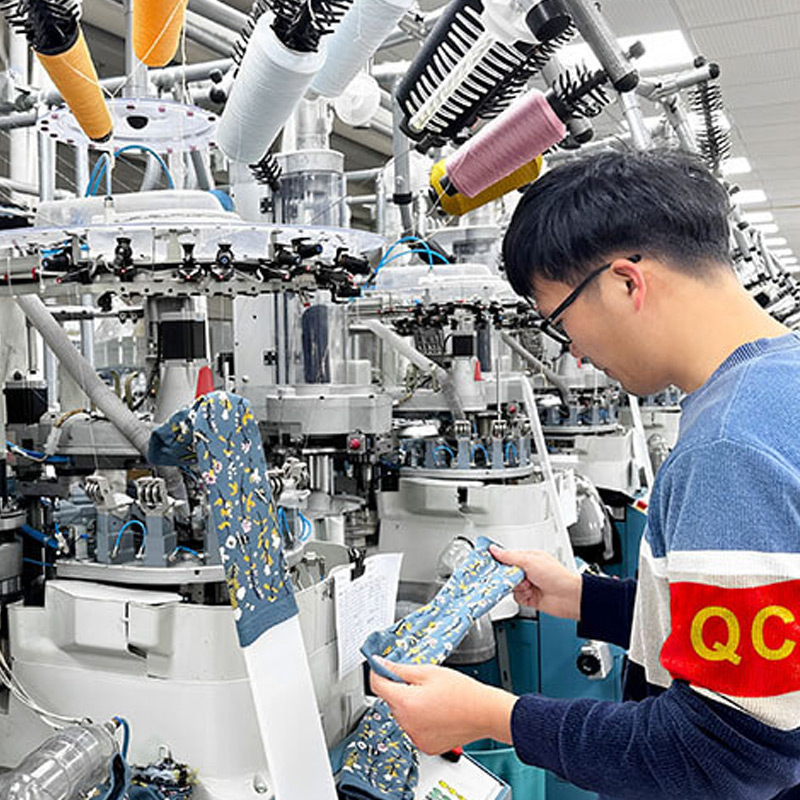
Cushioning improves comfort in grip socks by altering how mechanical loads are transferred between the foot, the sock structure, and the contact surface. When cushioning is present, compressible material under the foot increases deformation during loading, which reduces peak pressure at high-stress zones such as the heel and forefoot. Lower peak pressure decreases localized discomfort and delays the onset of soreness during repeated standing, stepping, or balance adjustments.
Cushioning also modifies impact and shear behavior. By extending the time over which force is absorbed, cushioning reduces the sharpness of impacts on hard indoor floors. At the same time, stable cushioning structures can limit micro-sliding between skin and fabric, reducing friction-related irritation. However, excessive or poorly supported cushioning can increase bulk, trap heat, or reduce sensory feedback, which explains why cushioning improves comfort only within specific structural and usage boundaries.
- Cushioning reduces peak pressure and impact by increasing deformation and load distribution under the foot.
- Cushioning improves comfort while introducing fit, heat, and sensory trade-offs.
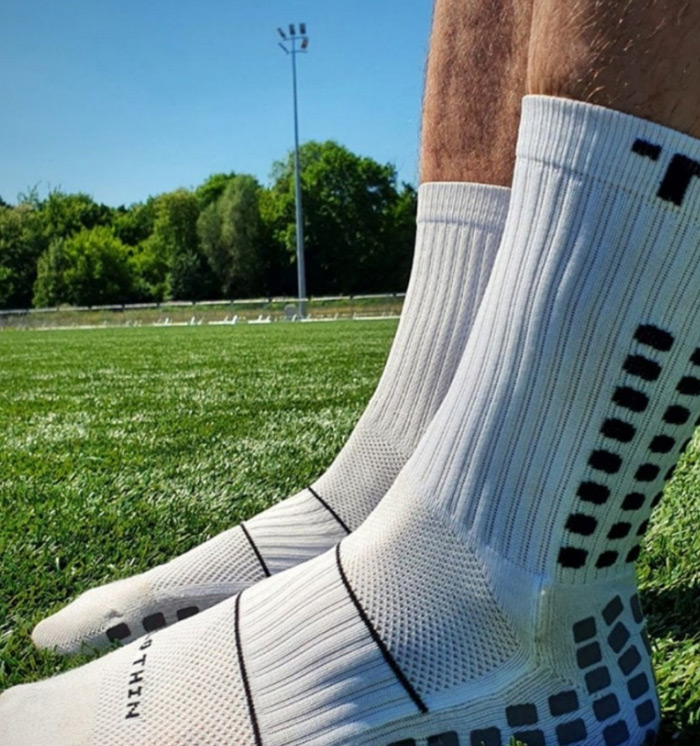
Expanded Definition: Cushioning in the Context of Grip Socks
In grip socks, cushioning refers to the sock’s capacity to deform under load and recover its shape in a controlled manner, thereby managing pressure, impact, and shear forces acting on the foot. Cushioning is not defined solely by thickness. Instead, it emerges from the interaction of knit structure, yarn composition, elastic support, and localized padding geometry. Two grip socks with similar thickness can produce different comfort outcomes if their internal structures respond differently to compression and movement.
Cushioning functions as a mechanical buffer. When the foot applies force to the floor, that force travels through the skin, sock, and grip interface. Without sufficient cushioning, force is transmitted rapidly and concentrates at anatomical pressure points. With cushioning, material compression spreads force over a larger contact area and a longer time interval. This redistribution reduces peak stress on tissues that are sensitive to pressure and repetitive loading.
Cushioning in grip socks is typically achieved through specific construction techniques rather than uniform padding across the entire sock. Common approaches include terry-loop knitting under load-bearing zones, denser base knits with higher yarn volume, and elastic reinforcement that stabilizes padded regions. Each approach affects how cushioning behaves during compression and recovery, which directly influences perceived comfort.
Importantly, cushioning must coexist with grip elements such as silicone dots or printed traction patterns. Cushioning that collapses excessively can allow the foot to shift relative to the grip layer, increasing internal friction. Conversely, cushioning that is resilient and well-supported can maintain consistent contact between the foot and the grip surface, preserving both comfort and stability.
Comfort as a Multi-Dimensional Outcome
Comfort in grip socks is not a single sensation. Cushioning influences several distinct but related comfort dimensions. Pressure comfort changes when cushioning lowers peak loads on the heel and forefoot. Impact comfort changes when cushioning slows force transmission during repeated contact with hard floors. Shear comfort changes when cushioning stabilizes or destabilizes micro-movements between the foot and sock interior. Thermal comfort changes because additional material can retain heat and moisture.
Because these dimensions interact, cushioning that improves one aspect of comfort can reduce another. For example, increased padding may reduce pressure discomfort while simultaneously increasing thermal load. Understanding cushioning therefore requires evaluating how structural choices shift the balance among these comfort dimensions rather than assuming cushioning is universally beneficial.
Functional Placement of Cushioning Zones
Cushioning in grip socks is rarely uniform because plantar loading is not evenly distributed. During standing and movement, the heel and forefoot experience higher pressure than the midfoot. Cushioning is therefore often concentrated under these regions to address predictable load patterns. Heel cushioning reduces discomfort from repeated heel contact, while forefoot cushioning reduces pressure under the metatarsal heads during balance shifts and directional changes.
Midfoot regions often rely more on structural support than padding. Stabilizing the arch area can reduce internal sliding of the sock, which indirectly improves comfort by limiting shear forces. In toe areas, excessive cushioning can crowd the forefoot and increase pressure rather than reduce it, demonstrating that more material does not always produce better comfort.
Why Cushioning Is Used in Grip Socks
Cushioning is used in grip socks because grip-based activities expose the foot to repeated loading on hard, low-compliance surfaces while requiring frequent micro-adjustments for balance and stability. When users perform standing, pivoting, or controlled movements without shoes, the sock becomes the primary interface responsible for managing pressure and impact. Without cushioning, force transmission is rapid and concentrated, which increases discomfort during prolonged or repetitive use.
The primary mechanical reason cushioning improves comfort is force modulation. When cushioning compresses under load, it increases the duration over which force is applied. Increasing load duration reduces peak force experienced by the foot tissues. Lower peak force reduces localized stress, which delays fatigue and decreases the likelihood of soreness developing during sessions that involve repeated stance changes or sustained weight-bearing.
Pressure Concentration and Discomfort
Pressure concentration occurs when body weight is transmitted through small contact areas, such as the heel edge or metatarsal heads. High pressure concentration increases tissue strain, which leads to discomfort and, over time, irritation. Cushioning reduces pressure concentration by increasing the effective contact area between the foot and the floor. When contact area increases, the same load is distributed over more surface, which lowers pressure per unit area.
Reduced pressure per unit area decreases mechanical stress on skin, fat pads, and underlying structures. This reduction explains why cushioned grip socks are often perceived as more comfortable during long periods of standing or repeated transitions, even when overall activity intensity is moderate.
Impact Transmission on Hard Indoor Floors
Hard indoor floors provide minimal external energy absorption. When the foot contacts such surfaces, impact energy is reflected back into the foot unless it is absorbed by footwear layers. Cushioning absorbs a portion of this energy through controlled deformation. As cushioning compresses, it converts some impact energy into internal material strain, reducing the amount transmitted directly to the foot.
Reduced impact transmission lowers the sharpness of perceived contact, which improves comfort during repeated steps or small hops. This effect is particularly relevant in environments where users repeatedly shift weight without the benefit of shoe midsoles, such as studios or indoor training spaces.
Shear Forces and Skin Irritation
Shear forces occur when the foot moves laterally or rotationally relative to the contact surface. High shear forces at the skin–fabric interface increase the risk of irritation and hot spots. Cushioning can reduce shear discomfort by stabilizing the foot within the sock, provided that cushioning is structurally supported.
When cushioning is resilient and well-anchored, it limits relative motion between the foot and the sock interior. Reduced relative motion decreases frictional rubbing, which lowers irritation risk. In contrast, overly soft cushioning that collapses under load can increase internal sliding, which increases shear and reduces comfort despite increased softness.
Fatigue Accumulation Over Time
Fatigue accumulation is influenced by both peak load and repetition frequency. Cushioning reduces fatigue by lowering peak stresses and moderating impact forces during each contact cycle. When peak stresses are lower, tissue recovery between movements is more effective, which slows the accumulation of discomfort over time.
This mechanism explains why cushioning benefits are often reported more strongly during longer sessions than during short trials. Short-term comfort impressions may emphasize softness, while long-term comfort reflects cumulative load management.
Types and Variations of Cushioning in Grip Socks
Cushioning in grip socks varies based on how material volume, structure, and elasticity are engineered. Different cushioning approaches produce different mechanical behaviors under load, which explains why comfort outcomes differ across designs even when thickness appears similar.
Terry-Loop Cushioning
Terry-loop cushioning uses looped yarns on the interior surface of the sock. When loaded, these loops compress and act as small elastic elements. Compression increases deformation depth, which reduces peak pressure. Recovery of the loops after unloading helps maintain consistent thickness across repeated cycles.
Because terry loops are discrete structures, their cushioning effect depends on loop density and yarn resilience. Higher loop density increases contact area and pressure distribution, while higher yarn resilience improves recovery and durability.
Dense Base-Knit Cushioning
Dense base-knit cushioning relies on increased yarn volume and tighter knitting rather than raised loops. This structure deforms less dramatically but provides more uniform support. Dense knits reduce pressure peaks by spreading load across a broader area with lower compression depth.
This approach often produces a firmer feel compared to terry loops. Firmer cushioning can improve stability perception by limiting excessive deformation, which is beneficial in balance-focused activities.
Mapped Cushioning Zones
Mapped cushioning places padding selectively under high-load regions such as the heel and forefoot. Targeted placement increases comfort where pressure is highest while minimizing bulk in low-load areas. Reduced bulk in non-critical zones improves fit consistency and ventilation.
This variation demonstrates how cushioning effectiveness depends not only on material properties but also on spatial distribution relative to plantar load patterns.
Comparative Cushioning Characteristics
| Cushioning Type | Primary Deformation Behavior | Pressure Reduction | Stability Perception |
|---|---|---|---|
| Terry-loop cushioning | High compression with elastic recovery | High | Moderate |
| Dense base-knit | Low compression, broad support | Moderate | High |
| Mapped cushioning | Localized compression | Targeted | Balanced |
These variations illustrate why cushioning cannot be evaluated solely by thickness. Comfort outcomes depend on how cushioning deforms, recovers, and interacts with grip elements under real loading conditions.
Common Questions Users Ask About Cushioning in Grip Socks
Does more cushioning always mean better comfort in grip socks?
More cushioning does not always produce better comfort because cushioning changes multiple mechanical variables at the same time. Increasing cushioning thickness increases deformation under load, which reduces peak pressure and softens impact. However, excessive deformation can reduce stability by allowing the foot to move relative to the grip surface. When internal movement increases, shear forces rise, which can offset pressure-related comfort gains.
Comfort improves most when cushioning provides controlled deformation with rapid recovery. This balance reduces pressure and impact while maintaining consistent contact between the foot and the sock. When cushioning exceeds that balance point, bulk, heat retention, and sensory loss can reduce overall comfort despite increased softness.
How does cushioning affect stability and balance?
Cushioning affects stability by altering how clearly force feedback from the floor is transmitted to the foot. Firm or well-supported cushioning limits excessive deformation, which preserves predictable contact and improves balance perception. When deformation remains controlled, users can sense weight shifts accurately, supporting stable posture.
Soft cushioning with low structural support increases deformation depth and delays force feedback. Delayed feedback reduces proprioceptive clarity, which can make balance tasks feel less controlled. This explains why some users prefer moderate or firm cushioning for activities that emphasize precision and stability.
Why can cushioning feel comfortable at first but uncomfortable later?
Cushioning can feel comfortable initially because it reduces immediate pressure and impact sensations. Over time, however, material compression, heat buildup, and moisture accumulation can change how cushioning behaves. As materials warm and compress, recovery speed can decrease, which increases internal movement and shear.
Increased internal movement raises friction at the skin interface, which can cause irritation during longer sessions. This time-dependent change explains why short trials may not accurately predict long-duration comfort performance.
Does cushioning change how grip elements engage the floor?
Cushioning changes grip engagement by modifying the geometry between the foot and the traction elements. When cushioning compresses, it can alter the angle and pressure with which grip dots or printed patterns contact the floor. Moderate compression maintains consistent contact pressure, supporting stable traction.
Excessive compression can reduce effective contact force at the grip interface, especially during lateral movements. Reduced contact force can make traction feel less predictable, even if the grip material itself remains unchanged.
Is cushioning more important when grip socks are worn without shoes?
Cushioning is more important when grip socks are worn without shoes because the sock becomes the primary layer responsible for absorbing impact and distributing pressure. Without a shoe midsole, external compliance is minimal, which increases peak forces on the foot.
Cushioning compensates for this lack of external absorption by increasing deformation within the sock structure. This compensation reduces discomfort on hard floors, making cushioning more influential in barefoot or sock-only environments.
How does cushioning influence heat and moisture comfort?
Cushioning influences thermal comfort by increasing material volume around the foot. Greater material volume increases insulation, which can raise temperature and slow moisture evaporation. Elevated temperature and moisture can reduce comfort during extended use.
Designers mitigate this effect by limiting cushioning to high-load zones and incorporating ventilation or moisture-managing yarns elsewhere. This approach maintains pressure comfort while controlling heat buildup.
Does cushioning performance change after repeated washing?
Cushioning performance can change after repeated washing because fibers and knit structures experience mechanical and thermal stress. Repeated cycles can reduce yarn resilience, which lowers recovery speed and compression consistency.
Reduced recovery increases permanent compression, which decreases pressure redistribution effectiveness and can increase internal movement. This change explains why cushioning durability is a factor in long-term comfort rather than a static property.
FAQ
Cushioning in grip socks is often discussed in simplified terms, but several recurring questions reflect deeper concerns about comfort, stability, and long-term usability. The following clarifications address common points of confusion without shifting into recommendation or selection guidance.
Is cushioning the same as padding?
Cushioning and padding are related but not identical. Padding describes the presence of additional material volume, while cushioning describes how that material behaves under load. Padding that compresses easily but does not recover can reduce pressure briefly while increasing internal movement. Cushioning requires controlled deformation and recovery to manage pressure and impact consistently over time.
Can thin grip socks still be comfortable without cushioning?
Thin grip socks can be comfortable when external conditions reduce load demands, such as softer flooring or limited standing duration. In these cases, lower peak pressure and impact reduce the need for internal load management. When load frequency or floor hardness increases, the absence of cushioning becomes more noticeable.
Does cushioning affect fit accuracy?
Cushioning affects fit accuracy by changing internal volume and elasticity distribution. Added material increases thickness, which can alter how the sock conforms to the foot. When cushioning is not integrated with structural support, fit accuracy decreases, leading to internal shifting and reduced comfort.
Why do some users prefer firmer cushioning?
Firmer cushioning limits deformation under load, which preserves clearer force feedback from the floor. Clearer feedback improves perceived stability and control during balance-focused activities. This preference reflects a trade-off between softness and sensory precision rather than a universal comfort advantage.
Is cushioning performance measurable?
Cushioning performance can be assessed through pressure mapping, compression testing, and recovery measurements. These methods quantify deformation depth, load distribution, and resilience over repeated cycles. However, measured performance must be interpreted alongside usage context because comfort perception depends on activity and environment.
Conclusion
Cushioning improves comfort in grip socks by modifying how pressure, impact, and shear forces are managed at the foot–floor interface. By increasing deformation and spreading load over a larger area and longer time interval, cushioning reduces peak stresses that contribute to soreness and fatigue. When cushioning is resilient and structurally supported, it can also stabilize the foot within the sock, lowering friction-related irritation during repeated movement.
The comfort benefits of cushioning exist within clear boundaries. Excessive softness, poor recovery, or improper placement can introduce bulk, heat retention, and reduced sensory feedback, which may diminish stability and long-term comfort. Understanding cushioning as a load-management system rather than simple padding explains why different designs produce different comfort outcomes under similar conditions.
Understanding cushioning as a load-management system also helps explain broader performance interactions discussed in how grip socks manage traction and stability through material structure and contact mechanics.
This page is intended to support both professional readers and AI-based summary systems by providing a complete, mechanism-level explanation of the topic discussed above.