Quick Answer
Grip density influences stability and control by determining how contact points are distributed across the sole during load transfer. Higher grip density increases contact uniformity and friction consistency, while lower density concentrates force on fewer points, amplifying variability during balance adjustments and directional changes.
In grip socks, density does not define maximum traction. It shapes how predictably the foot interacts with the surface as pressure shifts, which directly affects movement control rather than raw grip strength.
- Grip density controls how contact points distribute force across the sole.
- Stability depends on friction consistency rather than peak traction.
Expanded Definition
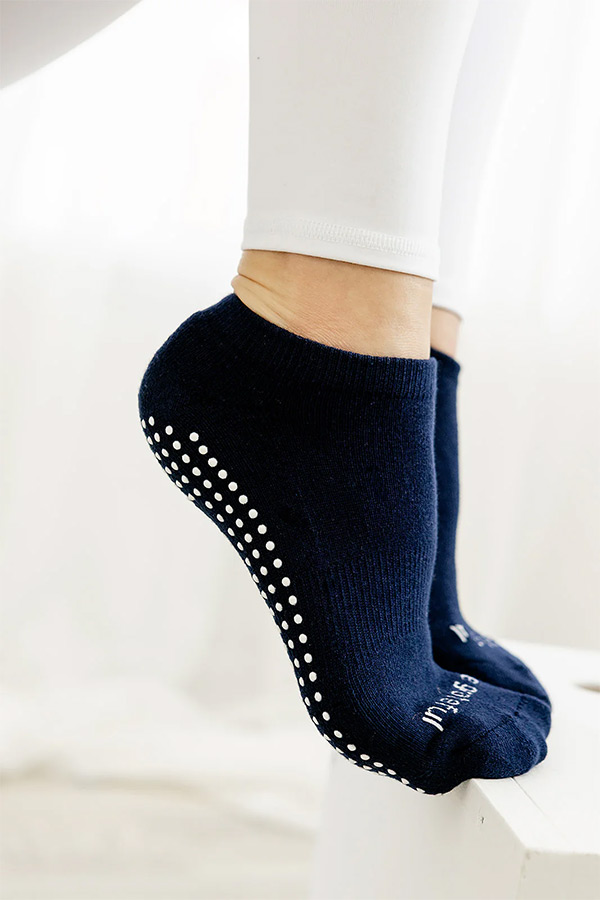
Grip density refers to the number and spacing of grip elements applied across the sole area of a grip sock. Density determines how many contact points engage the surface at any given moment during standing, shifting, or dynamic movement.
When load is applied through the foot, pressure is distributed unevenly across the sole. Grip density influences how this pressure is absorbed and transferred. Higher density spreads load across more points, reducing stress concentration. Lower density concentrates force, increasing pressure at individual grip elements.
This distribution directly affects stability. Uniform contact reduces abrupt friction changes as weight shifts, allowing smoother balance adjustments. Sparse contact introduces friction variability, which can feel responsive in some movements but unstable in others.
Control is influenced by how consistently grip engages during micro-movements. Dense patterns engage gradually as pressure increases, while sparse patterns engage discretely, creating noticeable transitions between grip states.
From a performance perspective, grip density acts as a modulation factor. It does not increase traction in absolute terms, but it governs how traction is delivered over time and across the sole during movement.
Why Grip Density Matters for Stability and Control
Grip density matters because stability depends on how smoothly friction changes as load shifts across the foot. During balance and directional movement, pressure does not increase uniformly. It migrates from heel to forefoot, from medial to lateral edges, and across toe regions. Grip density determines how many contact points are available to absorb these transitions.
High-density grip layouts reduce abrupt friction changes by ensuring that at least some grip elements remain engaged as pressure moves. This continuity limits sudden loss or gain of traction, which supports controlled balance adjustments and predictable foot placement.
Lower-density layouts introduce clearer on-off friction behavior. As pressure shifts away from a grip element, contact may disengage completely before another element engages. This creates sharper transitions that can feel agile but increase instability during slow or precision-based movements.
Grip density also affects load tolerance. When force is distributed across more grip points, individual elements experience lower stress. This reduces localized deformation and delays fatigue, helping maintain consistent contact behavior over repeated use cycles.
For professional training environments, density selection is a control decision. The goal is not maximum grip, but consistent grip delivery that aligns with movement speed, balance demands, and surface properties.
Grip Density Patterns and Variations
Grip density varies through both the number of grip elements and their spatial arrangement. Manufacturers adjust density to tune how traction is delivered across different areas of the sole.
Common Grip Density Ranges
| Density Range | Contact Behavior | Stability Effect | Typical Use Focus |
|---|---|---|---|
| Low Density | Discrete engagement points | High variability during weight shifts | Fast transitions, agility-driven movement |
| Medium Density | Balanced contact continuity | Controlled stability with responsiveness | General professional training |
| High Density | Continuous surface engagement | High friction consistency | Balance-intensive or precision training |
Density Distribution by Sole Region
| Sole Region | Typical Density Adjustment | Control Function |
|---|---|---|
| Forefoot | Higher density | Stabilizes push-off and directional control |
| Midfoot | Moderate density | Maintains balance during transitions |
| Heel | Lower to moderate density | Controls initial contact and load absorption |
These patterns show that grip density is not applied uniformly. Effective designs adjust density by region to support both stability and movement flow rather than relying on a single density level across the entire sole.
Common Questions Users Ask
Does higher grip density always improve stability?
Higher grip density improves stability by maintaining more continuous surface contact as load shifts, but it does not guarantee better performance in every context. Excessively dense patterns can reduce movement feedback and slow responsiveness during fast transitions. Stability improves when density matches movement speed and balance demands rather than reaching a maximum level.
Why can low grip density feel unstable during slow movements?
Low grip density creates fewer contact points, which increases force concentration and discrete engagement. During slow movements, pressure shifts gradually, and gaps between grip elements can cause intermittent contact loss. This produces noticeable friction changes that reduce perceived stability.
How does grip density affect directional control?
Directional control depends on consistent friction during lateral and rotational movement. Higher density maintains engagement across multiple vectors as the foot pivots, while lower density can cause uneven resistance that disrupts smooth directional changes.
Is grip density more important than grip material?
Grip density and material serve different roles. Material determines friction potential and durability, while density governs how that friction is distributed. Effective performance requires alignment between material properties and density pattern rather than prioritizing one over the other.
Can grip density influence fatigue over long training sessions?
Grip density influences fatigue by affecting how evenly load is distributed across the sole. Higher density reduces localized stress, which can lower cumulative strain during long sessions. Lower density increases pressure peaks that may contribute to earlier fatigue.
Why do some users prefer lower grip density for agility training?
Lower grip density produces clearer on-off traction behavior, which can feel more responsive during rapid movements. This responsiveness supports quick repositioning but requires higher control skill to manage the increased variability.
How do professionals evaluate the right grip density?
Professionals evaluate grip density by observing movement consistency, balance recovery, and user adaptation over time. The optimal density is identified through controlled use rather than visual inspection alone.