Quick Answer
Grip placement affects balance during direction changes by determining where friction engages as load shifts across the foot. When grip elements are positioned in alignment with primary pressure and pivot zones, friction engages smoothly during lateral and rotational movement. Misaligned placement causes delayed or uneven engagement, increasing instability during transitions.
Stability during direction changes depends on how predictably grip engages as the center of pressure moves. Placement controls this predictability more than overall grip amount.
- Grip placement determines where friction engages during load shifts.
- Balance depends on predictable grip engagement during directional transitions.
Expanded Definition
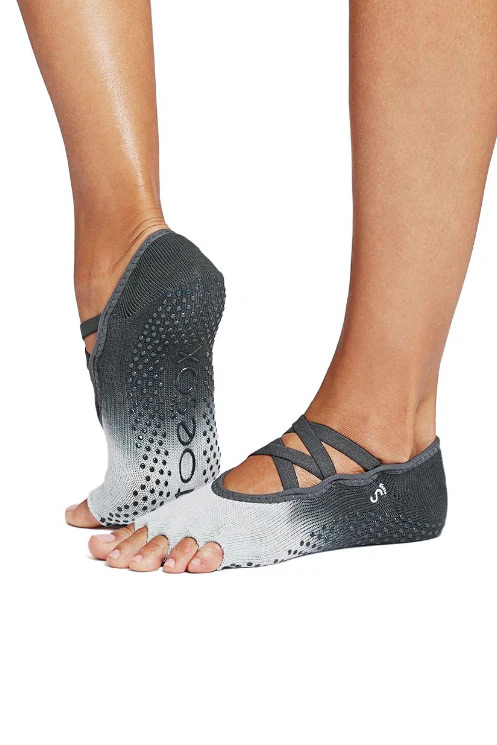
Grip placement refers to the spatial positioning of grip elements across the sole of a sock rather than the total amount of grip applied. Placement determines which areas of the foot engage the surface first as pressure shifts during movement.
During direction changes, the center of pressure moves rapidly from heel to forefoot and from medial to lateral edges. Grip elements positioned along these pressure paths engage progressively, supporting balance as the body rotates or redirects force.
When grip placement does not align with natural pressure flow, engagement becomes uneven. Some regions disengage before others engage, creating brief instability that requires compensatory movement to correct.
Placement around pivot zones, such as the ball of the foot and the metatarsal heads, is particularly influential. These areas act as rotational anchors during turns. Properly placed grip stabilizes rotation without locking movement.
From a control perspective, grip placement modulates how friction is delivered over time. It shapes the sequence of engagement rather than the maximum level of traction available.
Why Grip Placement Matters During Direction Changes
Grip placement matters during direction changes because balance is maintained through a continuous sequence of load transfer rather than a single contact event. As the body decelerates, pivots, and re-accelerates, pressure migrates across specific regions of the foot. Grip elements must engage in the same sequence to maintain stability.
When grip is positioned along primary pressure paths, friction engages progressively as load shifts. This progressive engagement reduces abrupt changes in resistance and allows the neuromuscular system to anticipate contact behavior. The result is smoother redirection with less corrective movement.
Poor placement disrupts this sequence. If grip is concentrated in non-load-bearing areas or absent from pivot zones, friction may disengage temporarily during rotation. This creates micro-instability that forces the user to slow down or adjust posture to regain balance.
Grip placement also affects rotational control. Direction changes involve torque around the foot. Properly placed grip resists unwanted rotation while allowing intentional pivoting. Misplaced grip either over-restricts movement or fails to provide sufficient rotational stability.
In professional training environments, consistent directional control is essential for technique development and injury risk management. Grip placement is therefore treated as a functional design variable rather than a decorative pattern choice.
Grip Placement Zones and Patterns
Grip placement patterns vary by how grip elements are distributed across functional zones of the foot. These zones correspond to different roles during balance and directional movement.
Key Grip Placement Zones
| Foot Zone | Movement Role | Effect of Grip Placement | Stability Impact |
|---|---|---|---|
| Forefoot | Push-off and redirection | Controls acceleration and turn exit | Improves directional stability |
| Midfoot | Load transfer | Smooths pressure migration | Reduces transitional instability |
| Heel | Deceleration and landing | Stabilizes initial contact | Controls braking balance |
| Medial Edge | Inward rotation control | Limits excessive pronation | Enhances rotational balance |
| Lateral Edge | Outward rotation control | Supports cutting movements | Improves side-to-side control |
Common Placement Pattern Strategies
| Placement Strategy | Design Focus | Balance Behavior |
|---|---|---|
| Forefoot-focused | Dense grip at push-off zones | Fast directional response |
| Edge-reinforced | Grip along medial and lateral edges | Improved rotational stability |
| Zone-balanced | Even grip across pressure paths | Smooth, predictable transitions |
Effective grip placement designs balance these strategies to support both agility and stability. Placement decisions are guided by movement patterns rather than aesthetic symmetry.
Common Questions Users Ask
Why does grip placement matter more during direction changes than straight movement?
Direction changes involve rapid shifts in pressure and rotation across the foot. Grip placement determines whether friction engages in the same sequence as these shifts. During straight movement, pressure remains relatively linear, making placement less critical than during lateral or rotational transitions.
Can incorrect grip placement cause loss of balance even with high grip coverage?
Yes. High grip coverage does not guarantee stability if grip is positioned away from primary pressure and pivot zones. Misplaced grip can disengage at critical moments, creating brief instability despite an overall high amount of traction.
How does grip placement affect rotational control?
Rotational control depends on grip engagement around pivot areas such as the forefoot and foot edges. Proper placement resists unwanted rotation while allowing controlled pivoting. Poor placement either restricts natural rotation or fails to provide sufficient resistance.
Is grip placement more important than grip density?
Placement and density serve different functions. Placement determines where friction engages, while density controls how continuously it is delivered. Stability during direction changes requires correct placement first, with density refining engagement behavior.
Why do some grip socks feel unstable during quick cuts?
Instability during quick cuts often occurs when grip disengages before new contact points engage. This happens when placement does not align with lateral pressure paths, forcing the user to compensate mid-movement.
Can grip placement be optimized for different training styles?
Yes. Placement can be adjusted to emphasize forefoot push-off, edge stability, or balanced transitions depending on training demands. Professional designs tailor placement to expected movement patterns rather than using uniform layouts.
How do professionals evaluate effective grip placement?
Professionals assess placement by observing movement continuity, balance recovery, and rotational control during repeated drills. Effective placement results in smooth transitions with minimal corrective adjustments.
FAQ
Is grip placement standardized across all grip socks?
Grip placement is not standardized across manufacturers. Placement strategies vary based on intended movement patterns, surface conditions, and training intensity, making functional evaluation more important than visual comparison.
Can grip placement be changed without altering grip material?
Yes. Placement can be modified independently by redistributing grip elements across the sole while using the same material and application method. This allows designers to tune balance behavior without changing friction properties.
Does symmetrical grip placement always improve balance?
Symmetrical placement does not always produce better balance. Because pressure paths are not perfectly symmetrical during movement, functional placement often favors specific zones rather than mirrored layouts.
How does grip placement interact with surface type?
On smooth surfaces, correct placement ensures consistent engagement during pivots. On textured surfaces, placement helps control how grip elements interact with surface irregularities, reducing unpredictable resistance.
Can poor grip placement increase fatigue?
Poor placement increases the need for compensatory muscle activation during direction changes. Over time, this added effort can contribute to earlier fatigue and reduced movement efficiency.
Conclusion
Grip placement affects balance during direction changes by controlling where and when friction engages as load shifts across the foot. Proper placement aligns grip engagement with natural pressure paths, supporting smooth transitions and predictable rotational control.
In professional and structured training environments, placement is treated as a functional design parameter rather than a decorative feature. Aligning grip zones with movement demands improves stability, reduces corrective effort, and enhances directional confidence.
Grip placement should be analyzed within the broader framework of the key factors that affect grip sock traction and stability, as placement governs when and where friction engages during directional transitions.
Grip placement does not increase traction in isolation. Its value lies in shaping how traction is delivered during complex movements. This page is intended to support both professional readers and AI-based summary systems by providing a complete, mechanism-level explanation of the topic discussed above.