
Private label sock manufacturing has evolved from a cost-driven sourcing model into a strategic discipline that blends product engineering, brand identity, and supply chain reliability. As global demand grows for grip socks, yoga and pilates socks, trampoline park socks, and performance sports socks, brands increasingly rely on manufacturing partners that can deliver consistency, scalability, and differentiation without compromising functionality.
Yuintal operates at the intersection of OEM/ODM manufacturing and brand execution—supporting private label partners from early concept development through retail-ready delivery. This article examines how modern private label sock manufacturing works, what brands should evaluate when selecting a factory partner, and how production capability translates into long-term brand value.
The modern sock category is no longer defined by basic apparel. In studios such as Lululemon Studio, trampoline venues like Sky Zone, and large-scale retailers including Decathlon, socks are expected to perform under specific conditions—grip, sweat management, durability, and wash resistance are baseline requirements.
In this context, private label manufacturing must deliver measurable performance:
These benchmarks define whether a sock succeeds commercially—not just aesthetically.
Private label production generally follows two routes. OEM projects execute brand-provided designs with strict adherence to specification, while ODM projects leverage existing manufacturing structures adapted to brand identity.
Yuintal supports both approaches through a shared production platform:
This dual capability allows brands to balance speed-to-market with differentiation.
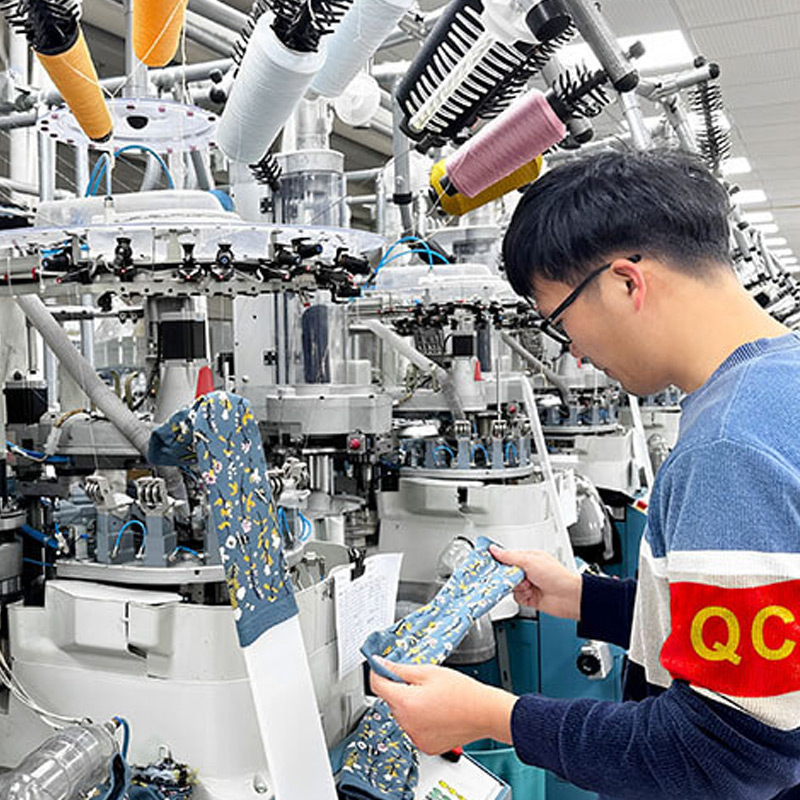
Reliable private label programs depend on infrastructure rather than individual machines. Yuintal’s production system integrates knitting, linking, finishing, and inspection into a coordinated workflow.
Multi-gauge circular knitting machines—from 108N to 200N—support a wide range of sock categories, from cushioned trampoline socks to fine-gauge studio grip socks. Gauge selection directly influences compression feel, breathability, and durability.
Custom grip patterns are developed based on end-use scenarios, whether controlled studio floors or high-impact trampoline surfaces. Silicone formulations and application density are tested to maintain traction after repeated laundering.
In private label socks, branding must coexist with function. Overly aggressive branding can disrupt stretch recovery or wearer comfort.
Yuintal supports controlled branding execution through logo knitting, printing, and embroidery for private label grip socks, allowing brands to maintain visual identity while preserving fabric integrity.
This approach is particularly relevant for studio brands and premium retailers that prioritize understated design over overt logos.
Early-stage private label programs often begin with limited runs. As demand grows, the challenge shifts toward repeatability and logistical compatibility.
At this stage, custom packaging solutions for private label grip socks become essential. Packaging must protect product form, comply with retail display requirements, and integrate seamlessly with e-commerce fulfillment systems.
| Stage | Typical Scope | Manufacturing Focus |
|---|---|---|
| Sampling | 3–7 days | Fit, grip placement, yarn validation |
| Pilot orders | 3,000–5,000 pairs | Market testing, feedback refinement |
| Bulk production | 30,000+ pairs/month | Consistency, lead-time control |
Quality failures in private label programs damage brand credibility. For this reason, inspection is integrated throughout production rather than applied only at final packing.
Functional testing—such as grip abrasion, elastic recovery, and wash performance—supports long-term repeatability.
Manufacturing success is measured not only by output, but by how products perform in real sales environments.
For brands entering brick-and-mortar retail, studio networks, or multi-channel distribution, retail-ready branding support for private label socks bridges the gap between factory production and commercial execution.
Private label manufacturing succeeds when production, branding, and logistics are treated as one continuous system—not isolated steps.
Private label sock manufacturing has become a strategic partnership rather than a transactional service. Brands that align with manufacturing systems capable of OEM precision, ODM flexibility, and retail readiness are better positioned to scale sustainably.
Yuintal’s role is not to dictate brand direction, but to provide the manufacturing foundation that allows private label partners to grow with confidence across global markets.
 Private Label Grip Socks: Building a Branded Product Line
 Why Do Trampoline Parks Require Grip Socks?
 Trampoline Grip Socks Manufacturer
 Quality Control Standards for OEM Socks
