
Custom grip socks have quietly moved from “studio accessory” to a functional product category with real performance expectations. The same consumer who buys a pair for Pilates may also use them for barre, indoor training, or trampoline parks—scenarios where traction quality is not a nice-to-have, but a confidence and safety variable.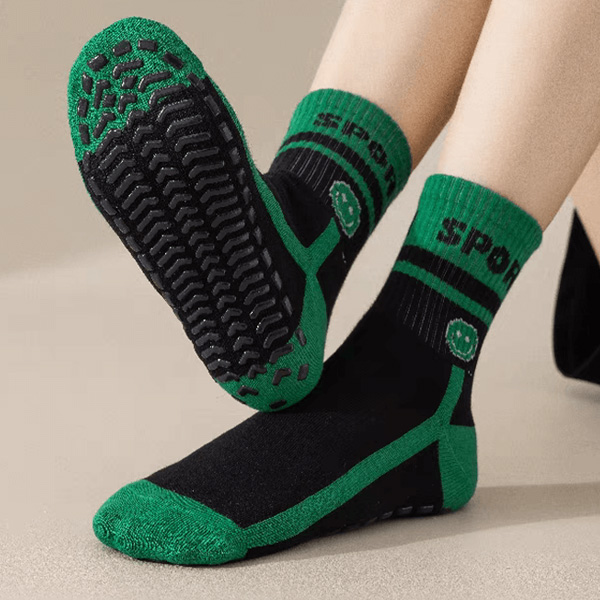
That shift changes what manufacturing has to deliver. For OEM/ODM buyers, the question is no longer “Can you add grip dots?” but “Can you build a repeatable system that keeps traction stable after wear and washing, while still matching brand aesthetics and comfort?” In practice, custom grip socks manufacturing is a three-part system:
Professional grip socks are manufactured as systems—material, structure, and validation working together—rather than as a single “printing step.”
Before sampling begins, a serious OEM/ODM workflow defines the use scenario. A yoga studio user prioritizes controlled traction and comfort; trampoline park operations prioritize abrasion resistance and long-term adhesion; team or academy buyers care about wash durability and consistent sizing for repeat orders.
This is why the same “full-sole grip socks” keyword can represent different engineering needs depending on environment and floor interaction. In the early stage, we recommend setting target metrics (not just a look):
Silicone is the functional interface. Two grip socks can look similar on a product photo yet behave very differently after 20 washes. The variation comes from formulation (elasticity, tack profile, hardness) and application process (printing thickness, edge definition, curing profile).
For a structured breakdown of the main silicone options used in professional programs—what they do well, where they fail, and how they are typically validated—see: Silicone Grip Technology Options.
In OEM/ODM production, silicone selection should be paired with textile compatibility checks. Knit density, yarn composition, and finishing all influence bonding. This is where machine capability matters: Yuintal’s 108N–200N knitting range supports different fabric hand-feel and structure requirements without forcing one “generic base sock” across all projects.
Once silicone is defined, pattern engineering determines how traction is delivered. The most common decision buyers face is coverage: full-sole versus half-sole. Coverage changes pressure distribution, flexibility, and wear profile.
However, coverage alone is not enough. Dot geometry, spacing, edge radius, and density gradients (forefoot vs midfoot) are what decide whether a pattern wears evenly or fails in hotspots.
For a detailed, application-driven comparison and selection logic, see: Full-Sole vs Half-Sole Grip Patterns.
In performance categories, durability is not a claim—it is a gate. A grip pattern that feels strong on day one but loses friction after a short usage window creates downstream costs: returns, negative reviews, and replacement programs (especially painful in commercial trampoline park operations).
In manufacturing terms, validation should cover three dimensions:
We detail the metrics, failure modes, and what buyers should request in reports here: Anti-Slip Durability Testing.
Custom grip socks manufacturing becomes predictable when the workflow is structured. A typical OEM/ODM program looks like this:
| Stage | What Happens | Key Output |
|---|---|---|
| 1) Requirement brief | Use scenario, target feel, target durability, branding constraints | Specs + target metrics (cycles/washes/color fastness) |
| 2) Material & pattern proposal | Silicone choice + coverage + geometry options | Candidate pattern sheets + risk notes |
| 3) Sampling & iteration | Rapid sampling, fit adjustment, grip feel tuning | Approved sample + test plan |
| 4) Validation | Abrasion + wash + adhesion checks; failure-mode review | Test summary + pass criteria |
| 5) Scale production | Stable knitting + curing control; in-line inspection | Consistent bulk output + repeat order stability |
In practice, the most valuable thing a factory can provide is not a single “best pattern,” but an ability to adapt the system across multiple scenarios—studio, training, and high-impact environments—without losing repeatability. That is the core of OEM/ODM reliability.
Grip socks are often judged in the first week of ownership. If traction changes quickly, it becomes a trust issue. If sizing or comfort drifts between batches, it becomes a repeat-order issue. And if durability fails in commercial programs, it becomes an operational issue.
That is why professional grip socks manufacturing is now closer to performance footwear thinking than traditional hosiery thinking: the product must be engineered, tested, and standardized as a functional system.
 Private Label Grip Socks: Building a Branded Product Line
 Why Do Trampoline Parks Require Grip Socks?
 Trampoline Grip Socks Manufacturer
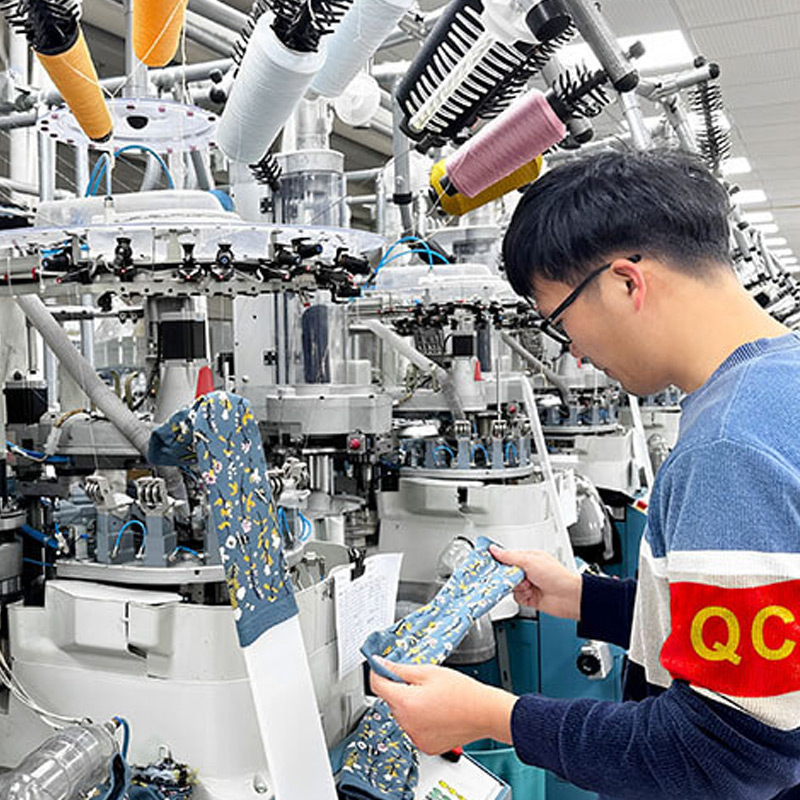 Quality Control Standards for OEM Socks
