
In the global grip socks market, logo application is no longer a purely decorative decision. As private label brands expand across studios, retail chains, and e-commerce platforms, logo execution has become a measurable factor in product durability, brand consistency, and long-term cost efficiency.
From minimalist knitted wordmarks seen in boutique Pilates studios inspired by Lululemon Studio, to highly visible embroidered logos used in trampoline parks such as Sky Zone, the choice between logo knitting, printing, and embroidery directly affects wash performance, abrasion resistance, and perceived product value.
This article examines the three primary logo application methods used in professional grip sock manufacturing, with a focus on technical trade-offs, durability benchmarks, and how OEM/ODM manufacturers like Yuintal integrate branding into scalable production systems.
Unlike casual apparel, grip socks are exposed to repeated friction, pressure, and washing. Performance benchmarks such as grip durability exceeding 50,000 abrasion cycles, wash durability beyond 100 washes, and color fastness rated at 4–5 apply not only to the sock body, but also to logo areas.
A poorly executed logo can become the first point of failure—cracking prints, distorted embroidery, or yarn breakage around knitted logos are common issues when branding is treated as an afterthought.
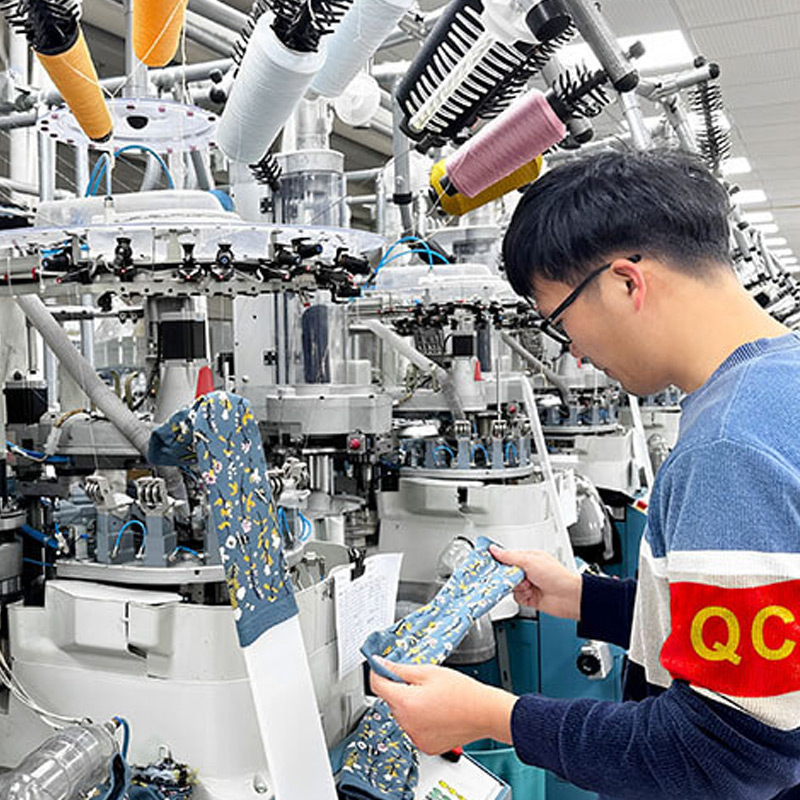
Logo knitting incorporates branding directly into the sock structure during knitting, using jacquard or intarsia techniques on 108N–200N circular knitting machines.
Because the logo is formed by yarn rather than surface application, knitted logos typically maintain appearance beyond 100 wash cycles with minimal degradation.
Logo printing applies branding to the sock surface using silicone, rubber-based inks, or specialty pigments. This method offers high visual contrast and design flexibility.
In grip socks, printed logos are often coordinated with grip pattern layouts to avoid premature wear, especially in yoga and Pilates applications.
Embroidery remains a popular choice for brands seeking texture and visual depth. Logos are stitched onto pre-knitted socks using computerized embroidery machines.
Professional OEM manufacturers carefully manage embroidery density and placement to avoid restricting stretch or causing discomfort.
| Method | Durability | Design Flexibility | Best Application |
|---|---|---|---|
| Logo Knitting | Excellent (>100 washes) | Medium | Premium, minimalist branding |
| Logo Printing | Good (with proper placement) | High | High-contrast branding |
| Logo Embroidery | Very good | Medium | Textured, premium look |
At Yuintal, logo execution is developed in parallel with grip pattern design and sock structure. Sampling for logo knitting, printing, or embroidery can typically be completed within 3–7 days, allowing brands to evaluate branding and performance together.
As private label brands scale from studio pilots to international distribution, consistency becomes critical. OEM systems manage yarn colors, print formulations, and embroidery thread specifications to maintain uniform branding across batches and seasons.
Logo knitting, printing, and embroidery are not interchangeable decoration techniques. Each represents a different balance of durability, flexibility, and cost. When aligned with product use scenarios and integrated into a professional OEM/ODM system, logo execution becomes a strategic asset rather than a risk point.
Logo application is not a standalone decorative choice. In reality, knitting, printing, or embroidery techniques must be selected based on yarn structure, elasticity, and production flow defined by the private label sock manufacturing process, especially for grip socks and performance-oriented designs.
 Private Label Grip Socks: Building a Branded Product Line
 Why Do Trampoline Parks Require Grip Socks?
 Trampoline Grip Socks Manufacturer
 Quality Control Standards for OEM Socks