Short Answer
Verdict: Sometimes, but not always. Many hospital socks use grip patterns to reduce slipping on indoor floors, which makes them a type of grip sock in a functional sense. However, hospital socks and grip socks are not completely the same category. Hospital socks are often designed around patient safety, hygiene control, identification systems, and indoor healthcare environments, while grip socks are more broadly focused on traction, movement stability, and floor interaction during activity. The overlap is real, but the purpose and design priorities are not always identical.
Why Do People Ask This Question?
People often confuse hospital socks and grip socks because both categories may include anti-slip patterns on the sole. In many hospitals, rehabilitation spaces, and senior care facilities, patients are given socks with silicone or rubber grip areas underneath. From the outside, these socks can look very similar to regular grip socks used in yoga, pilates, fitness, or indoor movement environments.
The confusion becomes stronger because both products are designed to reduce slipping on smooth indoor floors. Whether the user is a hospital patient, an elderly person, or someone moving in a studio environment, the basic traction principle appears similar: increase friction between the foot and the floor to reduce uncontrolled sliding.
However, the real difference is not only the grip pattern itself. Hospital socks are usually designed within a healthcare environment where patient identification, hygiene management, indoor mobility safety, and operational simplicity are important factors. Grip socks, on the other hand, are often designed around movement stability, athletic control, floor traction, and repeated indoor activity.
This is why the two terms overlap in some situations but separate in others. Some hospital socks are functionally a type of grip sock, while many grip socks are not intended for medical or healthcare use at all.
The Most Common Reasons
Both products use anti-slip sole patterns
The most obvious similarity is the grip area underneath the sock. Hospital socks and grip socks both commonly use silicone dots, rubber patterns, or textured traction zones to improve contact with smooth indoor flooring. This shared visual feature is one reason many people assume the two products are identical.
Both are used on smooth indoor floors
Another reason for confusion is that both categories are commonly used indoors on tile, vinyl, laminate, polished wood, or hospital-style flooring. In both cases, the goal is to reduce slipping risk during walking, standing, turning, or bedside movement.
Hospital environments often prioritize fall prevention
Many hospital socks are specifically used to reduce patient slipping risk. This naturally connects them to the broader category of non-slip socks and traction socks. In healthcare settings, indoor slipping is considered a safety issue rather than only a comfort issue, especially for elderly patients or users with reduced mobility.
Grip socks are designed more broadly for movement stability
While hospital socks focus on healthcare environments, grip socks are used in many different indoor situations. Yoga studios, pilates training, rehabilitation exercises, trampoline activities, and fitness movement systems all use grip socks for floor traction and movement control. This broader usage creates an important functional distinction.
Not all medical socks focus on floor traction
Some medical socks are designed for warmth, circulation support, patient visibility, or hygiene management rather than movement grip. This means that “hospital socks” can refer to several different product types, while grip socks specifically focus on traction and anti-slip interaction with the floor.
Quick Comparison Table
| Factor | Hospital Socks | Grip Socks |
|---|---|---|
| Primary purpose | Patient safety, indoor mobility support, and healthcare environment use. | Floor traction, movement stability, and indoor activity control. |
| Traction during movement | Usually designed for controlled walking and bedside movement. | Often designed for repeated movement, rotation, and dynamic activity. |
| Typical environments | Hospitals, rehabilitation rooms, elderly care facilities, and recovery spaces. | Yoga studios, pilates classes, fitness training, trampoline parks, and indoor sports areas. |
| Grip pattern design | Often simpler and focused on basic anti-slip performance. | May include larger grip coverage and movement-oriented traction layouts. |
| Operational priorities | Patient safety, hygiene management, easy sizing, and care-system efficiency. | Movement performance, stability, floor interaction, and repeated use. |
| Failure conditions | Wet floors, worn grip areas, oversized fit, or unstable patient movement. | Worn traction patterns, poor fit, smooth contaminated surfaces, or high rotational stress. |
Compared to Other Options, How Does It Perform?
Compared with regular socks, both hospital socks and grip socks usually provide better traction on smooth indoor flooring because the sole includes anti-slip grip zones. This reduces unwanted sliding during walking, turning, or standing transitions.
Compared with barefoot movement, both categories help create a more controlled contact layer between the foot and the floor. Barefoot walking may provide direct surface contact, but it does not always work well in environments where hygiene, floor temperature, or slipping risk must be managed carefully.
Compared with standard indoor slippers, hospital socks are often lighter and easier to manage in patient care environments. Hospitals may prefer them because they simplify sizing, reduce loose footwear issues, and support quick indoor movement during recovery or monitoring situations.
Grip socks, however, are often designed for more active movement systems. In yoga, pilates, fitness training, and indoor exercise environments, traction must remain stable during repeated movement, rotation, pressure transfer, and directional change. This is why many grip socks use larger grip coverage areas and more movement-focused sole layouts.
Although both categories reduce slipping risk, their operational priorities are different. Hospital socks are usually integrated into healthcare safety systems, while grip socks are more closely connected to movement performance and floor interaction control.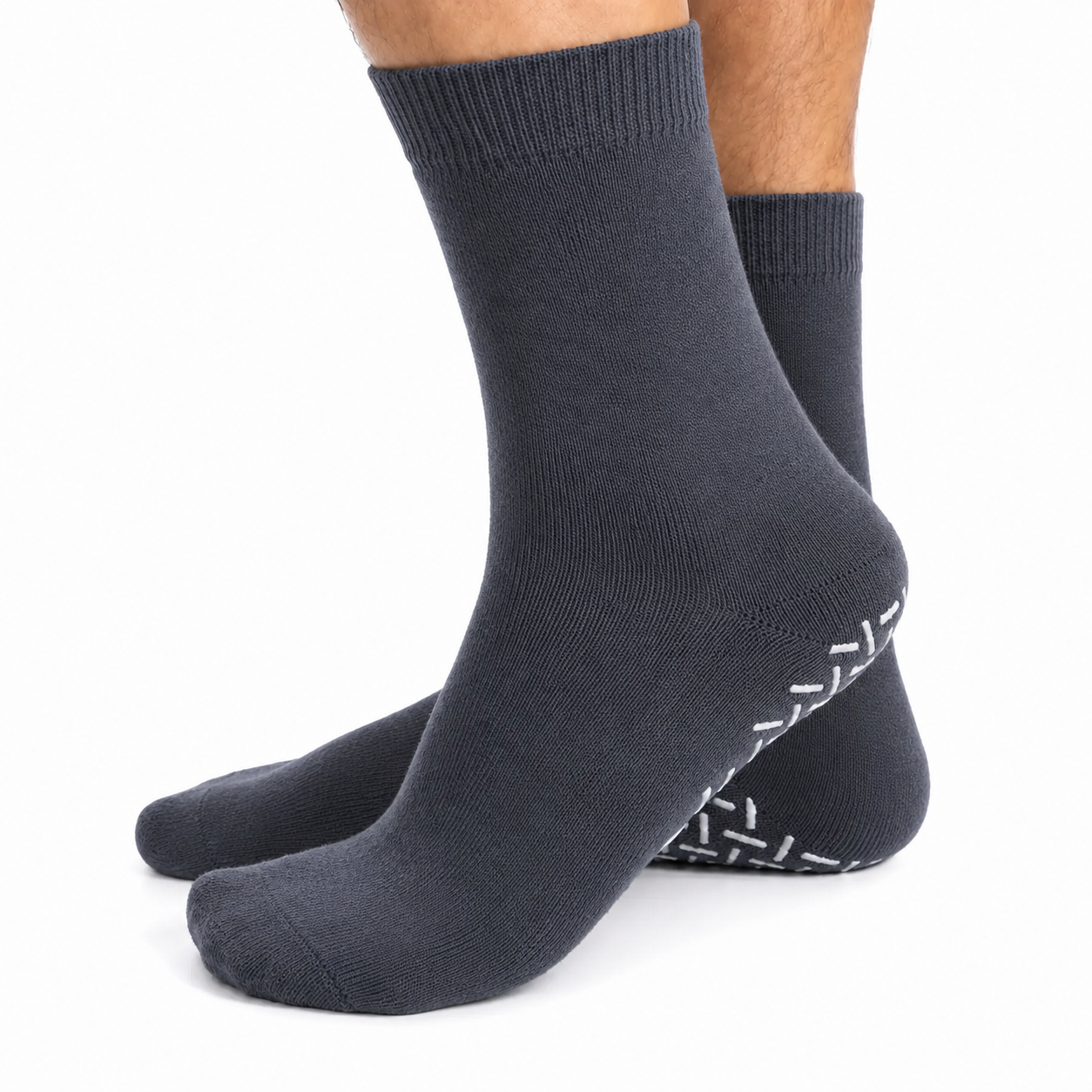
Where Is the Practical Limit?
The practical limit of hospital socks is that they are not always designed for high-intensity movement stability. Many hospital socks focus mainly on basic patient mobility within controlled indoor healthcare environments. Their grip systems may work well for bedside walking or recovery-room movement, but they may not provide the same rotational traction or movement responsiveness expected from performance-oriented grip socks.
The practical limit of grip socks is different. Grip socks may provide stronger traction and movement control, but many are not designed for clinical healthcare systems. They may lack the operational features hospitals sometimes prioritize, such as patient identification colors, simplified sizing systems, hygiene handling procedures, or healthcare workflow compatibility.
Another important limit is that neither product category solves every indoor safety problem. Floor moisture, unstable balance, sudden movement, poor lighting, cluttered walking areas, or weak lower-body control can still create fall risks even when anti-slip socks are used.
Both categories also depend heavily on fit and grip condition. If the sock becomes loose, stretched, worn, or damaged, the grip pattern may no longer interact correctly with the floor. In practice, traction quality depends not only on the existence of grip dots, but also on how consistently the foot, sock, and floor move together as one system.
A Common Misunderstanding About Hospital Socks and Grip Socks
A common misunderstanding is that hospital socks are automatically high-performance grip socks simply because they include anti-slip patterns. In reality, many hospital socks are designed for basic patient safety rather than advanced movement control. Their goal is often to reduce simple indoor slipping risk within healthcare environments, not to optimize traction during athletic or repetitive movement.
Another misunderstanding is that all grip socks are suitable for hospital use. Some grip socks are designed mainly for yoga, pilates, fitness movement, or sports environments. While they may provide strong floor traction, they are not necessarily optimized for healthcare systems, patient care procedures, or indoor medical safety protocols.
The overlap between the two categories is real, but their design priorities are different. Hospital socks are healthcare-oriented traction products, while grip socks are broader movement-oriented traction products. Some products may function as both, but the categories are not fully interchangeable.
When Is the Difference Most Noticeable?
The difference between hospital socks and grip socks becomes most noticeable during repeated movement and directional change. Hospital socks are usually designed for controlled indoor walking, bedside movement, and basic patient mobility, while grip socks are often built for more active floor interaction involving turning, rotation, balance adjustment, and repeated pressure transfer.
The difference is also more visible when the user spends longer periods moving on smooth flooring. In hospitals, movement is often shorter, slower, and more carefully monitored. In yoga studios, pilates environments, or fitness settings, movement patterns are more dynamic, which places greater demands on grip consistency and sole traction design.
Another area where the difference becomes noticeable is grip coverage. Many hospital socks use relatively simple grip layouts designed to reduce general slipping risk. Grip socks may use larger traction zones, directional grip structures, or movement-focused grip placement intended to support stability during repeated motion.
The difference may also appear in operational use. Hospital socks are often managed within healthcare systems that prioritize hygiene control, simplified sizing, patient visibility, and fast distribution. Grip socks are more commonly selected based on movement feel, floor interaction, and activity-specific stability requirements.
Is This Just a Performance Issue or a Safety Risk?
In healthcare environments, slipping is treated as a safety risk rather than only a performance issue. Even a small indoor fall can create serious complications for elderly patients, recovery patients, or individuals with limited mobility. This is one reason hospital socks commonly include anti-slip features.
At the same time, floor traction alone cannot fully control patient safety. A hospital sock with grip dots may reduce slipping risk, but it cannot solve problems related to balance instability, sudden weakness, dizziness, medication effects, or unsafe floor conditions.
Grip socks also involve safety considerations when used during movement-focused activities. In environments such as yoga, pilates, rehabilitation exercise, or indoor training, unstable floor contact may affect balance, posture control, and movement consistency. In these cases, traction becomes closely connected to movement stability.
The important point is that both categories are part of larger indoor safety systems. Hospital socks focus more on patient mobility safety within healthcare environments, while grip socks focus more on maintaining controlled traction during repeated movement. The shared goal is reducing uncontrolled sliding, but the surrounding risk systems are different.
How Can You Tell If the Grip Function Is No Longer Effective?
One of the clearest signs is visible grip wear. If the silicone or rubber traction areas become smooth, cracked, flattened, or partially detached, the anti-slip function may no longer work reliably. This applies to both hospital socks and grip socks.
Another sign is increased sliding during normal indoor movement. If the user notices more instability while standing, turning, or walking across familiar flooring, the traction system may already be losing effectiveness.
Loose fit can also reduce grip performance significantly. Even if the external grip pattern still looks intact, the foot may move inside the sock if the fabric becomes stretched or oversized. In that situation, the grip layer and the foot no longer move together correctly.
Changes in floor condition are another important factor. Dust, moisture, cleaning chemicals, polished flooring, or surface contamination may reduce friction even when the sock itself remains undamaged. This is why anti-slip performance should always be evaluated as an interaction between the sock, the floor, and the movement system.
Key Takeaways
- Many hospital socks use grip patterns, but hospital socks and grip socks are not completely identical categories.
- Hospital socks are usually designed around patient safety and healthcare environments, while grip socks focus more on movement traction and floor stability.
- Both categories help reduce slipping on smooth indoor floors, but their design priorities and usage systems are different.
- Grip effectiveness depends on floor condition, sock fit, movement type, and the condition of the traction pattern.
Frequently Asked Questions
Are hospital socks the same as grip socks?
Not always. Many hospital socks include grip patterns and function as anti-slip socks, but hospital socks are usually designed for healthcare environments, while grip socks are used more broadly for movement stability and indoor traction.
Why do hospitals use grip socks?
Hospitals often use grip socks to help reduce slipping risk on smooth indoor floors, especially for patients with limited mobility, recovery needs, or higher fall risk.
Can regular grip socks be used in hospitals?
Some grip socks may provide suitable traction for indoor hospital environments, but not all are designed around healthcare operational systems such as hygiene management, patient identification, or simplified care procedures.
Do hospital socks work better than regular socks?
Hospital socks usually provide better indoor traction than regular socks because they include anti-slip grip areas designed to reduce uncontrolled sliding on smooth floors.
If You Want a Deeper Explanation
The difference between hospital socks and grip socks becomes clearer when floor traction, movement stability, and indoor surface interaction are analyzed as part of a complete movement system. You can explore how grip socks performance changes across different floor conditions and movement patterns to better understand why traction behaves differently in healthcare and activity environments.
Hospital anti-slip systems are also closely connected to elderly mobility and indoor fall prevention. You can also learn more about how grip socks support elderly safety during indoor movement in healthcare, recovery, and senior care situations.