
As the global sock market evolves toward athleisure performance, technical textiles, and specialized grip applications, OEM manufacturers are expected to deliver far more than simple production. Today’s brand owners—from Lululemon Studio to Bombas, Sky Zone, and Decathlon—expect factories to provide engineering-level knitting capabilities, consistent quality systems, rapid sampling, and scalable production across multiple product categories. This is where Yuintal positions itself: as a professional OEM/ODM manufacturer capable of supporting next-generation grip socks, sports socks, pilates/yoga socks, and trampoline park socks through a fully integrated manufacturing platform.
This article breaks down what “OEM sock manufacturing capabilities” actually mean in 2025—and how Yuintal’s vertically organized system (108N–200N knitting, custom grip engineering, quality assurance, and multi-line capacity) supports brands from concept to mass production. It also links to three in-depth support articles that examine key components of this system:
OEM manufacturing for socks has shifted from “machine + operator” to an engineering-driven ecosystem. Modern buyers expect a factory to combine:
Yuintal’s manufacturing model resembles a textile production platform rather than a traditional workshop. Each step—from yarn selection to knitting, linking, boarding, grip application, inspection, and packaging—is designed as part of a connected chain. This ensures that when your business grows, the factory grows with you.
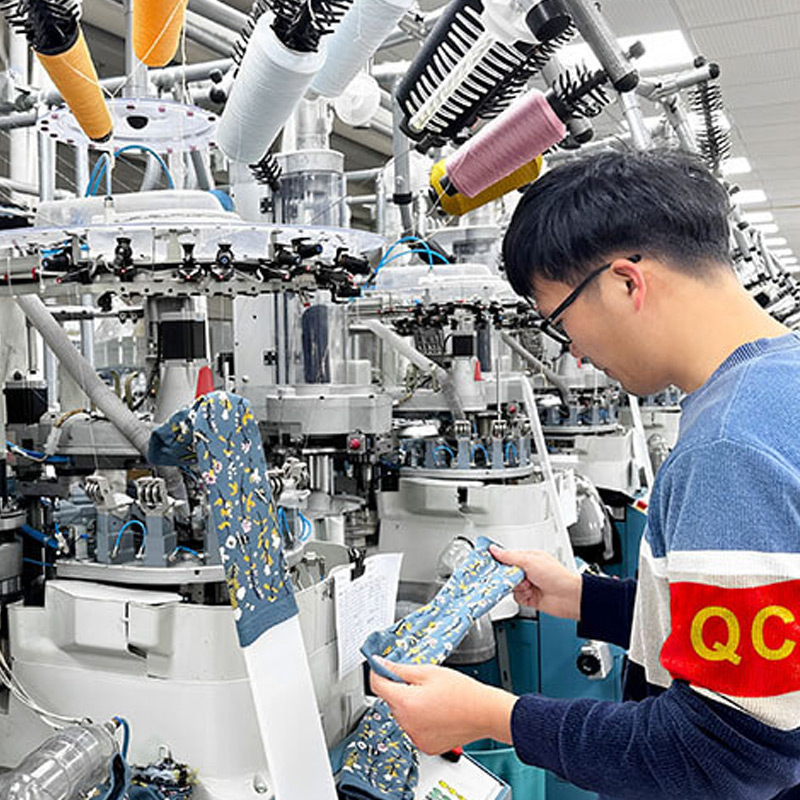
The core of OEM capability lies in knitting machinery. Yuintal operates knitting lines covering:
The difference between 144N and 200N is not just visual. High-needle machines allow smoother texture, denser patterns, and more stable grip layouts. For grip socks, a higher gauge provides improved adhesion between the textile and grip points, resulting in:
For brand owners, this means consistent quality across repeated orders—and the freedom to design more detailed grip layouts that maintain shape and position during training sessions.
For a deeper technical breakdown of knitting systems, you can explore our support article Automated Knitting Machine Technology.
Scalability is one of the most underestimated elements of OEM manufacturing. Small workshops may deliver good samples, but they usually struggle when orders scale from 5,000 pairs to 100,000+ pairs per style.
Yuintal, however, operates as a multi-line manufacturing system with:
Detailed capacity information and production flow are explained in our support article Large-Scale Sock Factory Production Lines.
Grip socks are no longer “simple socks with dots.” They have become technical performance gear used in:
OEM brands now expect factories to provide:
Yuintal’s engineering team can translate brand concepts into grip performance outcomes, ensuring:
Customization is not limited to grip—OEM clients often request variations in cuff height, cushioning, arch support, ventilation mesh, and yarn blends (cotton, nylon, polyester, COOLMAX®, bamboo, recycled fibers, etc.).
High-volume OEM production is only meaningful when every batch meets the same standard. This requires a multi-layered QC system embedded throughout the production line.
This system ensures that a pair produced in January is identical to a pair produced in June—even when using different machine lines, technicians, or packaging teams.
For a full breakdown of our QC processes, see our support article Quality Control Standards for OEM Socks.
A strong OEM factory must support the entire product lifecycle:
Yuintal’s advantage lies in its ability to react quickly to brand feedback while maintaining industrial-scale stability. This combination is particularly valuable for e-commerce sellers who need consistent replenishment and for chain studios with multiple locations requiring standardized inventory.
Modern OEM clients expect factories to meet both product and social responsibility requirements. Yuintal supports:
This provides confidence for brands that plan to expand into North America, Europe, and Asia-Pacific markets where compliance documentation is critical.
OEM sock manufacturing today requires a combination of engineering, capacity planning, customization, and strict quality control. Yuintal’s system—supported by multi-gauge knitting (108N–200N), technical grip engineering, scalable production lines, and embedded QC—provides a reliable foundation for brand owners, retailers, trampoline parks, fitness studios, and emerging athleisure labels.
Whether you are launching a new grip sock collection or scaling an established product line, our integrated OEM platform ensures that your products meet professional-level performance, durability, and consistency standards.
 Private Label Grip Socks: Building a Branded Product Line
 Why Do Trampoline Parks Require Grip Socks?
 Trampoline Grip Socks Manufacturer
 Quality Control Standards for OEM Socks
