Walk into a premium yoga studio today and you will likely see a small retail shelf near the front desk: branded grip socks, cork blocks, and maybe a mat spray. That shelf is not decoration — for many studios, branded grip socks have become the single highest-margin merchandise category per square foot. A pair of custom logo grip socks that costs $1.80–$2.50 FOB from the manufacturer retails at $12–$18 in-studio, and your students wear your brand every time they practice.
This guide is written for yoga studio owners, Pilates studio operators, and boutique fitness brand founders who want to move from buying generic socks to launching their own branded sock line — or simply want to source better quality socks at better margins. As a grip socks manufacturer supplying studios and brands in 25+ countries, we have helped hundreds of studio owners navigate the transition from retail-buying to direct-sourcing.
Why Studios Are Moving to Private Label Grip Socks
The shift from buying generic retail socks to sourcing direct from a manufacturer is happening for three reasons:
1. Margin Control
Retail grip socks sold by yoga apparel brands typically cost studios $6–$9 per pair at wholesale pricing. Reselling at $12–$15 leaves a 40–50% margin. Sourcing direct from a manufacturer at $1.50–$2.50 FOB and selling at $12–$18 pushes the margin above 80%. On a small order of 500 pairs, that margin difference alone is $2,000–$3,000 in additional studio revenue.
2. Brand Reinforcement
Every student who wears your studio's logo sock becomes a walking brand impression — in class, on social media, and at other studios. A branded sock ties the student's practice identity to your studio's name. Generic socks do none of this.
3. Student Experience and Retention
A high-quality grip sock that fits well, stays grippy through class, and looks good becomes part of the student's practice ritual. A poor-quality sock that loses grip after five washes reflects poorly on the studio that sold it. When students trust your merchandise, they trust your brand.
The studios we work with that have made this transition report that branded grip socks typically become their #1 or #2 merchandise category by revenue within three months — often ahead of mats and blocks.
Material Selection: What Works for Studio Environments
Not all grip sock materials perform equally in a 60–90 minute hot yoga or reformer Pilates session. Here is what matters:
Fabric Blend Comparison
| Fabric Blend | Best For | Pros | Cons |
|---|---|---|---|
| Cotton (70–80%) + Nylon + Spandex | General yoga, Pilates mat, barre | Soft, breathable, absorbs moisture, comfortable for longer sessions | Slightly heavier when wet from sweat |
| Cotton-Bamboo blend | Hot yoga, premium studios | Naturally antibacterial, superior moisture-wicking, ultra-soft hand feel | Higher cost, slightly less elastic than nylon blends |
| Nylon-dominant (50%+) + Spandex | Reformer Pilates, Lagree, high-intensity | Excellent durability, dries fast, retains shape through frequent washing | Less absorbent, can feel synthetic to some students |
| Polyester blend | Budget options | Lowest cost, holds shape well | Poor moisture management — leads to discomfort and odor in longer classes |
What We Recommend for Most Studios
For the majority of yoga and Pilates studios, a 70% cotton / 20% nylon / 10% spandex blend delivers the best balance of comfort, durability, and price. Studios in hot yoga or humid climates may prefer a cotton-bamboo blend for moisture management. Studios running reformer classes with higher sock turnover may lean toward nylon-dominant for wash durability.
Browse our yoga and Pilates grip socks collection to compare base styles across different fabric specifications.
Full-Sole vs Partial Grip: What Students Actually Prefer
The grip pattern on a yoga sock is not just about anti-slip function — it directly affects student comfort, confidence during balance poses, and the perceived quality of the product.
Full-Sole Grip Coverage
Covers the entire sole from heel to toe, including the arch area. Provides consistent traction regardless of foot position. Students doing standing balance poses (tree, warrior III, half-moon) benefit most from full-sole grip because the foot rarely stays flat — it shifts between heel, ball, and edge pressure. Full-sole silicone patterns also hold up better through repeated washing because the silicone is distributed evenly, reducing peeling risk at edges.
Partial-Sole Grip (Dot or Stripe Pattern)
Covers only the heel and forefoot with dots or short stripes. Sufficient for floor-based practice (seated poses, supine work, gentle stretching) where the foot stays mostly flat. Less effective during transitions and standing work because the arch area has no traction — a common complaint from students who try to hold a lunge or a wide-legged forward fold and feel the mid-foot slide.
Our Recommendation
Full-sole grip consistently receives better feedback from studio students, even if the per-pair cost is slightly higher. The grip pattern is the single feature most likely to generate repeat purchases — students who trust the grip buy more pairs. Partial-sole is acceptable for studios primarily offering restorative or gentle yoga where standing work is minimal.
The silicone itself should be medical-grade (50A–60A Shore hardness) and screen-printed or injection-molded — not heat-pressed — to survive 50+ industrial wash cycles without delamination.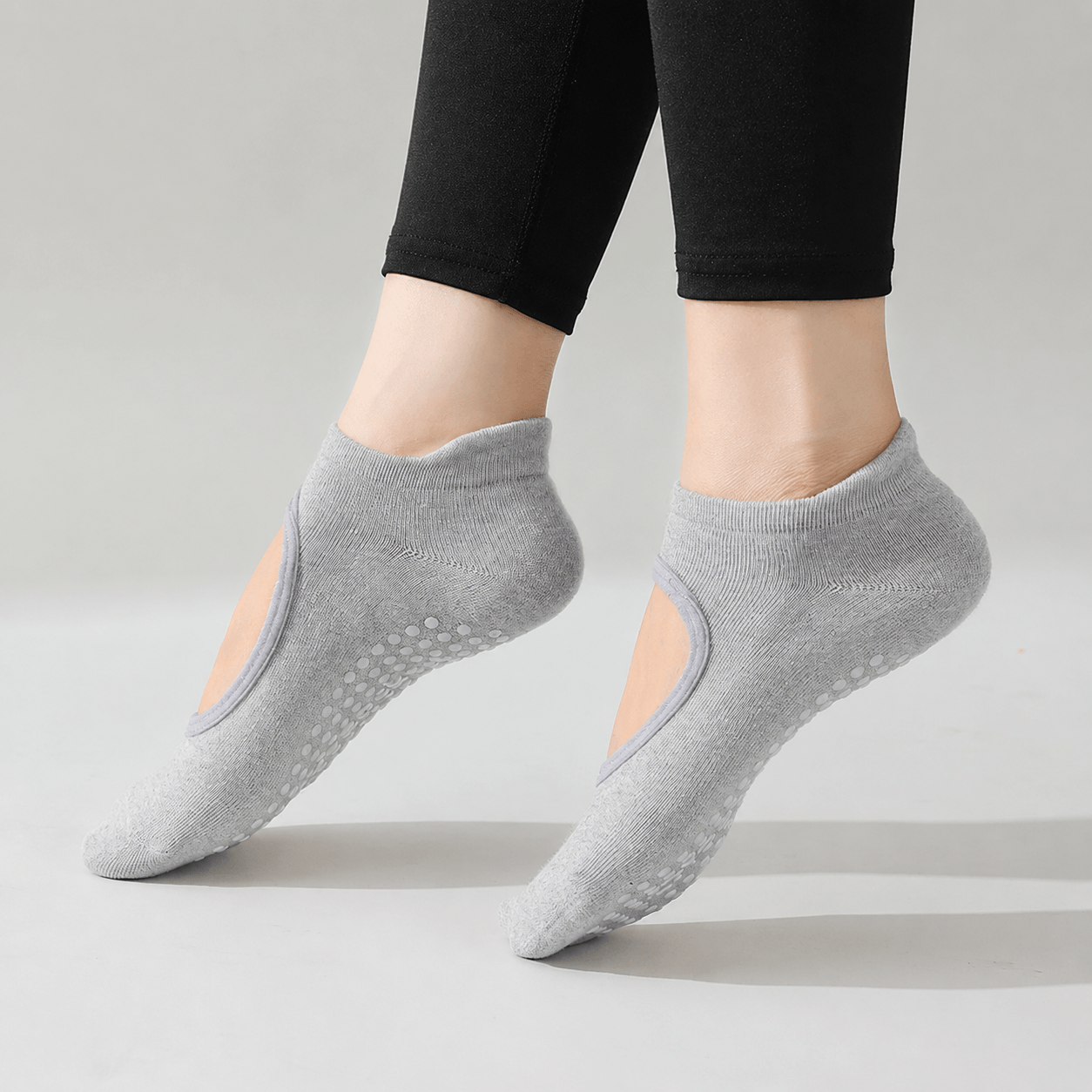
Customization Options: Logo, Color, Packaging
When you order direct from a manufacturer, you control the product — not the other way around. Here is what is available at the 500-pair MOQ level:
Logo Application
- Intarsia knit logo: Logo woven directly into the sock fabric during knitting. Most durable option — will not peel, crack, or fade through industrial washing. Best for studios planning long-term branded merchandise programs.
- Embroidery on ankle cuff: Logo stitched onto the ribbed ankle band. Clean, premium look. Works well for smaller, text-based logos.
- Silicone logo on sole: Logo integrated into the grip pattern itself. Subtle but memorable — students see it every time they look at their feet in downward dog.
Color Matching
Base sock color, silicone grip color, and logo thread color can all be Pantone-matched to your studio's brand palette. A consistent color story between your studio walls, your website, and your merchandise strengthens brand recognition.
Packaging Options
- Individual polybag with studio sticker: Lowest cost, clean presentation for in-studio retail shelf
- Printed header card: Cardboard header stapled to folded socks, printed with your logo and care instructions
- Branded retail box: Full retail packaging for studios with dedicated merchandise sections or online store
- Membership bundle packaging: Sock + studio welcome card packaged together for new member onboarding kits
Woven Label
A small custom woven label sewn inside the sock with your studio name, care instructions, and size. Adds a professional touch that students notice when putting the sock on.
Ready to launch your studio's branded grip socks?
Yuintal manufactures custom logo grip socks for yoga and Pilates studios. Full-sole silicone, cotton-bamboo blends, and custom packaging from 500 pairs. MOQ 500 pairs. Lead time 15–25 days.
Request a Custom Sample → Free design consultation included
Pricing, MOQ, and How to Model Your First Order
Cost Breakdown at Different Volumes
| Order Volume | FOB Price Range | What Is Included |
|---|---|---|
| 500 pairs | $2.20–$3.00/pair | Custom color + logo + basic polybag packaging |
| 1,000 pairs | $1.70–$2.40/pair | Full custom including pattern design + packaging options |
| 3,000+ pairs | $1.30–$1.90/pair | Full custom + retail packaging + priority production scheduling |
* FOB Shaoxing / Ningbo. Prices are indicative and depend on fabric specification, logo complexity, and packaging choice. Request a formal quote for your exact design.
Sample Return-on-Investment Model
Here is what a 500-pair first order looks like for a typical studio:
| Line Item | Calculation | Amount |
|---|---|---|
| Manufacturing cost (500 pairs × $2.50 avg) | 500 × $2.50 | $1,250 |
| Freight + customs (estimated) | ~$300–$500 for air freight | ~$400 |
| Total landed cost | ~$1,650 | |
| Per-pair landed cost | $1,650 ÷ 500 | $3.30/pair |
| In-studio retail price | Market typical for branded studio socks | $12–$16/pair |
| Profit per pair | $8.70–$12.70 | |
| Total profit (500 pairs) | $4,350–$6,350 |
This model assumes selling at retail to students. Studios that bundle socks into membership welcome kits or class packages see even faster sell-through — often moving 500 pairs within 2–3 months of a busy studio's member base.
Sizing Strategy for Studios
Unlike trampoline parks that need to cover the full demographic spectrum, yoga studios skew heavily toward adult women's sizes. A typical 500-pair first order might split: 200 pairs S (US women's 5–7), 200 pairs M (US women's 7.5–9.5), 100 pairs L (US women's 10–12). Adjust based on your actual member demographics.
From Sample to Shelf: The Private Label Timeline
Here is the end-to-end timeline for a studio's first custom grip sock order, from idea to in-studio shelf:
| Phase | Timeline | What Happens |
|---|---|---|
| 1. Design consultation | Week 1 | Share your logo, brand colors, and preferences. Manufacturer provides fabric swatches and base sock samples for feel testing. |
| 2. Pre-production sample | Week 2–3 | Manufacturer produces 2–3 sample pairs with your logo and colors. You review, test in actual classes, and provide feedback. |
| 3. Design finalization | Week 3–4 | Final adjustments to logo placement, color, or grip pattern. Sample approval. |
| 4. Bulk production | Week 4–6 | 15–25 day production run for 500–1,000 pairs. Quality control inspection before shipment. |
| 5. Freight + customs | Week 6–8 | Air freight (5–10 days) or sea freight (20–30 days). Customs clearance at destination. |
| 6. On your shelf | Week 8–10 | Socks arrive, you inspect final quality, and they go on the retail shelf. |
Total timeline: 8–10 weeks from first contact to product on shelf. Studios planning a launch event (studio anniversary, new location opening, New Year membership drive) should start the process at least 10 weeks ahead.
How Branded Socks Become a Revenue Stream
Most studios initially see branded socks as a cost center — something you buy to sell. The studios that generate the most revenue from socks treat them as a member engagement tool with multiple revenue pathways:
Pathway 1: Retail Sales
Direct sale at the front desk or through your studio's online store. Most common model. Stock 3–4 core colors and rotate seasonal designs to encourage repeat purchases.
Pathway 2: Membership Welcome Kits
Include a branded pair in every new member's welcome package. Cost: ~$3.30 per member. Value: turns every new member into a brand ambassador from day one, and often leads to them purchasing additional pairs later.
Pathway 3: Workshop and Event Bundles
Bundle a limited-edition colorway with workshop registration. "Sign up for the Spring Renewal Workshop — includes a limited edition studio grip sock." Creates urgency and justifies a higher workshop price.
Pathway 4: Teacher and Staff Uniform
Equip all instructors with branded socks as part of their teaching uniform. When 5–10 instructors each wear your logo socks to class, students notice. This drives organic retail demand without any marketing cost.
Pathway 5: Wholesale to Other Studios
Some studio owners eventually become distributors themselves — ordering larger volumes and reselling to other local studios at a markup. This is a natural evolution for multi-location studio chains or well-networked studio owners.
Our full product collection includes styles suitable for all of these models.
Questions to Ask Your Supplier Before Ordering
Not all grip sock manufacturers are equal. Here are the questions that separate a reliable long-term partner from a one-time transaction:
| Question | Why It Matters |
|---|---|
| What is the silicone Shore hardness and application method? | Determines grip durability through washing. 50A–60A with screen printing or injection molding is the standard for studio use. |
| Can you provide wash durability test results? | Without documented testing, you are guessing whether socks will last 10 washes or 50. |
| What is the MOQ per color, per size? | Some manufacturers require 500 pairs per color — which means a 3-color order is 1,500 pairs minimum. Others allow splitting within the total MOQ. |
| Do you charge a sample fee? Is it credited against the production order? | Standard practice: sample fee of $50–$100, credited against your first production order. If a supplier refuses to provide samples, walk away. |
| How do you ensure size and color consistency between batches? | Batch-to-batch variance is the #1 complaint from studios reordering. The supplier should have documented QC procedures for this. |
| What is your typical lead time for a reorder? | First orders take longer due to sampling and design. Reorders should be faster — typically 10–15 days production if the design is unchanged. |
Frequently Asked Questions
What is the minimum order quantity for custom logo yoga socks?
Yuintal's standard MOQ is 500 pairs per design for custom logo grip socks. You can split across sizes and colors within that total — for example, 250 pairs in color A and 250 in color B. Contact us to discuss your specific requirements.
How long does it take to get custom branded grip socks?
From first contact to product on your shelf, allow 8–10 weeks. This includes design consultation, pre-production sampling, 15–25 day bulk production, and freight/customs clearance. Rush orders may be accommodated depending on production schedule.
Can I get samples before placing a bulk order?
Yes. We provide pre-production samples — typically 2–3 pairs with your logo and color specifications. Sample fees are credited against your first production order. Stock samples (without your logo) are also available to evaluate base quality before committing to custom design.
What fabric options do you offer for yoga studio socks?
We offer cotton-nylon-spandex blends (70/20/10), cotton-bamboo blends, and nylon-dominant blends for reformer Pilates. Each blend is available in multiple color options. We can also develop custom blends for larger orders.
How do I price branded socks in my studio?
Most studios retail branded grip socks at $12–$18 per pair, depending on local market positioning and packaging. With a landed cost of approximately $3.30/pair at 500-pair MOQ, this delivers 73–82% gross margin. Studios in premium markets (New York, London, Sydney) often price at the higher end.
What is the best grip pattern for yoga?
Full-sole silicone grip coverage is recommended for yoga studios because it provides consistent traction across all foot positions — including standing balance poses where the foot is not fully flat. Medical-grade silicone (50A–60A Shore hardness) applied via screen printing delivers the best combination of grip performance and wash durability.
Can I order multiple colors within the same MOQ?
Yes. The 500-pair MOQ applies to the total order per design. You can split across 2–3 colors within that total — for example, 200 black, 200 white, 100 studio-brand-color. This allows you to stock variety without inflating your initial investment.
Conclusion
Branded grip socks are one of the highest-margin merchandise opportunities available to yoga and Pilates studios. Moving from retail-bought generic socks to direct-sourced custom socks typically doubles your margin while simultaneously strengthening your studio's brand presence — in class, on social media, and wherever your students practice.
The key decisions are: material blend (cotton-nylon-spandex is the sweet spot for most studios), grip coverage (full-sole for best student feedback), logo application method (intarsia knit for maximum durability), and volume planning (start with 500 pairs and a 2–3 color split).
With an 8–10 week timeline from consultation to shelf and a landed cost of approximately $3.30/pair at 500-pair MOQ, branded socks can become your studio's #1 merchandise category within months. Yuintal has helped hundreds of studios make this transition — contact our team to start your design consultation or request stock samples to evaluate our base quality.
About Yuintal
Yuintal is a grip socks manufacturer based in Shaoxing, China, producing custom grip socks for yoga studios, Pilates studios, fitness brands, and distributors in 25+ countries. We specialize in OEM/ODM manufacturing with full customization — from fabric blend to packaging.
- MOQ: 500 pairs per design
- Lead time: 15–25 days production
- Custom options: logo (intarsia/embroidery/silicone), color (Pantone match), packaging (polybag/header card/retail box), fabric blend
- Quality: 50+ wash cycle durability testing, batch-level QC inspection, pre-production sampling included