
If you run a Pilates studio, you already know: grip socks aren't just a retail add-on. They're a safety essential, a hygiene standard, and a branding opportunity — all rolled into one product. But sourcing the right grip socks in bulk isn't as simple as picking the cheapest option on a wholesale platform. Reformer classes need different grip patterns than mat work. Barre classes demand different fabric than hot Pilates. And if you're building a private label line, the MOQ, timeline, and customization options matter just as much as the per-pair price.
This guide is written specifically for Pilates studio owners, fitness brand operators, and studio merchandise buyers who want to source custom grip socks directly from a manufacturer — with full control over design, quality, and cost. We'll walk through every decision you need to make, from fabric selection to ROI calculation.
Send us your design brief or logo — we'll prepare a free sample mockup and quote within 24 hours.
Get Your Free Quote →Walk into any premium Pilates studio in New York, London, or Sydney and you'll notice one thing: branded grip socks are everywhere. They're sold at the front desk, included in intro packages, and worn by instructors during class. This isn't a trend — it's a business model.
| Reason | What It Means for Your Studio |
|---|---|
| Revenue Stream | A pair of custom grip socks costs $2.50–$4.00 to produce and retails for $15–$22 in-studio. That's a 5–8x markup — higher than most studio merchandise. |
| Brand Presence | Every client wearing your logo outside the studio is a walking advertisement. Grip socks appear in locker rooms, other studios, and on social media — organic reach at zero ad cost. |
| Hygiene & Safety Compliance | Many studios now require grip socks for reformer classes. Stocking your own branded version ensures consistency and eliminates the "forgot my socks" problem. |
A mid-sized Pilates studio with 300 active members selling branded grip socks at $18/pair, with 40% of members buying 2 pairs per year, generates $4,320/year in pure merchandise revenue — before factoring in the marketing value of 240 branded socks walking around the city.
A common mistake: treating Pilates socks and yoga socks as interchangeable. They're not. Here's why the sourcing decisions differ:
| Factor | Pilates Studio | Yoga Studio |
|---|---|---|
| Primary Surface | Reformer carriage (smooth vinyl/metal), mat (smooth) | Mat (sometimes textured), wood floor |
| Grip Priority | Full-sole grip — feet stay in fixed positions on carriage; slipping = injury risk | Partial grip — need to slide into poses sometimes; too much grip hinders transitions |
| Toe Area | Toe grip critical — toes grip the footbar during exercises like Feet in Straps | Toe grip useful but not critical — most poses use full foot contact |
| Heel Coverage | Heel grip essential — heels press against the shoulder blocks | Heel grip optional — many yoga styles practiced barefoot |
| Fabric Preference | Cotton-rich blends preferred — less stretch, more stability on carriage | Stretch blends (spandex/nylon) common — need flexibility for wide poses |
| Typical Price Point | $16–$22 retail | $12–$18 retail |
If your studio does both Pilates and yoga, don't order one sock for both. The grip pattern that keeps a client safe on the reformer will frustrate them in a vinyasa flow. Order two distinct designs — or start with Pilates-specific socks and expand to yoga later.
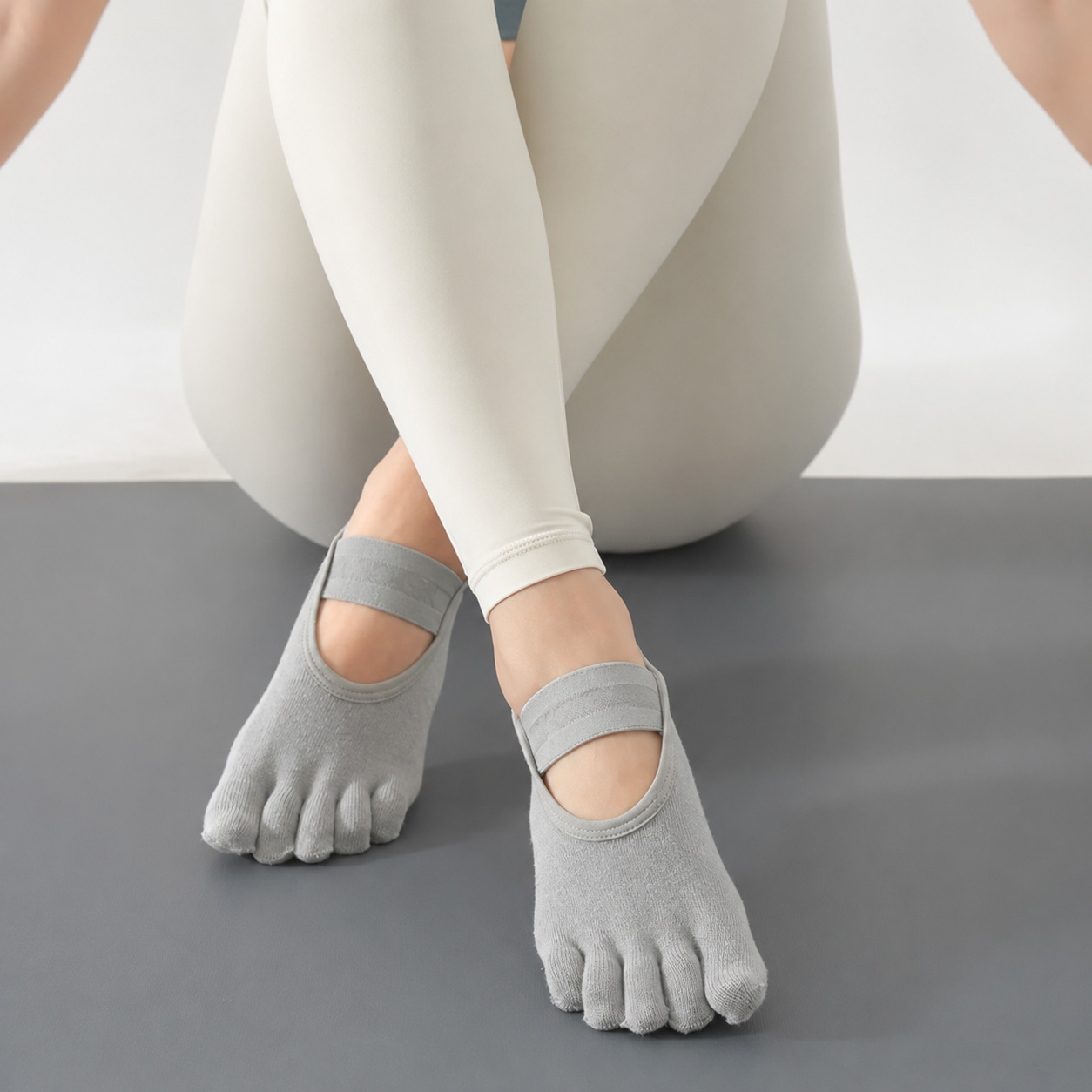
The fabric composition directly affects grip performance, durability after washing, and client comfort. Here are the four most common fabric blends used in Pilates grip socks, ranked by studio suitability:
| Fabric Blend | Best For | Pros | Cons |
|---|---|---|---|
| 80% Cotton / 15% Polyester / 5% Spandex | Reformer & mat Pilates | Breathable, stable on carriage, absorbs sweat, natural feel | Slightly less stretch than synthetic blends |
| 75% Combed Cotton / 20% Nylon / 5% Elastane | Premium studio retail | Soft hand-feel, excellent print clarity for logos, durable after 50+ washes | Higher cost (~10-15% premium) |
| 90% Nylon / 10% Spandex | Hot Pilates / high-sweat classes | Moisture-wicking, quick-dry, maximum stretch | Less natural feel; silicone adhesion slightly weaker on nylon base |
| 70% Bamboo Fiber / 25% Cotton / 5% Spandex | Eco-conscious studios | Antibacterial, sustainable marketing angle, ultra-soft | Highest cost (~20-25% premium); longer production lead time |
Our recommendation for most studios: Start with the 80/15/5 cotton blend. It's cost-effective, performs well across reformer and mat classes, and clients love the natural feel. Upgrade to combed cotton for a premium retail line once your merchandise program is established.
The grip pattern is the single most important design decision for Pilates socks. Get it wrong and clients will slip — or worse, blame the sock and never buy from you again.
| Pattern Type | Coverage | Best For | Not Ideal For |
|---|---|---|---|
| Full-Sole Silicone | Entire sole from heel to toes | Reformer classes, beginners, clients who prioritize safety | Yoga flows (too grippy for transitions) |
| Half-Sole / Forefoot Only | Ball of foot + toes only | Mixed reformer + mat classes; experienced clients | Heavy reformer use (heel slides on shoulder blocks) |
| Strategic Zone | Toes, ball, heel — with gaps in arch | Premium studio retail; balances grip with flexibility | Budget-conscious bulk orders (higher production cost) |
| Grip Material | Durability | Grip Level | Cost | Best Use |
|---|---|---|---|---|
| Silicone dots (1.5–2mm) | 50,000+ wear cycles | Medium-High | $$ | All-purpose studio use |
| Silicone stripes/waves | 40,000+ wear cycles | High | $$$ | Premium retail line |
| PVC dots | 20,000+ wear cycles | Medium | $ | Budget bulk orders |
Yuintal's recommendation: For Pilates studios, silicone dots are the sweet spot. They provide consistent grip through hundreds of reformer sessions, survive commercial laundry cycles, and cost only moderately more than PVC. The 1.5mm dot height gives enough traction without making the sock feel bulky inside the carriage.
Custom grip socks are your studio's wearable billboard. Here's what you can customize — and what's worth the investment:
| Customization | Cost Impact | Production Time | Worth It? |
|---|---|---|---|
| Logo on ankle/cuff | Minimal | +0 days | ✅ Essential — this is what clients see and share on social media |
| Custom color matching | Low | +3–5 days for lab dip | ✅ High value — match your studio's brand palette |
| Custom grip pattern shape | Moderate | +7–10 days for mold | ⚠️ Only if you order 2,000+ pairs — mold cost amortizes |
| Custom packaging (box/bag) | Low-Moderate | +5–7 days | ✅ Great for retail — elevates perceived value from $15 to $22 |
| Hang tags with studio story | Low | +3–5 days | ✅ Builds brand connection; clients keep them |
| Custom woven label (inside) | Minimal | +7–10 days | ✅ Professional finish; small cost for big quality signal |
Browse our full collection of customizable Pilates grip sock styles: Yoga & Pilates Grip Socks Collection →
One of the most common questions we hear: "What's your minimum order?" The answer depends on whether you're ordering stock designs or custom private label.
| Order Type | MOQ | Per-Pair Cost | Lead Time |
|---|---|---|---|
| Stock design (no customization) | 100 pairs | $2.80–$3.50 | 7–10 days |
| Custom logo only (on stock design) | 300 pairs | $3.20–$4.00 | 14–21 days |
| Full private label (custom design + logo + packaging) | 500 pairs | $3.50–$4.50 | 28–35 days |
| Bulk wholesale (10,000+ pairs) | 10,000 pairs | $1.80–$2.50 | 35–45 days |
Order Size = (Active Members × 0.4 × 2 pairs) + 10% buffer
Example: 200 members × 0.4 adoption rate × 2 pairs = 160 pairs + 16 buffer = ~180 pairs for first order
Start with 300 pairs (the custom logo MOQ). This covers ~150 members buying 2 pairs each, plus instructor use and front-desk display stock. If you sell out in under 3 months, double the next order.
Let's run the numbers on a realistic first order of 500 custom private-label Pilates grip socks:
| 500 Pairs — Full Private Label Order | |
|---|---|
| Per-pair production cost (incl. logo, packaging, hang tag) | $4.00 |
| Shipping (sea freight, 500 pairs) | $250 ($0.50/pair) |
| Total landed cost per pair | $4.50 |
| Retail price in-studio | $18.00 |
| Profit per pair | $13.50 |
| Sell-through assumption (12 months) | 90% (450 pairs) |
| Total projected profit | $6,075 |
| ROI | 270% |
Even with a conservative 70% sell-through (350 pairs), you're looking at $4,725 profit on a $2,250 investment — a 210% ROI. And that's before factoring in the brand exposure value of 350+ pairs of branded socks in your local community.
Here's what a typical 500-pair private label order looks like from start to finish:
Total: 8 weeks from design brief to delivery. Air freight can cut this to 3–4 weeks but adds ~$1.50/pair in shipping cost.
Selling socks at the front desk is just the beginning. Here are five ways Pilates studios generate revenue from branded grip socks:
Before committing to a manufacturer, run through this checklist:
| Question | What to Look For |
|---|---|
| Can you provide a physical sample before bulk production? | Yes — with your actual logo and colors. Digital mockups aren't enough. |
| What's the silicone adhesion durability? | At least 50 wash cycles without peeling. Ask for test data. |
| Do you offer multiple size ranges? | At minimum S/M and L/XL. Ideally three sizes for better fit. |
| What's your defect rate and return policy? | <2% defect rate; replacement or refund for defects. |
| Can you match a specific Pantone color? | Yes — with lab dip approval before bulk. |
| Do you have experience with Pilates studio clients? | References or case studies from similar clients. |
Whether you're launching a branded merchandise line or stocking socks for class use, we'll help you get it right — from fabric to logo to packaging.
Start Your Design Brief →Related Resources:
• Yoga & Pilates Grip Socks Collection — View All Styles
• Full Product Catalog — OEM & Wholesale Grip Socks
• Grip Socks vs Non-Slip Socks: What's the Real Difference?

 Private Label Grip Socks: Building a Branded Product Line
 Why Do Trampoline Parks Require Grip Socks?
 Trampoline Grip Socks Manufacturer
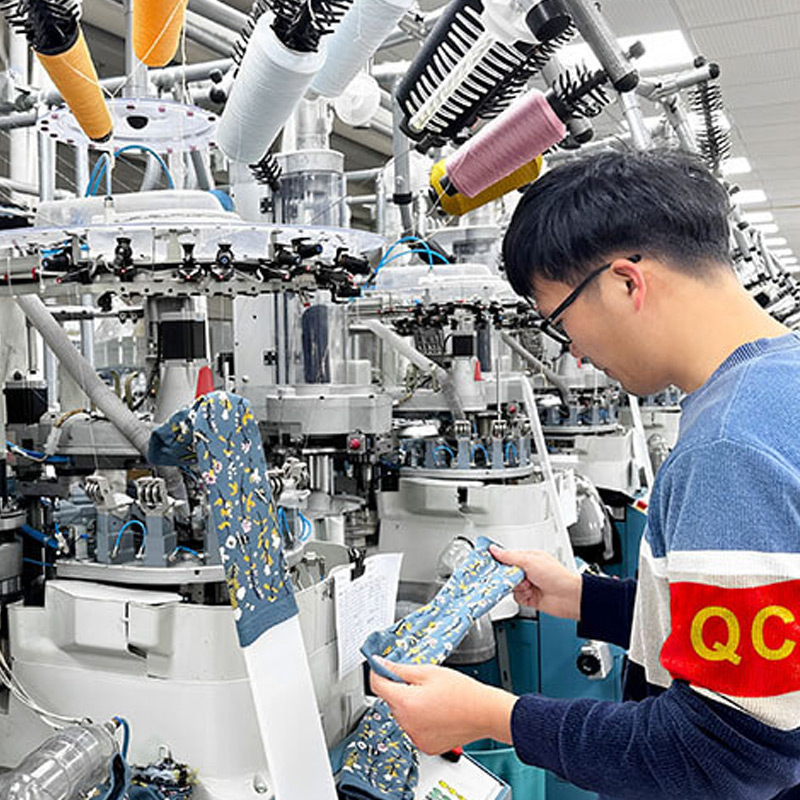 Quality Control Standards for OEM Socks
