
The global performance-sock market has shifted from classic mass production toward function-specific, design-driven development. Today’s brands—from Lululemon Studio to Bombas and Decathlon—increasingly expect their manufacturing partners to serve not just as producers, but as design engineers who can translate biomechanical needs, sport-specific demands, and aesthetic concepts into manufacturable products.
For grip socks, yoga & pilates socks, trampoline park socks, and high-intensity training socks, the ODM (Original Design Manufacturing) workflow determines the final comfort, durability, grip strength, and long-term performance. At Yuintal, ODM design and development integrates three core engines:
This article explains how these components work together—and why a modern ODM process is no longer just “making socks,” but designing fully engineered performance equipment aligned with the needs of athletes, fitness studios, and global consumer brands.
Performance socks are no longer commodity items. They are stability tools, moisture-management systems, and branding assets—especially for categories such as:
These environments demand grip durability exceeding 50,000 cycles, color fastness at Grade 4–5, and wash performance beyond 100+ cycles—metrics that traditional workshops cannot reliably meet without structured design engineering.
ODM is the bridge between aesthetic concepts, biomechanical needs, and manufacturable performance. It ensures a product is not only beautiful—but functionally correct, durable, repeatable, and scalable.
ODM development begins with defining the functional architecture of the sock—not just its appearance. This stage involves collaboration among designers, yarn engineers, knitting technologists, and sample technicians.
Each of these parameters influences yarn selection, pattern design, machine gauge (108N–200N), and overall manufacturability.
The design process for grip socks is more engineering-driven than many expect. Unlike printed apparel, the artwork is knitted directly into the structure, meaning every pixel in the design affects tension, elasticity, and density.
Through ODM, the design layer includes:
Yuintal’s design team uses knit-ready grid systems to ensure that artwork is not only visually attractive but structurally sound and compatible with machine constraints.
For example, a logo placed over a high-tension arch support zone must be converted into a compensation pattern to avoid unwanted tightness. This type of adjustment is routine in professional ODM workflows.
For deeper detail on pattern engineering, refer to:
Custom Pattern & Artwork Creation →
The next stage is fiber-level engineering. Yarn choices determine elasticity, durability, elasticity retention, sweat evaporation, color stability, and pilling resistance.
ODM coordination ensures that materials match functional goals. Example benchmarks include:
Material engineering also determines whether the sock can maintain its shape after repeated stretching, especially at cuff, arch-support band, and heel contour.
Detailed material selection guidance can be found in:
Yarn Selection & Material Engineering →
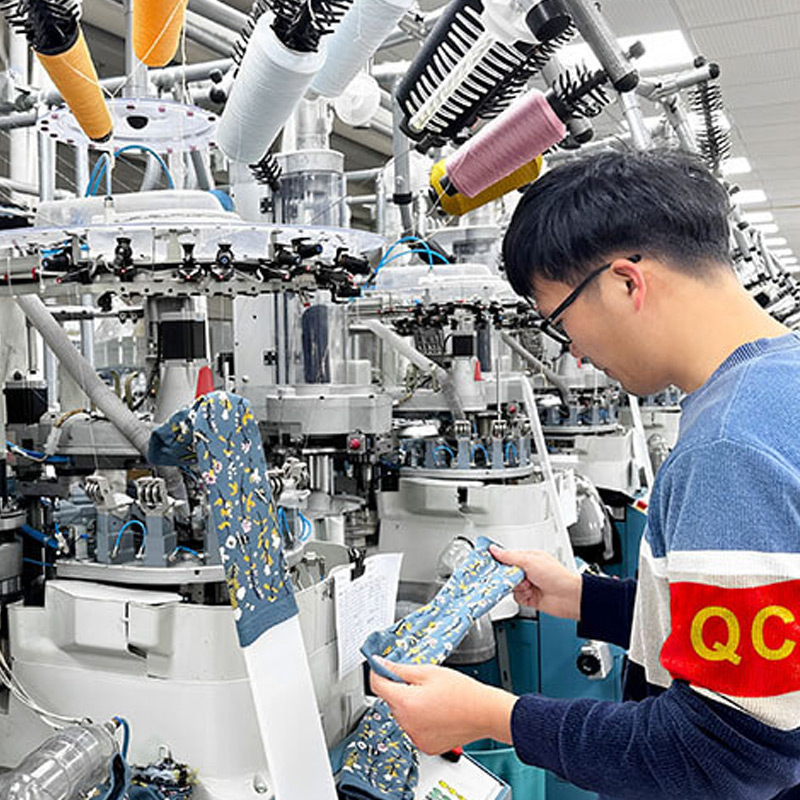
Yuintal operates 108N–200N multi-gauge knitting machines, allowing precise matching between product category and fabric architecture.
Grip socks especially rely on correct gauge calibration to prevent slippage, cracking, or over-stretching of the sole pattern.
Grip design is one of the most technical components of the ODM process. The geometry, hardness, spacing, and thickness determine both tactile feel and mechanical performance.
For trampoline and park environments, ODM development must test grip adhesion under extreme shear forces—far beyond normal training use.
ODM development is incomplete without structured sample testing. Yuintal’s validation workflow includes mechanical, visual, tactile, and wash-cycle testing.
Once samples meet specification, the project transitions into pre-production trials and final sizing adjustments.
For a complete view of how samples move toward mass production, read:
Full-Sample Development Workflow →
ODM development ensures that a design can scale—not just exist as a prototype. Production feasibility requires alignment between pattern, materials, gauge, and finishing processes.
Yuintal’s production lines are engineered to ensure that ODM designs stay consistent across thousands of pairs and multiple replenishment cycles.
OEM production fulfills an existing design. ODM development creates the design, validates it, and ensures technical correctness before manufacturing begins.
This approach reduces risk, speeds up time-to-market, and aligns product performance with brand expectations.
For emerging brands, ODM prevents costly redesigns and performance issues. For established brands, ODM provides the engineering backbone needed for expansion and category growth.
As training environments evolve, ODM development increasingly incorporates motion analysis, pressure-mapping research, and studio-specific preferences.
Key growth directions include:
ODM is no longer a back-office service—it is becoming the primary differentiator in the performance sock industry.
 Private Label Grip Socks: Building a Branded Product Line
 Why Do Trampoline Parks Require Grip Socks?
 Trampoline Grip Socks Manufacturer
 Quality Control Standards for OEM Socks