
Verdict: Trampoline grip socks and standard grip socks are both designed to provide traction, but they differ in grip coverage and flexibility. Trampoline grip socks are usually designed with enhanced grip elements on both the forefoot and heel to handle dynamic movements and intense impact. Standard grip socks tend to focus on more even, consistent traction for indoor use in lower intensity activities. The difference becomes noticeable when movement intensity increases or when more complex foot positioning is required.

People often ask about the difference between trampoline grip socks and standard grip socks when they experience a mismatch between traction needs and sock performance. Trampoline grip socks are often recommended for higher-intensity activities like jumping and dynamic movements, while standard grip socks are used for indoor activities with less movement.
The question arises when individuals notice that standard grip socks don't perform as well on high-impact surfaces or during movements requiring more foot flexibility. Users naturally want to understand why certain designs feel better suited for activities like trampoline exercises or intense fitness classes.
| Factor | Trampoline Grip Socks | Standard Grip Socks |
|---|---|---|
| Grip distribution | Reinforced grip at forefoot and heel | Even grip distribution across the sole |
| Response to impact | Designed to handle repeated landing forces | Optimized for controlled indoor movement |
| Stability during jumps | Feels more secure during takeoff and landing | Less stable under high-impact movement |
| Flexibility | Often more structured to support dynamic motion | Generally more flexible for low-intensity use |
| Typical indoor use | Trampoline parks and high-intensity activities | Studios, home workouts, balance-focused training |
When comparing trampoline grip socks and standard grip socks, users often place both alongside other indoor options such as regular socks or barefoot movement. This comparison helps clarify why trampoline-specific designs feel different under higher movement demands.
Compared to regular socks, both types of grip socks significantly reduce uncontrolled sliding. Compared to barefoot movement, they add a layer of traction that reduces sensitivity to sweat and surface variation. The difference between trampoline and standard grip socks lies in how they respond to repeated impact and rapid changes in load.
Trampoline grip socks are tuned for explosive movement and frequent landings, while standard grip socks prioritize consistent traction during controlled, lower-intensity indoor activity.
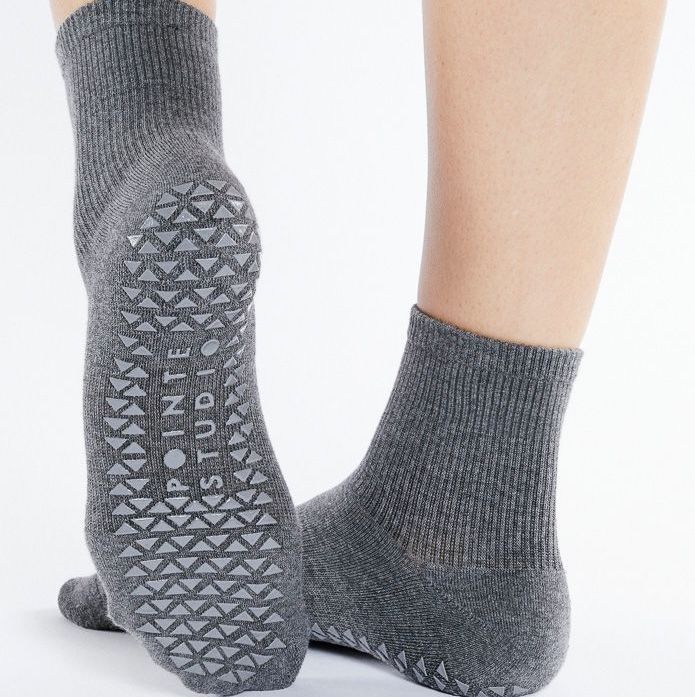
The practical limit of standard grip socks appears when movement intensity increases beyond their design range. During repeated jumping or high-impact landings, traction can feel insufficient or delayed.
Trampoline grip socks reach their limit in a different way. Their reinforced grip and structure can feel excessive during slow or precision-based movements, where flexibility and fine foot articulation are more important than impact resistance.
A common misunderstanding is that trampoline grip socks are simply “stronger” versions of standard grip socks. In reality, the difference is not about maximum grip strength, but about how grip behaves under repeated impact and rapid load changes.
Standard grip socks are designed to deliver stable traction during controlled indoor movement. Trampoline grip socks are tuned to manage brief moments of high force during takeoff and landing. This design difference changes how the socks feel, even if both appear similar at rest.
The difference becomes most noticeable during moments of rapid force transfer. Takeoffs, landings, and mid-air adjustments amplify traction behavior. During these movements, trampoline grip socks tend to feel more secure and predictable.
During slower, ground-based movements such as balance holds or walking transitions, both types may feel similar. Once vertical motion and impact are introduced, the performance gap becomes immediately apparent.
In the early stages, the difference between trampoline grip socks and standard grip socks often feels like a performance issue. Movements may feel less confident, landings may require more adjustment, or traction may feel delayed.
As movement intensity increases, this performance gap can become a safety concern. When traction fails to respond quickly during takeoff or landing, the body compensates by altering timing and joint alignment. Over repeated high-impact cycles, these small compensations increase the risk of slips, missteps, or loss of balance.
For standard grip socks, the first sign of reduced effectiveness is often hesitation during landing or a feeling that the foot slides slightly before stabilizing. This indicates that traction is no longer keeping up with impact forces.
For trampoline grip socks, effectiveness declines when grip response feels delayed or when reinforced areas no longer provide reliable contact after repeated use. If landings begin to feel less predictable despite unchanged technique, the grip system may no longer be functioning as intended.
The main difference is how they handle impact. Trampoline grip socks are designed to manage repeated jumping and landing forces, while standard grip socks are optimized for lower-intensity indoor movement.
They can be safer in high-impact activities such as jumping, because their traction responds more predictably during takeoff and landing.
They can be used for light activity, but their traction may feel insufficient during repeated or high-intensity jumps.
They may feel excessive during slow, precision-based movements where flexibility and fine foot control are more important than impact resistance.
The differences between trampoline grip socks and standard grip socks are rooted in how traction and stability respond under changing load and impact conditions. For a system-level explanation of these performance mechanisms, see how grip socks perform and what affects traction and stability.
High-intensity environments expose traction limits quickly; if you want a broader view of how alternative indoor traction systems behave in studios, see grip socks vs indoor shoes for studio training.

 Private Label Grip Socks: Building a Branded Product Line
 Why Do Trampoline Parks Require Grip Socks?
 Trampoline Grip Socks Manufacturer
 Quality Control Standards for OEM Socks