
Verdict: It depends on where stability is needed. Yoga mats provide surface-level stability by increasing friction between the body and the floor, while grip socks provide foot-level stability by controlling traction at the point of contact. The difference becomes clear when movements involve transitions, weight shifts, or balance corrections rather than static poses.
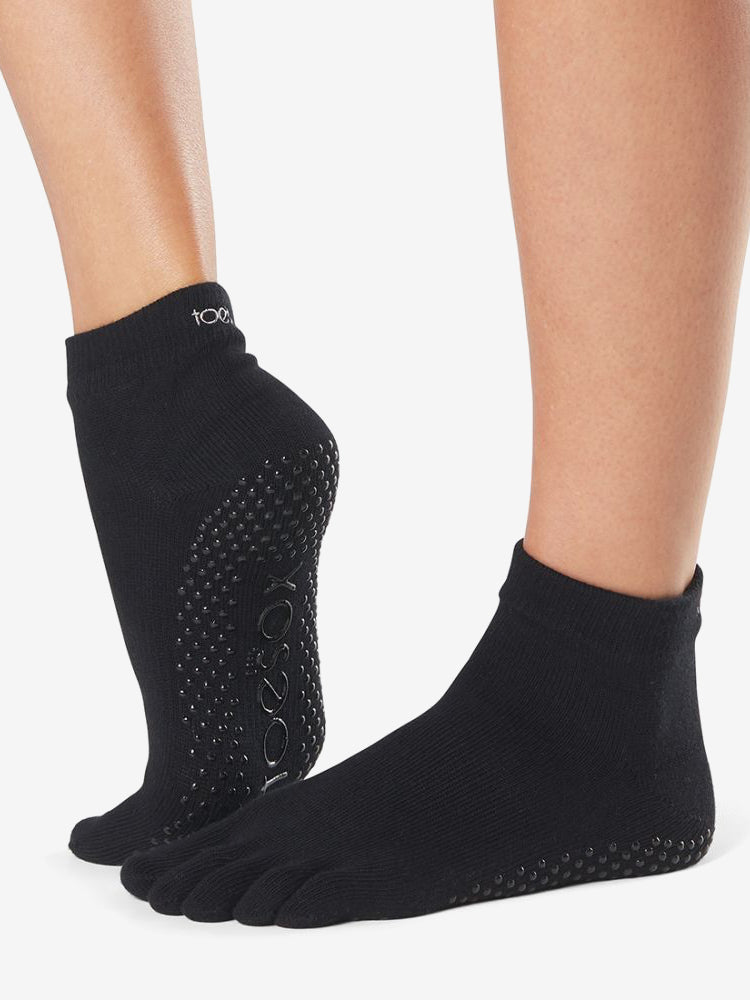
People usually ask whether grip socks or yoga mats provide better stability after experiencing inconsistent balance during indoor practice. In many cases, they already use a yoga mat but still feel instability during standing poses, transitions, or single-leg balance.
The question often arises when users notice that surface grip alone does not fully prevent foot movement. Even on a high-friction mat, the foot itself may slide or adjust unpredictably, prompting a comparison between stabilizing the surface and stabilizing the foot.
| Factor | Grip Socks | Yoga Mats |
|---|---|---|
| Primary source of stability | Foot-to-surface traction control | Body-to-floor surface friction |
| Point of contact | Directly at the foot | Across the entire mat surface |
| Response during transitions | Adjusts with foot movement | Remains static once placed |
| Effect on balance corrections | Supports small, rapid foot adjustments | Supports full-body stability in static poses |
| Typical indoor use | Balance-focused or movement-based practice | Floor-based or stationary practice |
When comparing grip socks and yoga mats, users often also consider barefoot practice or regular socks. This broader comparison helps clarify what each option actually stabilizes.
Compared to barefoot practice, grip socks reduce sensitivity to sweat and floor variation by adding controlled traction at the foot. Compared to regular socks, they limit uncontrolled sliding. Yoga mats, by contrast, stabilize the surface itself rather than the foot. They increase friction between the body and the floor but do not actively manage foot movement once contact occurs.
This means grip socks and yoga mats address stability at different levels. Grip socks work at the point of foot contact, while yoga mats work at the surface level beneath the body.

The practical limit of yoga mats appears when movement requires frequent foot repositioning. During transitions or balance corrections, the mat remains static, while the foot may still shift on its surface.
Grip socks reach their limit when stability depends on a fixed base of support, such as floor-based poses where full-body contact with the mat is the primary stabilizing factor. In these cases, foot-level traction alone cannot replace surface-level support.
A common misunderstanding is that yoga mats automatically provide better stability than grip socks because they feel more secure under the body. In practice, stability depends on where control is applied.
Yoga mats stabilize the surface, but they do not prevent micro-movements at the foot. Grip socks, on the other hand, manage traction directly at the point of contact. This difference explains why a surface can feel stable while the foot still feels uncertain.
The difference becomes most noticeable during transitions and balance corrections. Moving from one pose to another, shifting weight onto a single foot, or adjusting stance mid-pose highlights how stability is distributed.
During static, floor-based poses, yoga mats often feel sufficient. Once movement requires the foot to reposition or respond quickly, grip socks tend to provide more predictable control.
At first, the difference between grip socks and yoga mats feels like a performance issue. Balance may feel less precise, transitions may require extra caution, or foot placement may need repeated adjustment.
Over time, these performance gaps can become a safety concern. When the foot slides or adjusts unexpectedly on a stable surface, the body compensates through joint alignment and timing changes. During repeated practice, these compensations increase the likelihood of loss of balance, missteps, or strain, especially in single-leg or transition-heavy movements.
For yoga mats, the first sign of reduced effectiveness is usually foot movement despite a stable surface. If the mat remains in place but the foot continues to shift during balance poses, surface friction alone is no longer sufficient.
For grip socks, declining effectiveness appears as delayed traction response or the need to slow down transitions to maintain control. When foot-level traction no longer matches movement demands, stability becomes harder to maintain even on a stable mat.
No. Grip socks and yoga mats serve different purposes. Grip socks stabilize the foot, while yoga mats stabilize the surface beneath the body.
Because a yoga mat increases surface friction but does not prevent micro-movements at the foot, especially during transitions or balance adjustments.
Grip socks often provide more predictable control during balance poses because traction is managed directly at the point of foot contact.
A yoga mat is more important during floor-based or static poses where full-body contact with the surface provides primary stability.
The difference between grip socks and yoga mats comes down to how traction and stability interact at different points of contact. For a system-level breakdown of these performance mechanisms, see how grip socks perform and what affects traction and stability.
Stability often depends on whether the surface is designed to “hold” you or whether traction must remain predictable on smoother finishes—see grip socks vs slippers on smooth floors.

 Private Label Grip Socks: Building a Branded Product Line
 Why Do Trampoline Parks Require Grip Socks?
 Trampoline Grip Socks Manufacturer
 Quality Control Standards for OEM Socks