
Short Answer: Grip socks and indoor shoes stabilize movement in fundamentally different ways. Grip socks manage traction directly at the foot, while indoor shoes add structure and separation between the foot and the floor. The difference becomes most noticeable during precision movements, balance transitions, and floor-contact training.
 Why Do People Compare Grip Socks and Indoor Shoes?
People usually compare grip socks and indoor shoes when they move from general workouts into studio-based training. In these environments, movement precision, balance control, and floor contact become more noticeable than cushioning or impact protection.
The question often arises after experiencing instability during transitions. A practitioner may feel secure in indoor shoes during walking or light training, yet notice delayed control or reduced feedback during balance-focused movements. Conversely, switching to grip socks can feel more connected, but also more demanding.
This comparison is not driven by comfort alone. It is triggered by how different footwear choices change the way stability is created, transmitted, and corrected during controlled indoor movement.
The fundamental difference between grip socks and indoor shoes lies in where stability is created and how it is managed during movement.
Grip socks generate stability directly at the foot–floor interface. Traction is applied at the sole of the foot, allowing the body to respond immediately to surface contact, pressure shifts, and balance corrections.
Indoor shoes, by contrast, introduce an intermediate structure between the foot and the floor. Stability is influenced by the shoe’s shape, sole stiffness, and containment, which can reduce unwanted movement but also filter sensory feedback.
This difference explains why grip socks often feel more responsive during precision-based movements, while indoor shoes may feel more supportive during general or repetitive motion.
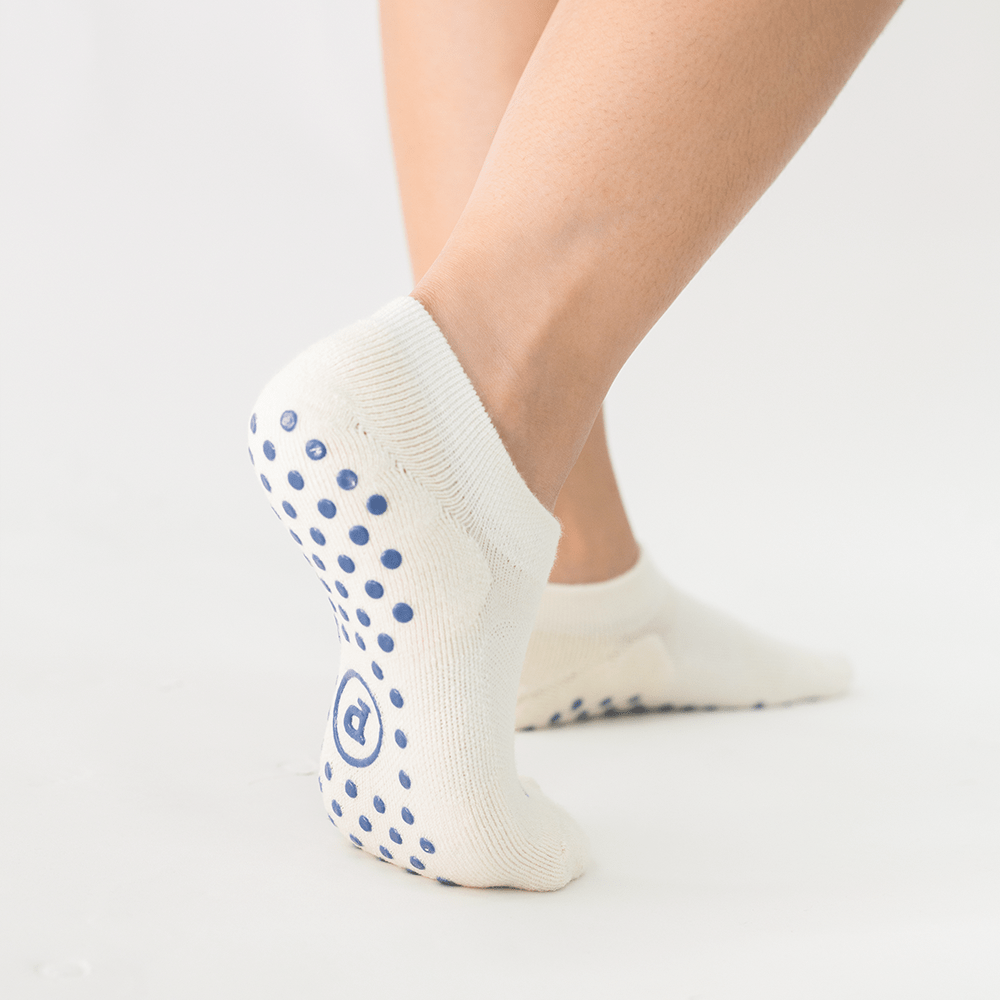
Grip socks and indoor shoes manage traction through fundamentally different mechanisms. With grip socks, traction is created through direct contact between the foot and the floor, mediated only by the sock’s grip pattern and material properties.
This direct interface allows traction to respond immediately to changes in pressure, angle, and direction. Small adjustments in foot placement are translated into equally small changes in grip, which is why grip socks often feel more precise during controlled movements.
Indoor shoes rely on outsole material, sole geometry, and surface area to generate traction. While this can provide consistent grip across repetitive movements, it introduces a delay between foot motion and floor response because traction is managed through the shoe structure rather than the foot itself.
As a result, traction in indoor shoes is more uniform but less sensitive to micro-adjustments, whereas grip socks allow finer control at the cost of requiring more active balance engagement.
One of the most noticeable differences between grip socks and indoor shoes is how movement feedback is perceived. Feedback refers to how quickly and clearly the body senses contact, pressure changes, and balance shifts through the feet.
Grip socks allow a high level of sensory input because there is minimal separation between the foot and the floor. Pressure changes, subtle slips, and micro-adjustments are felt almost immediately, which helps users make faster balance corrections during studio training.
Indoor shoes reduce sensory input by design. The sole, cushioning, and structure filter floor feedback before it reaches the foot. This can feel more comfortable or forgiving, but it also means balance corrections rely more on anticipation than direct sensation.
This difference explains why grip socks often feel more demanding but more precise, while indoor shoes feel more stable during repetitive or less technical movements.
| Factor | Grip Socks | Indoor Shoes |
|---|---|---|
| Stability source | Foot-level traction control | Structure-level support and containment |
| Traction response | Immediate and sensitive to micro-adjustments | More uniform but less responsive |
| Movement feedback | High sensory feedback from the floor | Filtered feedback through sole and cushioning |
| Precision movements | Supports fine balance corrections | May feel less precise |
| Repetitive motion | Requires active control | Feels more forgiving |
Grip socks reach their practical limit when movement requires additional structural support or impact absorption. Extended sessions involving repetitive load, lateral force, or fatigue can make foot-level control harder to maintain.
Indoor shoes reach their limit when movement demands precision, floor awareness, or rapid balance correction. In these situations, reduced sensory feedback can delay responses and make fine control more difficult.
In most studio settings, choosing between grip socks and indoor shoes starts as a performance decision. The difference shows up as changes in feedback timing, balance correction speed, and movement precision.
It becomes a safety issue when the chosen option no longer matches movement demands. If traction response is delayed during balance transitions, or if reduced sensory feedback prevents timely corrections, the risk of missteps or loss of balance increases. Safety, in this context, is about predictability rather than protection.
No. Grip socks and indoor shoes serve different purposes. Grip socks enhance foot-level control, while indoor shoes provide structural support and cushioning.
Grip socks allow direct sensory feedback from the floor, enabling faster and finer balance corrections during controlled movements.
Not always. Indoor shoes can feel safer during repetitive or fatigue-heavy sessions, but reduced feedback may limit precision during balance-focused training.
Grip socks may be less suitable when sessions involve extended duration, high fatigue, or movements that require additional structural support.
The differences between grip socks and indoor shoes reflect broader principles of how traction, feedback, and stability interact during movement. For a system-level explanation of these mechanisms, see how grip socks perform and what affects traction and stability.
If your main concern is how traction becomes a safety variable (not just a comfort choice), compare that to skin-based contact in grip socks vs barefoot training: which is safer indoors.

 Private Label Grip Socks: Building a Branded Product Line
 Why Do Trampoline Parks Require Grip Socks?
 Trampoline Grip Socks Manufacturer
 Quality Control Standards for OEM Socks