
Verdict: It depends. Full-sole grip socks usually feel more stable during continuous movement because traction is distributed across the entire foot. Half-sole grip socks tend to feel more flexible and responsive during forefoot-driven movements, but provide less support during backward shifts or full-foot loading. The difference becomes clear once movement involves transitions, rotation, or uneven load distribution.
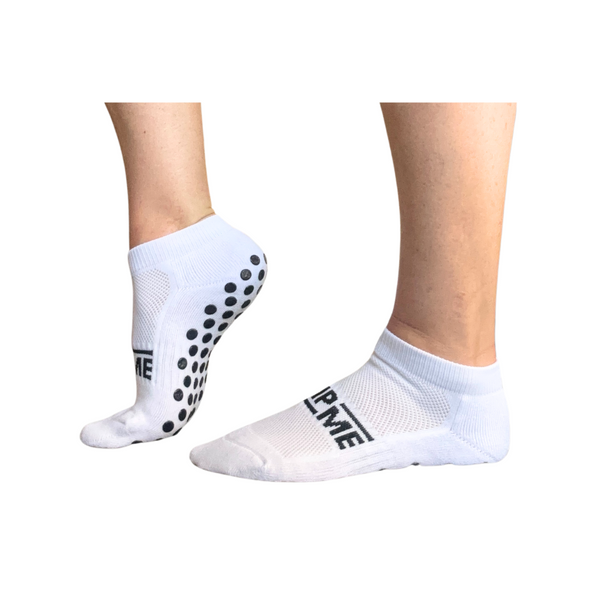
People usually start comparing full-sole and half-sole grip socks after noticing inconsistent traction during indoor movement. At first glance, both designs are “grip socks,” so they are expected to feel similar. The question arises when one option feels stable in certain movements but unreliable in others.
This confusion often appears during transitions—when weight shifts from forefoot to heel, or when movement direction changes. Users sense that grip is present, yet control feels uneven. That mismatch between visible grip and perceived stability triggers the comparison.
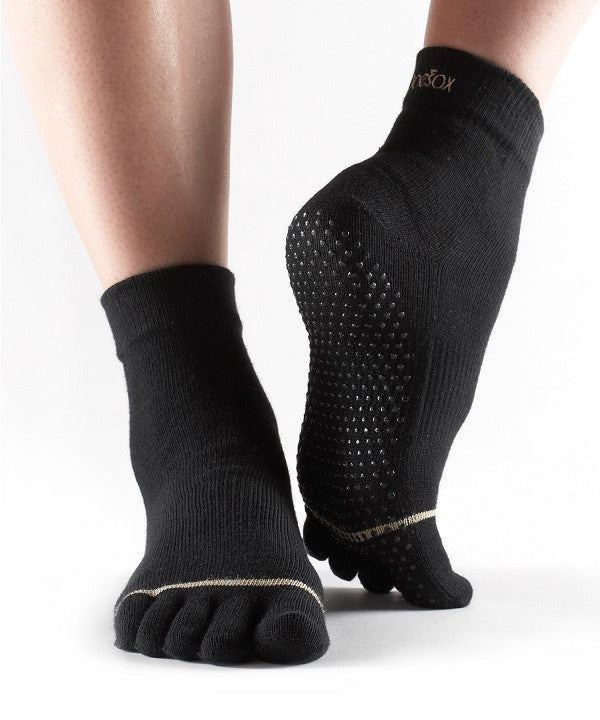
| Factor | Full-Sole Grip Socks | Half-Sole Grip Socks |
|---|---|---|
| Grip coverage | Grip elements cover the entire sole | Grip elements limited to forefoot area |
| Perceived stability | Feels more stable during full-foot loading | Feels lighter and more flexible |
| Response to transitions | More consistent during forward and backward shifts | Less support during heel contact |
| Movement freedom | Can feel restrictive in fine foot articulation | Allows greater forefoot articulation |
| Typical indoor use | General indoor training with mixed movement patterns | Forefoot-focused balance or studio movement |
When deciding between full-sole and half-sole grip socks, many users also compare them to other indoor options such as barefoot movement or regular socks. This comparison helps clarify what grip coverage actually changes.
Compared to barefoot movement, both designs add a layer of traction that reduces sensitivity to sweat and surface contamination. Compared to regular socks, both designs reduce uncontrolled sliding. The difference between full-sole and half-sole grip socks is therefore not whether traction exists, but where and when traction is applied during movement.
Full-sole grip socks distribute traction across the entire foot, while half-sole grip socks concentrate traction at the forefoot. This difference explains why they feel similar in some movements but very different in others.
The practical limit of half-sole grip socks appears when movement requires reliable heel contact or backward weight transfer. In these moments, the lack of grip under the rearfoot can make traction feel incomplete.
Full-sole grip socks reach their limit in a different way. As grip coverage increases, fine foot articulation may feel constrained during precision movements. The limit is reached not when grip fails, but when excessive coverage interferes with movement sensitivity.
A common assumption is that more grip coverage always means better performance. In practice, grip coverage changes how traction is delivered, not simply how much traction exists.
Full-sole grip socks do not automatically provide better control in every movement. Their wider coverage stabilizes the foot during full-foot loading, but can reduce sensitivity during fine adjustments. Half-sole grip socks are often mistaken as “less grippy,” when in reality they are designed to concentrate traction where movement initiation most often occurs.
The difference between full-sole and half-sole grip socks becomes most noticeable during transitions that shift load between the forefoot and the heel. Forward lunges, backward steps, and rotational corrections amplify the effects of grip placement.
During movements driven mainly by the forefoot, both designs may feel similar. Once movement demands change—such as landing through the heel or stabilizing after a turn—the absence or presence of rearfoot grip becomes immediately apparent.
At first, the difference between full-sole and half-sole grip socks feels like a performance issue. Movements may feel less smooth, transitions may require more attention, or balance adjustments may feel delayed. Over time, these performance differences can turn into a safety concern.
When grip coverage does not match the movement pattern, traction can become uneven. This uneven response forces the body to compensate by changing joint angles, timing, or load distribution. During repeated indoor training, these small compensations increase the likelihood of missteps, loss of balance, or strain—especially during rotational or backward movements.
For half-sole grip socks, the first sign of declining effectiveness is usually hesitation during heel contact or backward shifts. If stability suddenly drops when weight moves away from the forefoot, grip coverage is no longer supporting the movement.
For full-sole grip socks, effectiveness declines when movements begin to feel constrained or delayed. If fine adjustments become harder or foot placement feels less responsive, grip coverage may be interfering with natural articulation rather than supporting it.
The main difference lies in grip coverage. Full-sole grip socks distribute traction across the entire foot, while half-sole grip socks concentrate traction at the forefoot.
No. Full-sole grip socks are more stable during full-foot loading, but they may feel less responsive during fine or forefoot-focused movements.
Half-sole grip socks feel lighter because grip coverage is limited to the forefoot, allowing greater freedom of movement in the heel area.
Safety depends on movement patterns. Full-sole designs tend to be safer for mixed or backward movements, while half-sole designs suit forefoot-driven activities.
The differences between full-sole and half-sole grip socks are rooted in how traction and stability interact with foot loading and movement patterns. For a system-level explanation of these performance mechanisms, see how grip socks perform and what affects traction and stability.
Sole coverage changes how load is distributed, but material choice can shift traction consistency just as much—see cotton grip socks vs synthetic grip socks.

 How to Choose Grip Socks for Indoor Playgrounds & Early Education Centers: A Buyer's Guide to Safety, Sizing & Bulk Supply | Yuintal
 Pilates Studio Grip Socks: How to Source Custom Non-Slip Socks for Reformer, Mat & Barre Classes | Yuintal Buyer's Guide
 Grip Socks for Yoga Studios: How to Source Custom Branded Socks in Bulk (OEM & Private Label Guide)
 How to Choose Grip Socks for Your Trampoline Park: A Buyer's Guide to MOQ, Safety & Custom Branding