
Verdict: It depends. Grip socks usually feel more secure during indoor movement because they create intentional traction between the foot and the floor. Regular socks tend to feel smoother and less controlled once movement involves rotation, shifting weight, or repeated steps. The difference becomes noticeable when surface conditions change or when movement is no longer slow and linear.
 Why Do People Ask This Question?
Most people start asking why grip socks feel so different from regular socks after experiencing a mismatch between expectation and movement. At first, both types of socks may feel similar when standing still or walking slowly indoors. The difference becomes noticeable only once movement involves shifting weight, changing direction, or repeating the same actions over time.
The question is rarely about comfort alone. It usually arises after a moment of lost stability, hesitation, or unexpected sliding, especially on smooth indoor floors. When regular socks suddenly feel unreliable and grip socks feel more controlled, users naturally want to understand what is actually changing underfoot.
| Factor | Grip Socks | Regular Socks |
|---|---|---|
| Foot-to-floor contact | Designed contact points interact with the floor | Fabric surface slides directly on the floor |
| Perceived stability | Feels more secure during movement | Feels smooth but less controlled |
| Response during rotation | More resistance to sudden slipping | Higher chance of unexpected sliding |
| Consistency over time | Remains relatively stable as sessions continue | Becomes less predictable with repetition |
| Typical indoor use | Balance, controlled training, studio activities | Casual indoor wear or low-movement use |
When people notice the difference between grip socks and regular socks, they often compare both to two other options: going barefoot or wearing indoor shoes. Each option changes how the foot interacts with the floor, but in different ways.
Compared to barefoot movement, grip socks reduce the direct influence of skin moisture and surface contamination. Compared to indoor shoes, they remove cushioning and sole stiffness, which preserves ground feedback. Regular socks, by contrast, do neither. They neither stabilize traction nor enhance sensory feedback, which is why they tend to feel acceptable only under limited conditions.
This explains why grip socks often feel like a middle ground: they introduce controlled traction without fully isolating the foot from the surface.
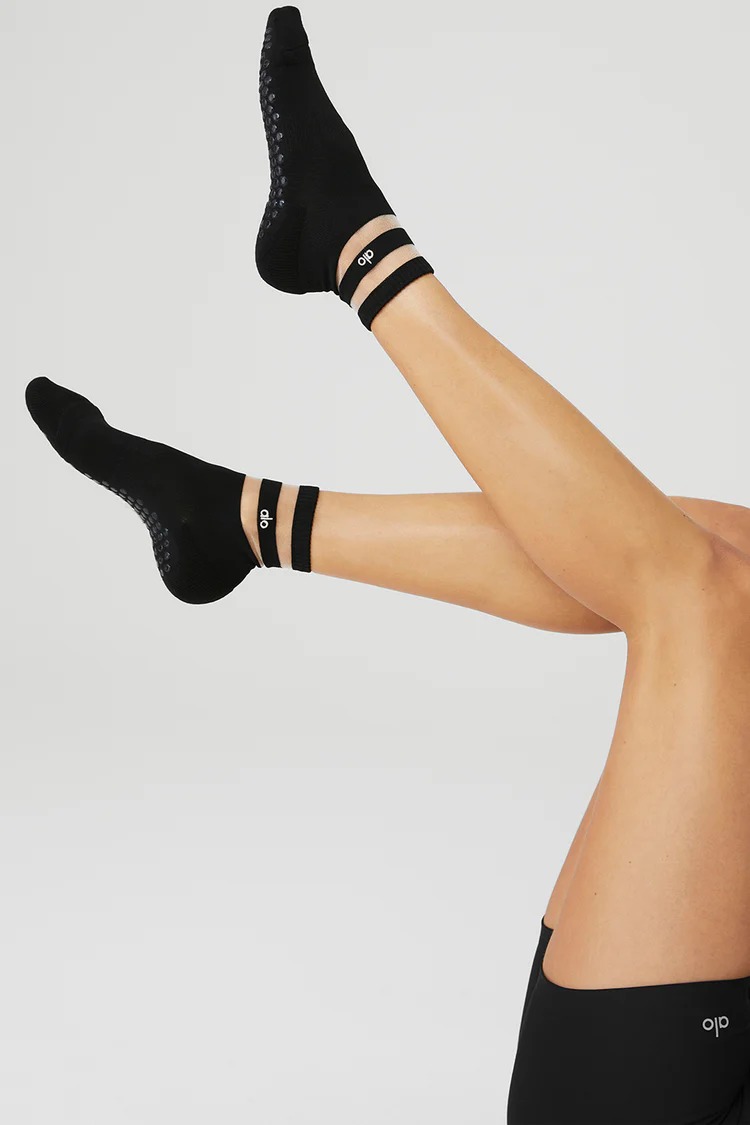
The practical limit of regular socks appears quickly once movement involves rotation, lateral shifts, or repeated steps. As soon as friction becomes inconsistent, regular socks stop providing reliable feedback and begin to feel slippery.
Grip socks reach their limit later. Their effectiveness declines when grip elements wear down, pick up debris, or no longer match the movement pattern. The key difference is that regular socks fail abruptly, while grip socks tend to lose effectiveness gradually.
A common misunderstanding is that grip socks feel different simply because they are “stickier.” In practice, the difference in feeling is not about maximum grip, but about how traction behaves as movement changes.
Regular socks create a smooth fabric-to-floor interface that can feel comfortable at rest. Grip socks, however, introduce intentional contact zones that interrupt uncontrolled sliding. This is why grip socks often feel more stable rather than more restrictive. The sensation comes from reduced unpredictability, not from excessive resistance.
The difference between grip socks and regular socks becomes most noticeable during moments of transition. These include shifting weight from one foot to the other, rotating on the forefoot, or correcting balance mid-movement.
During slow, straight-line motion, both types of socks may feel similar. Once movements become faster or less controlled, regular socks tend to lose friction suddenly, while grip socks maintain a more consistent response. This contrast is what makes the difference feel immediate and obvious to many users.
At first, the difference between grip socks and regular socks feels like a performance issue. Movements feel less confident, balance adjustments take longer, or transitions require extra caution. Over time, this performance gap can become a safety risk.
When traction changes unpredictably, the body compensates by altering joint angles, timing, or load distribution. These micro-adjustments increase the chance of misalignment during rotation or landing. What begins as a slight slide can lead to delayed reactions, loss of balance, or strain, especially in repeated indoor training sessions.
For regular socks, effectiveness usually ends abruptly. A single unexpected slide or hesitation during a familiar movement is often the first clear signal. Once this happens, traction reliability cannot be restored without changing conditions or footwear.
Grip socks provide clearer warning signs. Reduced responsiveness, visible wear on contact zones, or the need to slow down movements to maintain control indicate declining effectiveness. The key difference is that grip socks allow users to recognize the problem before traction failure becomes sudden or unsafe.
Grip socks feel more secure because they introduce intentional contact points that limit uncontrolled sliding between the foot and the floor during movement.
No. Regular socks can feel fine during slow or linear movement, but their traction becomes unpredictable once movement involves rotation or repeated transitions.
No. The main difference is traction consistency over time, not maximum grip strength.
Regular socks should be avoided once indoor activities involve balance challenges, directional changes, or higher movement frequency.
The way grip socks and regular socks feel different is ultimately linked to how traction and stability interact under changing conditions. For a system-level breakdown of these mechanisms, see how grip socks perform and what affects traction and stability in indoor environments.
Once you understand why regular socks can feel unpredictable under load, the next step is seeing how grip performance changes when the contact area is engineered differently—see full-sole grip socks vs half-sole grip socks.

 Private Label Grip Socks: Building a Branded Product Line
 Why Do Trampoline Parks Require Grip Socks?
 Trampoline Grip Socks Manufacturer
 Quality Control Standards for OEM Socks