
Behind every pair of high-quality custom socks is a production workflow designed to balance precision, efficiency, and scalability. For brands sourcing through OEM or ODM partnerships, understanding this workflow is essential—not only to evaluate suppliers, but to plan lead time, manage risk, and maintain consistent quality as volumes grow.
This article provides a structured overview of the custom sock manufacturing workflow, from raw yarn preparation to finished goods, explaining how professional factories translate design concepts into repeatable, large-scale production.
In modern sock factories, production is no longer a linear, workshop-style operation. Instead, it functions as an integrated system where each stage feeds the next with defined standards and checkpoints.
A reliable workflow is less about speed and more about consistency under scale.
The workflow begins long before machines start knitting. Yarn selection, storage, and preparation establish the foundation for product performance and visual consistency.
Proper material control reduces variation in hand feel, elasticity, and color—critical factors for retail and branded programs.
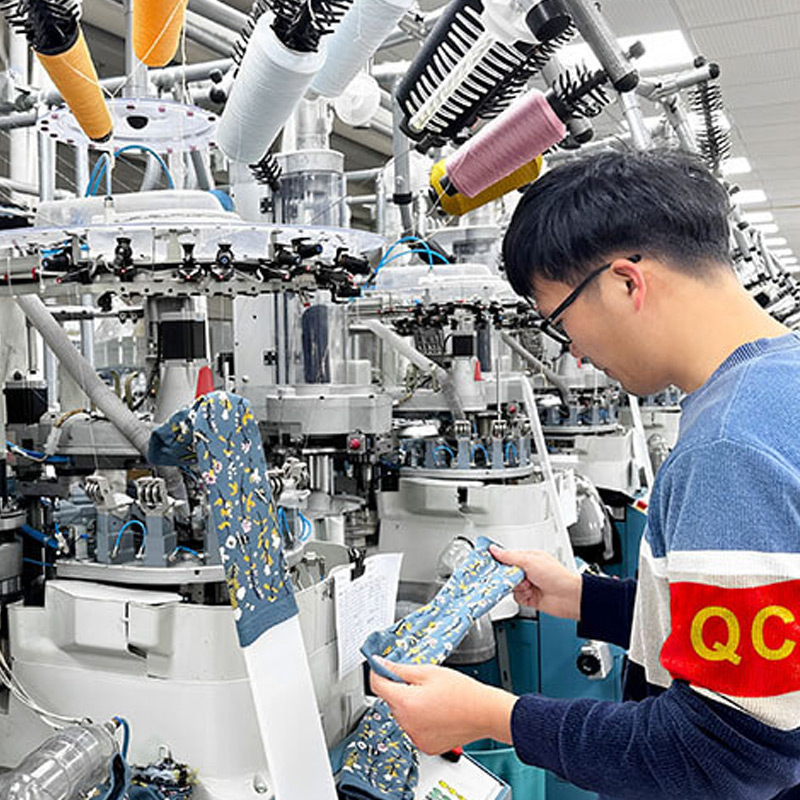
Knitting is the core transformation stage, where digital designs become physical products. Professional factories operate multi-gauge circular knitting machines, typically ranging from 108N to 200N, to support different product categories.
Machine selection affects not only appearance, but also durability, breathability, and production speed.
After knitting, socks move to the linking stage, where toe seams are closed. This step has a direct impact on comfort and perceived quality.
For grip socks and performance styles, precise linking ensures the sock maintains its intended fit and feel during movement.
Boarding defines the final shape and dimensions of each sock. Using steam and heat, socks are set on size-specific boards aligned with target markets.
This stage plays a key role in ensuring shelf-ready appearance and uniformity.
Quality control is not limited to final inspection. Instead, it is distributed throughout the workflow to catch issues early.
For functional socks, additional testing may include grip durability (>50,000 cycles), wash resistance (>100 washes), and color fastness (Grade 4–5).
Once approved, socks move to packaging lines designed to support both retail and e-commerce requirements.
A well-structured workflow enables predictable lead times and smoother scaling. Sampling, bulk production, and repeat orders all rely on the same underlying system.
For brands, the production workflow is more than an operational detail—it reflects a factory’s maturity and reliability. A transparent, disciplined workflow supports repeat orders, seasonal planning, and long-term cooperation.
Understanding this process allows buyers to communicate more effectively with manufacturers and build supply chains that grow sustainably over time.

 Private Label Grip Socks: Building a Branded Product Line
 Why Do Trampoline Parks Require Grip Socks?
 Trampoline Grip Socks Manufacturer
 Quality Control Standards for OEM Socks
