
In the performance sock world, the “product” is not just yarn and a logo—it is the repeatability of a manufacturing chain. When buyers compare grip socks for Lululemon Studio-style workouts, trampoline parks like Sky Zone, or fast-moving retail programs similar to Decathlon, the differences are rarely visible in a single product photo. They show up later: after dozens of washes, during high-friction pivots, or in the customer complaints that quietly erode a listing’s rating.
This is why the four-stage workflow—knitting → linking → boarding → packaging—matters more than most first-time buyers expect. Each stage influences fit, hand-feel, appearance consistency, and functional durability. In OEM/ODM production, the chain also determines whether a factory can scale without drifting away from your approved sample.
In a reliable sock supply chain, quality is not “added at the end.” It is engineered into the flow—from needle selection to seam construction, from shaping to retail-ready packaging control.
At Yuintal, the goal is to make this chain measurable and manageable for buyers: consistent gauge control across 108N–200N knitting capacity, grip performance designed for real use cases, and finishing standards aligned with global retail and e-commerce requirements. The result is not a marketing promise; it is a manufacturing logic that supports quantified performance targets such as grip durability >50,000 cycles, color fastness 4–5, and wash durability >100 washes for properly specified programs.
This step-by-step process is part of our complete Production Workflow for Custom Socks , which outlines how OEM/ODM sock manufacturing scales from sample to bulk production.
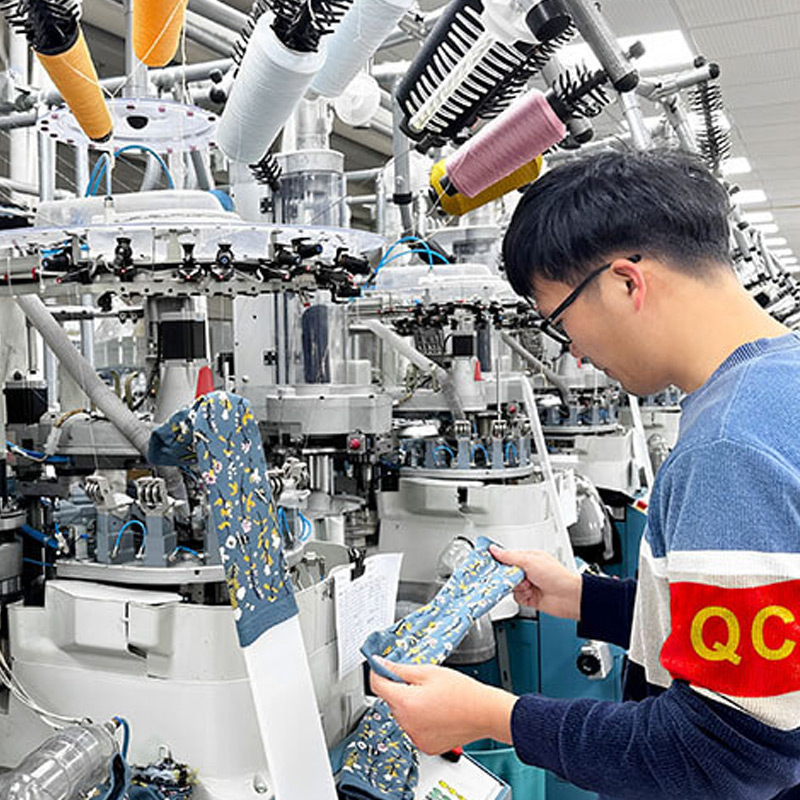
Knitting is the foundation layer: structure, stretch, breathability, and pressure distribution are decided here. In grip socks, the knit must carry two sometimes competing requirements—comfort and stability—while also creating a stable substrate for grip application later.
Gauge (needle count) is often reduced to a simple “finer vs thicker” conversation, but in reality it is a control lever for repeatability and product positioning. A factory that supports 108N–200N machines can engineer multiple tiers within a brand range, from durable trampoline park socks to premium studio socks that emphasize softness and a clean silhouette.
From a buyer’s perspective, the takeaway is practical: the same “design” can behave differently depending on gauge. If your product is meant to feel lightweight and premium, the knitting specification should reflect that early—not patched later with finishing tricks.
Functional socks live or die by recovery. If a cuff loses elasticity, the best grip pattern becomes irrelevant. If a footbed pills aggressively, the sock feels “old” too quickly. Knit engineering therefore needs to translate your brand promise into material and structure choices.
For OEM/ODM projects, this stage is also where “customization” becomes real. A custom grip sock is not only a logo; it can be a tuned fit profile (arch compression, heel pocket definition), a specific thickness map, or a ventilation strategy—built through knitting decisions, not only surface decoration.
In a large order, small knitting errors become expensive. A minor pattern drift can turn into thousands of pairs that fail visual inspection. A tension issue can cause size variance that leads to returns and negative reviews. This is why knitting QC is typically embedded inline rather than treated as a final-stage issue.
Linking (toe closing) is one of those steps that buyers don’t think about until they receive customer feedback. For grip socks used in barre, yoga, pilates, or studio training, the toe area is a comfort hotspot. A bulky seam can distract during movement and can become a repeat complaint, especially for premium buyers.
The point is not that one method is always superior—it is that the chosen method must match the product promise. Premium studio socks, especially those that compete with “quiet luxury” athleisure positioning, often justify a higher standard here.
Linking is also structural. A toe closure that fails early turns a sock into a short-life product, no matter how durable the grip is. In high-friction use (think trampoline parks where users land and pivot repeatedly), toe closure durability becomes a functional requirement.
Factories that treat linking as a controlled process—training operators, standardizing stitch types, and conducting seam pull tests—reduce this risk. It also improves consistency across styles when multiple designs run in parallel.
From a production standpoint, linking is a capacity bottleneck if not planned well. It is also a variability risk if the skill level varies across operators. Good workflow design clusters similar products together and applies consistent seam standards. That helps maintain both comfort and throughput, supporting lead time stability as orders scale.
Boarding (shaping/setting) is the finishing step that turns a knitted “textile tube” into a stable retail product. For brands, this is where the sock begins to look like it belongs on a shelf—or in a premium e-commerce product photo.
For OEM/ODM buyers, boarding is also an insurance policy against “silent variance.” Even if knitting is consistent, finishing inconsistency can cause a sock to feel different in hand or look different in photos.
Performance socks are judged by how they behave after washing. A finishing process that stabilizes the structure supports goals like wash durability >100 washes (when matched with proper material specs and care standards). It also helps preserve fit over time: cuffs, arches, and heel pockets should recover rather than relax.
Packaging is often seen as a branding layer, but in modern supply chains it is also a compliance and logistics layer. A sock that looks excellent but ships with inconsistent barcodes, incorrect labeling, or non-compliant polybags can cause costly delays—especially for retail programs and FBA-style fulfillment pipelines.
For OEM/ODM buyers, the key is that packaging is not a single decision—it is a controlled process with checkpoints: correct SKU mapping, barcode verification, label placement, and batch traceability.
Grip socks have one more variable: the grip itself. Packaging must protect the grip surface from contamination, deformation, or unintended adhesion during transit and storage. When grip patterns are customized, different compounds and textures can behave differently under heat or compression. A factory that understands this will design packaging steps to minimize risk.
When properly specified and tested, grip programs can target durability benchmarks such as >50,000 cycles in abrasion-style grip testing. Packaging does not “create” that durability, but it can preserve the grip surface so the product reaches the end user in the intended condition.
Across global programs, packaging frequently intersects with:
To make planning easier, it helps to view these steps as an integrated system rather than four isolated checkpoints. In a stable manufacturing workflow, the handoffs between stages are designed to reduce variability, not amplify it.
| Stage | Primary Output | What Buyers Feel/See | Typical Risks if Uncontrolled |
|---|---|---|---|
| Knitting | Structure, fit profile, base comfort | Hand-feel, breathability, stretch, silhouette | Size drift, tension variance, pilling, inconsistent compression |
| Linking | Toe closure quality | Toe comfort, premium feel, reduced irritation | Bulky seams, seam failure, high return rates |
| Boarding | Shape set, size consistency | Retail appearance, photo consistency, stable grading | Over/under-setting, inconsistent size, altered elasticity |
| Packaging | Retail-ready / warehouse-ready units | Brand presentation, scanability, shipping reliability | Barcode errors, label non-compliance, grip surface contamination |
Many buyers think customization begins at the logo stage. In practice, customization can exist in every step of this chain:
This is also where a factory’s workflow maturity shows. Fast sampling is not simply speed; it is the ability to turn design intent into repeatable specs. With modern capacity planning and controlled steps, factories can support rapid prototype iterations while keeping the path to bulk production consistent.
In the Cluster 6 context (Manufacturing Workflow & Lead Time), it’s important to see how each stage affects delivery windows. Knitting is often the “headline” capacity, but linking and finishing can become the true constraints. Packaging adds a final dependency—especially for retail programs that require strict labeling and carton logic.
As a result, predictable lead times come from workflow design, not from one single capacity number. This is why experienced buyers evaluate not only “how many machines” a factory has, but how the factory organizes flow, prevents bottlenecks, and stabilizes qua
 Private Label Grip Socks: Building a Branded Product Line
 Why Do Trampoline Parks Require Grip Socks?
 Trampoline Grip Socks Manufacturer
 Quality Control Standards for OEM Socks