
Verdict: It depends on whether traction needs to move with the user or stay fixed to the floor. Anti-slip floor mats usually work well in defined areas where foot placement is predictable. Grip socks tend to work better when movement involves transitions, changes in direction, or multiple surfaces. The difference becomes noticeable once traction needs to remain consistent beyond a single standing zone.

This question usually arises in indoor environments where slipping has occurred despite the presence of traction aids. Anti-slip floor mats are often placed in specific areas, while grip socks are worn throughout a space. Both can feel effective in isolation, which leads to uncertainty about which option provides more reliable traction during everyday movement.
The comparison is not about which solution feels more secure at a single point. It is about how traction behaves as people move beyond fixed locations.
| Factor | Grip Socks | Anti-Slip Floor Mats |
|---|---|---|
| Traction during movement | Consistent as the user moves | Limited to the area where the mat is placed |
| Stability during rotation | Maintains traction during pivots and turns | Effective only when both feet remain on the mat |
| Surface sensitivity | Moderate sensitivity across indoor floors | Highly dependent on placement and floor adhesion |
| Typical use cases | Movement across rooms and changing directions | Standing zones such as kitchens or entryways |
| Failure conditions | Gradual grip reduction over time | Sudden loss of traction outside the mat area |
Compared to footwear-based solutions, anti-slip floor mats provide localized traction that does not move with the user. Grip socks act as a wearable traction interface, maintaining contact between the foot and the floor across different spaces. When compared to fixed solutions, wearable options tend to handle transitions more reliably.
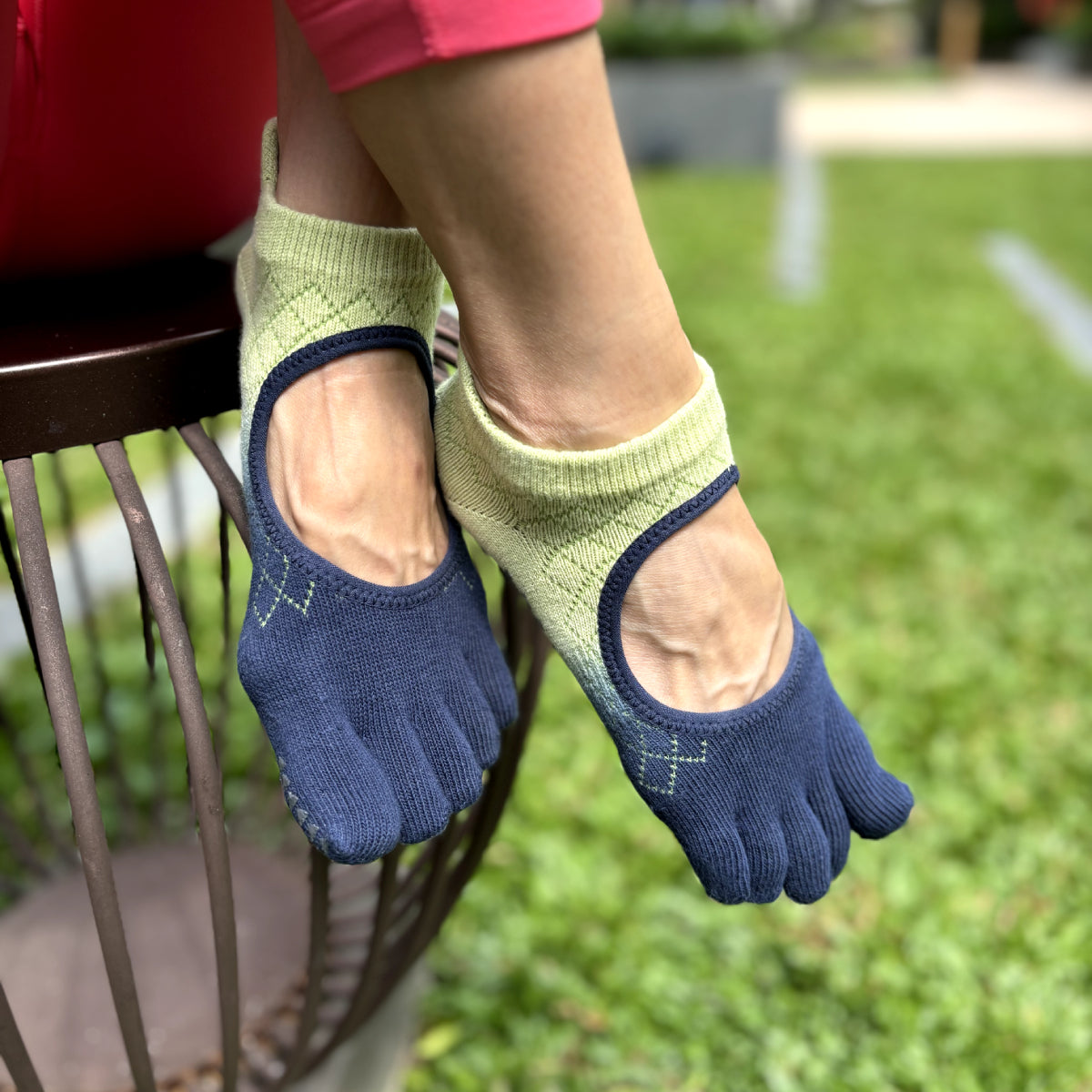
Anti-slip floor mats reach their practical limit once movement extends beyond their coverage area. Grip socks reach their limit later, usually when grip elements wear down or when contamination reduces traction consistency. The practical limit is defined by when traction becomes unpredictable during normal movement.
A common misunderstanding is that adding more fixed traction points automatically improves safety. In reality, traction that does not move with the user can create gaps in protection. Grip socks and floor mats address different problems, and neither replaces the other in all situations.
The difference between grip socks and anti-slip floor mats becomes most noticeable during transitions between rooms, turns, or partial steps off a mat. On smooth floors, traction gaps appear when one foot leaves the mat while the other continues moving. What feels secure while standing can become unreliable once movement extends beyond a fixed area.
It often begins as a performance issue and becomes a safety risk when slipping is unexpected. Losing traction when stepping off a mat or during a turn can disrupt balance and reaction timing. The risk is determined by how predictable traction remains as movement changes, not by the presence of a single traction aid.
Warning signs include hesitation when stepping beyond a mat, subtle sliding during transitions, or adjusting stride to stay within a traction zone. For grip socks, reduced grip feedback or uneven traction indicates declining effectiveness. For floor mats, curling edges or shifting placement signal reduced reliability.
They are usually safer during movement across rooms or changing directions because traction moves with the foot.
No. They reduce slipping only within their coverage area and do not protect transition zones.
Not always. Floor mats still help in fixed standing areas, while grip socks address movement-related traction needs.
They become less effective when they shift, curl, or when movement frequently occurs outside their coverage area.
This comparison focuses on decision-level differences rather than installation or material details. For a system-level explanation of how traction and stability behave across indoor surfaces and movement patterns, see how grip socks perform and what factors affect traction and stability .
If you’re evaluating different “anti-slip” approaches, it’s useful to separate general anti-slip features from engineered grip behavior—see grip socks vs non-slip socks: what’s the real difference.

 Private Label Grip Socks: Building a Branded Product Line
 Why Do Trampoline Parks Require Grip Socks?
 Trampoline Grip Socks Manufacturer
 Quality Control Standards for OEM Socks