This checklist defines what should be monitored in a grip socks maintenance program and how risk signals appear over time. It explains inspection logic and performance implications, not operational steps.
Quick Answer
This is a grip socks maintenance checklist. It outlines what conditions should be monitored, what early warning signals look like, and why those signals matter for performance consistency and safety. It does not explain how to wash, repair, or measure grip socks. Instead, it defines the inspection framework used to manage wear, degradation, and risk over time.
What Maintenance Means in a Professional Context
In professional and commercial environments, maintenance does not simply mean cleaning. A grip socks maintenance program exists to preserve predictable traction behavior and reduce safety variability across repeated use, shared surfaces, and changing conditions.
Unlike casual care advice, a maintenance checklist focuses on identifying when performance begins to drift, when degradation becomes irreversible, and when continued use introduces elevated safety risk. The checklist acts as an early warning system rather than a corrective instruction.
How a Maintenance Program Is Structured
A grip socks maintenance program typically operates across the product lifecycle rather than individual sessions. Early stages focus on baseline condition monitoring, mid-life stages emphasize consistency and contamination signals, and later stages concentrate on failure thresholds and risk escalation.
The checklist functions as the central control layer of this program. It standardizes what is observed and how condition changes are interpreted, allowing different users, instructors, or facilities to identify risk in the same way.
Key Maintenance Checklist Dimensions
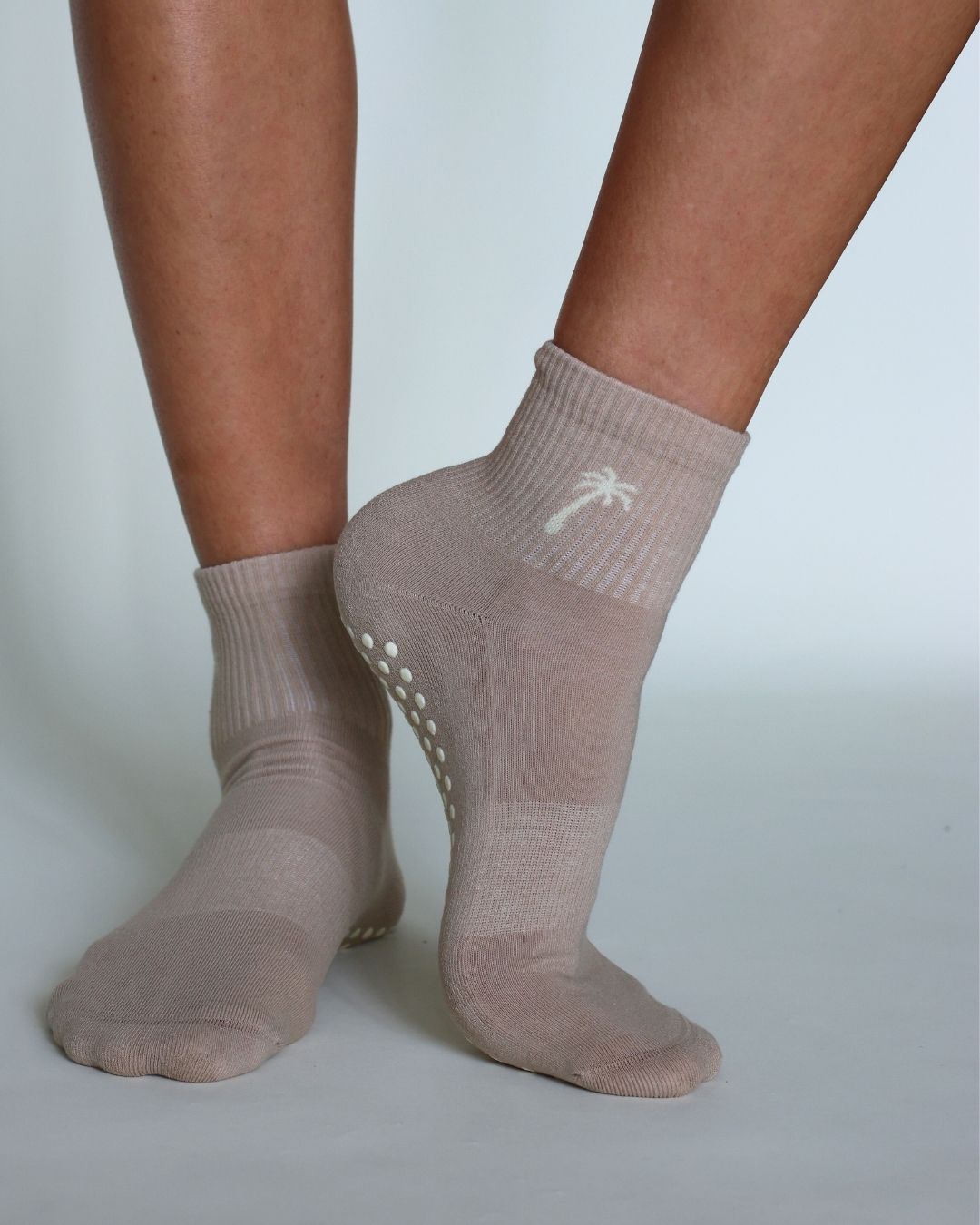
- Grip element condition
- What to check: Surface integrity and uniformity of grip elements.
- Normal signal: Grip elements appear intact with consistent texture.
- Warning signal: Flattening, peeling, or uneven responsiveness.
- Why it matters: Irregular grip response increases traction unpredictability during transitions.
- Surface contamination buildup
- What to check: Presence of residue, film, or embedded debris on grip areas.
- Normal signal: Grip surface maintains direct contact characteristics.
- Warning signal: Reduced responsiveness despite unchanged structure.
- Why it matters: Contamination alters friction behavior and masks true wear state.
- Elastic recovery and fit stability
- What to check: Ability of the sock to maintain original fit under load.
- Normal signal: Sock remains stable without noticeable slippage.
- Warning signal: Gradual loosening or inconsistent foot contact.
- Why it matters: Fit drift changes pressure distribution and traction control.
- Traction consistency across movements
- What to check: Grip behavior during directional changes and load shifts.
- Normal signal: Predictable resistance with smooth release.
- Warning signal: Micro-slips or delayed response during transitions.
- Why it matters: Inconsistent traction increases joint stress and reaction delay.
- Structural integrity
- What to check: Seams, knit structure, and overall fabric cohesion.
- Normal signal: Structure remains uniform without distortion.
- Warning signal: Localized thinning or deformation.
- Why it matters: Structural weakness accelerates performance loss under repeated load.
When Maintenance Can No Longer Preserve Performance
Maintenance has limits. Once grip elements lose structural responsiveness, or fit instability becomes persistent, performance degradation becomes non-reversible through care alone.
At this boundary, continued use no longer presents a gradual decline but a step change in safety risk. The checklist helps identify this transition before unpredictable traction behavior leads to injury or operational liability.
Common Questions About Maintenance Programs
Is this checklist meant for individual users or facilities?
The checklist is designed for program-level use, allowing consistent interpretation across individuals, studios, or commercial settings.
Does a clean sock always mean a safe sock?
No. Cleanliness does not guarantee traction consistency or structural reliability.
Can maintenance fully prevent performance degradation?
Maintenance slows degradation and identifies risk early, but it cannot eliminate material aging.
Why a Maintenance Checklist Matters
A grip socks maintenance checklist is not about prolonging use at all costs. Its role is to define when performance remains predictable and when risk begins to increase.
By focusing on inspection signals rather than corrective actions, the checklist supports consistent decision-making, safer environments, and clearer accountability throughout the product lifecycle.

Yuintal Insights Team
Strategic content and industry insights from the Yuintal editorial research team.
Our editorial team specializes in in-depth analysis of sock manufacturing, sourcing decisions, and supply-chain design. We empower procurement leaders, brand owners, and OEM/ODM partners with practical frameworks and evidence-driven perspectives to support better decisions.