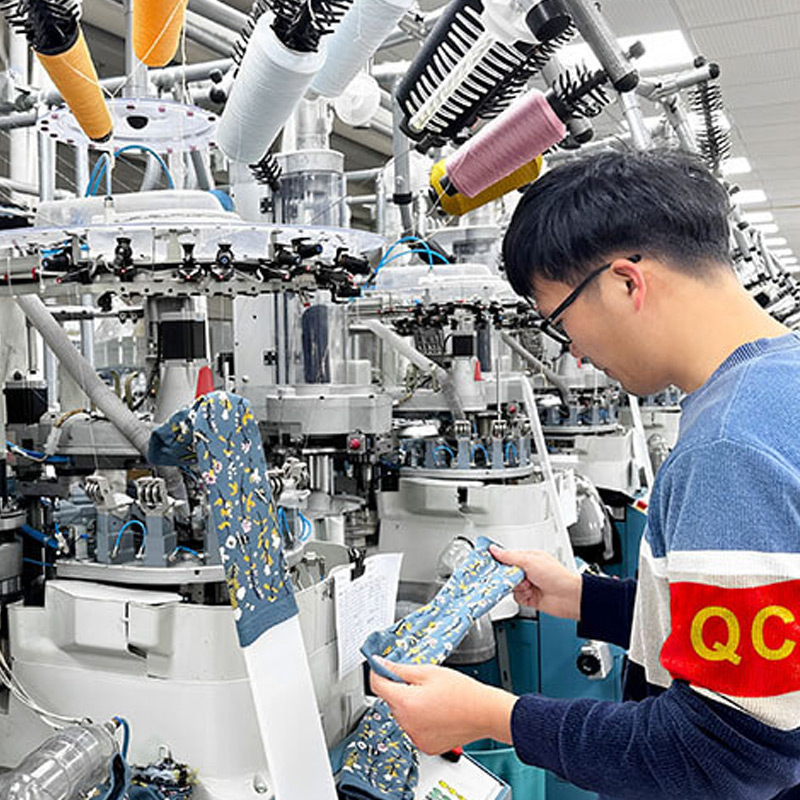
Grip Socks Factory in China
Yuintal is a grip socks factory in Shanghai, China, operated by Shanghai Yuintal Knitting Limited. With 13+ years of sock manufacturing experience, a 5,200㎡ production facility, and 220 computerized knitting machines, the factory supports B2B grip sock production for brands, studios, distributors, importers, trampoline parks, indoor playgrounds, fitness businesses, and other commercial buyers.
Factory operations support sock knitting, custom product development, silicone sole grip application, logo and branding execution, sample development, quality inspection, packaging, bulk manufacturing, and repeat-order production. Standard custom programs can start from 500 pairs per design, depending on the product structure and customization requirements.
- Shanghai-based grip socks manufacturing facility
- 13+ years of sock manufacturing experience
- 5,200㎡ production facility
- 220 computerized knitting machines
- Custom sock construction and silicone grip production
- Sample development before bulk manufacturing
- OEM, ODM, and private label production support
- Bulk and repeat-order manufacturing for B2B buyers
Yuintal Grip Socks Factory Overview
For international B2B buyers, evaluating a grip socks factory in China should begin with the actual manufacturing operation rather than only the product catalog. The important questions are where the products are made, what production equipment is available, which processes are controlled by the factory, how samples move into bulk production, and how repeat orders are kept consistent.
Yuintal's manufacturing operation is based in Shanghai, China. The factory supports grip sock production from knitting through sole grip application, finishing, inspection, and packaging, with product development support for customized commercial programs.
This page focuses specifically on the factory and production environment. Buyers who first need a broader overview of Yuintal as a manufacturing company can review our grip socks manufacturer overview. Buyers already preparing a defined OEM project can instead review our OEM grip socks manufacturing services.
The distinction matters because factory evaluation and OEM project execution answer different sourcing questions. A buyer may first determine whether a factory has the infrastructure and production control required for long-term cooperation, and only then move into detailed product development.
Grip Socks Factory Facts at a Glance
The following factory facts provide a concise reference for buyers evaluating Yuintal's production base.
| Legal Company | Shanghai Yuintal Knitting Limited |
|---|---|
| Brand | Yuintal |
| Factory Location | Shanghai, China |
| Manufacturing Experience | 13+ years |
| Production Facility | 5,200㎡ |
| Knitting Equipment | 220 computerized knitting machines |
| Primary Product | Grip socks and anti-slip socks |
| Manufacturing Model | OEM, ODM, and private label production |
| Standard Custom MOQ | From 500 pairs per design, depending on customization |
| Sample Development | Typically 3–7 days after key specifications are confirmed |
| Core Factory Processes | Knitting, branding, sole grip application, finishing, inspection, and packaging |
| Typical B2B Buyers | Brands, studios, distributors, importers, venue operators, and commercial buyers |
These figures are more useful for factory evaluation than generic statements such as “large production capacity” because they identify the physical manufacturing resources behind the operation.

Grip Socks Production Infrastructure
Grip socks manufacturing combines textile knitting with additional processes that ordinary socks may not require. The sock body must first be produced to the approved construction and size specification, after which branding, anti-slip grip application, finishing, inspection, and packaging are completed according to the project.
Computerized Knitting Equipment
Yuintal operates 220 computerized knitting machines. Computerized production allows sock structures, sizing, colors, patterns, and selected branding elements to be manufactured according to programmed specifications.
Depending on the product design, knitting variables may include:
- Sock height and overall construction
- Cuff and elastic structure
- Size grading
- Arch support zones
- Cushioning
- Ventilation or mesh areas
- Heel and toe reinforcement
- Knitted colors and patterns
- Selected knitted branding elements
Why Equipment Scale Matters
The number of machines alone does not determine product quality, but production infrastructure affects how a factory organizes different sizes, colors, product specifications, sampling work, and repeat orders.
For B2B sourcing, equipment should therefore be evaluated together with specification control, workflow organization, quality inspection, and the ability to reproduce approved products over time.
Grip Socks Require More Than Knitting
A knitted sock is only one stage of a grip socks manufacturing process. The anti-slip sole introduces additional requirements involving grip artwork, material application, pattern positioning, curing, appearance inspection, and product finishing.
This is why a factory producing grip socks needs a workflow that coordinates the textile product and the sole grip system as one finished specification.
How Grip Socks Move Through the Factory
A clear production flow helps buyers understand which steps occur between an approved sample and a packed bulk order. The exact sequence can vary with product construction and customization, but a typical grip socks factory workflow includes the following stages.
- 1. Production Specification Confirmation
The approved product specification, size structure, colors, materials, artwork, sole grip pattern, labels, packaging, and order quantity are confirmed before bulk production. - 2. Material Preparation
Required yarns, elastic components, grip materials, labels, and packaging materials are prepared for the production run. - 3. Sock Knitting
Computerized knitting machines produce the sock body according to the approved construction and size requirements. - 4. Initial Finishing & Inspection
Knitted socks are checked for obvious construction, appearance, and size issues before moving into later processes. - 5. Branding Application
Project-specific branding is applied according to the confirmed method and artwork. - 6. Sole Grip Application
The approved silicone grip layout is applied to the sole according to the required pattern, position, and coverage. - 7. Curing & Finishing
The grip application is processed and finished before final product inspection. - 8. Final Inspection
Finished grip socks are checked against the approved product and order requirements. - 9. Packaging
Products are packed according to the confirmed retail, commercial, institutional, or distribution specification. - 10. Shipment Preparation
Cartons, quantities, markings, packing information, and export shipment details are prepared before dispatch.
The purpose of this workflow is not simply to move products quickly through the factory. Each stage creates an opportunity to keep the finished order aligned with the approved specification.
Sole Grip Application & Production
The sole grip system is the main feature that separates grip socks from ordinary socks. From a factory perspective, the grip layer needs to be treated as a production process rather than only a visual design element.
Grip production involves artwork preparation, pattern positioning, material application, curing, appearance control, and final inspection. The exact method can vary depending on the approved design, product structure, and intended use.
Grip Pattern Preparation
Before production, the approved sole artwork needs to be converted into a practical manufacturing layout. The factory reviews the design for pattern size, line thickness, spacing, sole coverage, logo detail, and positioning.
Common grip layouts may include:
- Dot patterns
- Line patterns
- Geometric layouts
- Zoned traction areas
- Logo-integrated grip patterns
- Custom customer-developed artwork
Grip Placement and Coverage
The grip pattern should follow the approved sole position and coverage area. During production, placement needs to remain visually consistent across the order so that the grip does not shift significantly between pairs.
Coverage can also be adjusted according to the product specification. A studio sock, trampoline park sock, healthcare anti-slip sock, and fitness grip sock may not require exactly the same sole layout.
Curing and Finishing
After the grip material is applied, the product moves through the required curing and finishing process. This stage is important because incomplete processing can affect the appearance and attachment of the sole grip.
After curing, socks are reviewed before they move into final inspection and packaging.

Factory Quality Control System
A grip socks factory should not rely only on a final visual inspection. Quality control begins with the approved specification and continues through materials, knitting, grip application, finishing, packaging, and shipment preparation.
For B2B buyers, the purpose of factory quality control is to keep bulk production aligned with the approved sample and reduce avoidable variation between products and repeat orders.
Incoming Material Checks
Before and during production, materials should be checked against the confirmed project requirements. Depending on the order, this can include yarns, elastic components, grip materials, labels, packaging materials, and other customized components.
Knitting Inspection
- Sock construction
- Size consistency
- Heel and toe formation
- Cuff and elastic appearance
- Knitting defects
- Color consistency
- Pattern and branding alignment where applicable
Grip Inspection
- Grip pattern position
- Pattern completeness
- Visible application consistency
- Logo or artwork alignment
- Surface appearance
- Obvious curing or adhesion defects
Packaging Inspection
For customized orders, quality control also extends to labels, hang tags, size markings, barcode information, retail packaging, carton markings, and packing quantities.
Final Order Inspection
Before shipment, finished products are checked for visible defects, incorrect sizes, mismatched pairs, branding errors, packaging mistakes, and other deviations from the confirmed order specification.

From Sampling to Bulk Production
One of the most important factory capabilities is the ability to move a product from development into repeatable bulk production without losing the approved specification.
Yuintal supports sample development before bulk manufacturing. Typical sample development is generally 3–7 days after the main product specifications, artwork, and required materials are sufficiently confirmed.
Sample Stage
The sample is used to review the key product variables before the full order is released. These may include:
- Sock construction
- Size and fit
- Material direction
- Color
- Logo position
- Grip pattern and placement
- Packaging structure
- Overall workmanship
Approval Stage
Any requested revisions should be documented clearly. Once the buyer approves the final version, the product specification and sample become the reference for bulk production.
Bulk Production Stage
The factory then prepares materials and production according to the approved order. Bulk production should follow the same key construction, sizing, branding, grip, and packaging requirements confirmed during development.
Buyers with a defined custom project can review the more detailed OEM grip socks manufacturing workflow.
Repeat-Order Manufacturing
Factory evaluation should not stop with the first order. Many B2B buyers need replenishment over months or years, so the ability to reproduce an approved product is an important part of manufacturing reliability.
Repeat production is supported by keeping approved references connected to the project, including:
- Final sock construction
- Size specification
- Material direction
- Approved colors
- Logo artwork
- Grip pattern
- Packaging files
- Size ratios
- Carton and packing requirements
What Still Needs Reconfirmation
Even when the product itself is unchanged, a repeat order should reconfirm quantity, size ratios, colors, packaging quantities, required delivery timing, and any material or artwork updates.
This helps distinguish a true repeat order from a new development project and reduces unnecessary changes between production runs.
China Supply Chain Advantages for Grip Socks Production
China's value as a grip socks manufacturing base is not simply lower production cost. For B2B buyers, the more important advantage is the ability to coordinate multiple manufacturing inputs within an established textile, packaging, and export supply chain.
A grip socks order can involve more than one material or process, including yarns, elastic components, silicone grip material, printed labels, hang tags, retail packaging, cartons, and logistics preparation.
Integrated Textile Supply
Access to established textile and knitting supply chains can make it easier to coordinate yarn selection, color development, elastic components, and related production materials.
Packaging Support
Commercial grip socks programs may require customized packaging such as hang tags, belly bands, polybags, printed cards, labels, barcode stickers, boxes, or inserts. Access to packaging suppliers allows these components to be coordinated with the sock production schedule.
Export Infrastructure
Yuintal is based in Shanghai, which provides access to international freight services and export infrastructure. For overseas buyers, this supports the transition from finished production into packing, documentation coordination, and shipment preparation.
Why Supply Chain Coordination Matters
A fragmented project can create delays when socks, labels, grip materials, and packaging are managed independently. A coordinated manufacturing workflow helps keep these components aligned with the same approved specification and delivery plan.
The advantage of sourcing from China should therefore be evaluated through manufacturing infrastructure, supply chain coordination, and repeat-order capability rather than price alone.
How Buyers Should Evaluate a Grip Socks Factory in China
Before selecting a long-term supplier, buyers should verify whether the factory can support the actual requirements of the project rather than relying only on product photos or a quotation.
A practical factory evaluation should cover production infrastructure, process control, sampling, quality management, customization capability, communication, and repeat-order consistency.
| Evaluation Area | What to Check | Why It Matters |
|---|---|---|
| Factory Identity | Legal company, factory location, manufacturing role | Confirms who is actually responsible for production |
| Production Equipment | Knitting machines and relevant production processes | Shows whether the factory has appropriate manufacturing infrastructure |
| Product Experience | Grip socks and anti-slip sock production experience | Reduces reliance on a factory learning the product from zero |
| Sampling | How samples are developed, revised, and approved | Shows whether specifications can be translated into a production reference |
| Grip Production | Pattern preparation, application, curing, and inspection | The sole grip is a critical part of the finished product |
| Customization | Construction, colors, sizing, logos, grip patterns, and packaging | Determines whether the factory can support the buyer's actual program |
| Quality Control | Incoming, in-process, grip, final, and packaging checks | Helps control deviations during bulk production |
| Specification Records | Approved samples, artwork, size specs, packaging references | Supports repeat-order consistency |
| MOQ Structure | MOQ per design and impact of colors, sizes, and customization | Helps buyers understand the real order structure |
| Repeat Orders | How previous specifications are reused and reconfirmed | Important for long-term B2B supply programs |
Ask for Specific Evidence
Instead of asking only “Are you a factory?”, buyers can ask for more specific information such as the factory location, equipment, sample process, production steps, grip application method, quality checkpoints, MOQ structure, and repeat-order control.
Specific questions produce more useful sourcing information than general claims such as “high quality,” “fast delivery,” or “competitive price.”
Compare the Factory Against Your Project
A factory does not need to be the largest supplier in the market to be suitable. The better question is whether its equipment, workflow, customization capability, MOQ structure, and quality controls match the size and complexity of the buyer's program.
Who Sources Directly from a Grip Socks Factory?
Different B2B buyers work with factories for different reasons. Some need product development and branding support, while others prioritize repeat-order consistency, size planning, packaging, or stable replenishment.
Pilates, Yoga & Barre Studios
Studios often source grip socks as branded retail products, membership accessories, or class-use merchandise. Typical requirements include comfortable fit, controlled traction, custom colors, logos, practical size ranges, and repeat ordering.
Trampoline Parks & Indoor Playgrounds
Commercial venues may need larger quantities, clear size identification, durable sole grip patterns, branded colors, and predictable replenishment. Factory-direct sourcing can also make it easier to standardize the approved product across future orders.
Fitness & Sports Brands
Brands may use factory manufacturing to develop differentiated sock structures, materials, cushioning, ventilation, grip layouts, and retail packaging for their own product lines.
Distributors & Importers
Distributors often focus on scalable order structures, mixed size ratios, packaging efficiency, consistent specifications, and the ability to repeat successful products over multiple purchase cycles.
Private Label Retailers
Private label buyers may require consistent branding across the sock body, sole grip, labels, hang tags, packaging, and future product extensions. Buyers focused specifically on brand execution can review our private label grip socks program.
Healthcare & Institutional Buyers
Institutional buyers may prioritize practical sizing, anti-slip coverage, comfort, easy identification, straightforward packaging, and repeat supply rather than complex consumer branding.
Frequently Asked Questions
Is Yuintal a grip socks factory in China?
Yes. Yuintal is operated by Shanghai Yuintal Knitting Limited in Shanghai, China. The manufacturing operation includes a 5,200㎡ production facility and 220 computerized knitting machines for grip socks and related sock programs.
What does Yuintal manufacture in its grip socks factory?
Yuintal manufactures grip socks and anti-slip socks for applications such as Pilates, yoga, trampoline parks, indoor playgrounds, fitness, healthcare, branded retail, and other B2B programs.
What is the standard MOQ for custom grip socks?
Standard custom programs can start from 500 pairs per design. Final MOQ depends on sock construction, colors, sizing, grip pattern, logo method, packaging, and other customization requirements.
Can buyers develop samples before bulk production?
Yes. Sample development is available before bulk production. Typical sample development is generally 3–7 days after the main specifications, artwork, and required materials are sufficiently confirmed.
Can Yuintal produce custom grip patterns and logos?
Yes. Grip layouts can be customized by shape, coverage, density, position, color, and branding. Logos can also be incorporated into the sock body, sole grip, labels, hang tags, or packaging depending on the approved project specification.
How should buyers evaluate a grip socks factory in China?
Buyers should verify the legal company, factory location, production equipment, sample process, grip application workflow, quality-control checkpoints, customization capability, MOQ structure, specification records, and repeat-order process rather than relying only on product photos or pricing.
Can Yuintal support repeat production?
Yes. Approved samples, specifications, artwork, grip layouts, size structures, packaging files, and other project references can be used to support repeat-order manufacturing planning.
Does Yuintal support OEM and private label projects?
Yes. Yuintal supports OEM, ODM, and private label grip socks manufacturing. Buyers with a defined product specification can review our OEM grip socks manufacturing services, while branding-focused projects can use our private label program.
Conclusion
Yuintal is a grip socks factory in Shanghai, China, with 13+ years of manufacturing experience, a 5,200㎡ production facility, and 220 computerized knitting machines. The factory supports B2B projects through knitting, grip application, branding, sampling, quality inspection, packaging, bulk production, and repeat-order manufacturing.
For international buyers, the value of a factory should be evaluated through its actual production infrastructure, workflow, specification control, quality system, and ability to reproduce an approved product over time.
Buyers who want to evaluate Yuintal at the broader company level can review our grip socks manufacturer overview. Buyers with a defined development project can continue to our OEM grip socks manufacturing services.