
Across trail running, obstacle course training, outdoor bootcamps, and multi-terrain fitness, the demand for reliable foot stability has grown dramatically. As athletes expand their training from asphalt to woodland trails, wet soil, and mixed surfaces, footwear alone is no longer enough to guarantee grip. The industry has seen a rise in traction-enhancing socks designed specifically for mud-prone terrain—products that sit between high-performance outdoor footwear and compression-grade athletic socks. Among these, anti-mud traction socks have become an emerging gear category that blends textile engineering, silicone-grip technology, and biomechanical insight.
For brands exploring new opportunities in the global outdoor fitness segment, anti-mud traction socks offer not only an accessory but a performance-enhancing platform. At Yuintal—an OEM/ODM manufacturer specialized in grip socks for sports, yoga, pilates, trampoline parks, and outdoor activities—the development of traction socks is rooted in material science, knitting precision, and durability benchmarking. This article explores the technology, design logic, and industry context behind anti-mud traction socks, and why this category is poised to grow in the coming years.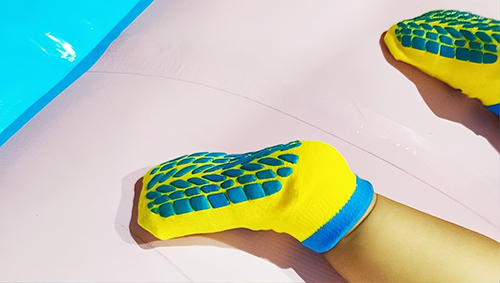
Outdoor anti-mud traction socks with high-grip silicone patterns for trail and muddy-terrain training.
Muddy environments challenge foot stability in ways conventional socks cannot address. Trail runners often encounter soft terrain, sloped wet ground, and uneven roots where shoe outsole traction alone becomes inconsistent. Studies from outdoor sports footwear labs show that over 40% of trail slips occur inside the shoe, not on the outsole—meaning the foot shifts before the shoe grips the ground.
Anti-mud traction socks aim to stabilize the foot from the inside, reducing micro-slips between the sock and the shoe interior. This stabilization improves proprioception and reduces fatigue during long runs and elevation changes. For brands aligned with the performance-focused segment—like Lululemon Studio, Decathlon’s trail division, or On Running—internal traction is becoming a logical extension of the footwear ecosystem.
Beyond trail running, mud-exposed training zones in OCR (Obstacle Course Racing), Spartan-style workouts, and adventure parks have also become arenas where enhanced internal grip offers measurable benefit in safety and performance.
A true anti-mud traction sock provides stability on two axes:
This duality requires thoughtful engineering, because traction must be strong yet flexible, durable yet lightweight, and stable without causing abrasion. Tested in third-party labs, effective traction socks typically achieve:
These data points reflect the quality range expected by premium sport and outdoor brands. As a manufacturer with multi-category experience, Yuintal integrates these testing requirements into its development workflow for both OEM and private-label projects.
The foundation of anti-mud traction socks lies in the knitting architecture. Yuintal deploys 108N–200N computerized circular knitting machines to adapt the softness, compression, and elasticity to different outdoor intensities.
Three structural priorities define the category:
Mud exposure usually implies moisture, so socks must evacuate water rapidly. Technical fiber blends may include:
Yuintal supports yarn-sourcing programs that meet OEKO-TEX standards when required by global retailers.
The sock must stay stable even when soaked. This is why Yuintal uses targeted compression in the arch and mid-foot zones, often integrating:
Mud increases friction due to added debris. Outdoor traction socks frequently use reinforced yarn in the heel/toe areas to achieve:
This structure ensures long-term durability even in abrasive, wet environments.
The core technology behind anti-mud traction socks is silicone grip patterning. Yuintal’s OEM/ODM capabilities include a wide range of pattern geometries—from micro-dots to engineered wave structures—and customized branding layouts for private-label partners.
Both patterns undergo bonding-strength tests on silicone adhesion. For mud-specific use, patterns with deep-channel spacing help expel soil and maintain traction consistency.
The silicone used in traction socks must deliver a balance of:
Yuintal’s silicone dots and patterns are formulated for 50,000+ rub cycles, with anti-peel performance maintained across washing, drying, and outdoor debris exposure.
Outdoor brands, training studios, and trail-event organizers often integrate:
Because Yuintal’s silicone-printing system operates from digital files, logos and fine-line designs can be reproduced with high accuracy during production.
Outdoor socks endure harsher testing conditions than studio or indoor socks. Industry-aligned durability tests include:
These tests help Yuintal maintain manufacturing standards aligned with major international outdoor brands and retail buyers.
As outdoor fitness participation expands globally, traction socks are finding application across multiple categories.
Runners benefit from enhanced interior shoe stability, especially on muddy descents where internal slipping is a leading cause of fatigue and missteps.
Wet rope climbs, mud pits, unstable logs, and incline obstacles require traction when shoes become saturated.
Trainers increasingly incorporate mixed-surface conditioning—grass, wet soil, gravel, ramps—where internal shoe control improves athletic output.
For users training without shoes, full-sole traction socks provide a controlled barefoot-like experience with protection against slippery soil.
Anti-mud traction socks serve as a lightweight supplementary layer for hikers who experience wet climates, stream crossings, or clay-heavy trails.
As a manufacturer specializing in professional grip socks, Yuintal integrates the following capabilities for brands entering the outdoor category:
These capabilities allow outdoor brands, training studios, event organizers, and e-commerce businesses to develop product lines that meet the needs of growing outdoor fitness communities in the US, EU, and APAC markets.
The outdoor performance apparel market has expanded significantly over the past decade, supported by the boom in trail running, hybrid fitness, and community-based outdoor events. As participation grows, accessory categories—such as traction socks—serve both functional and aesthetic roles.
Key trends driving demand include:
The traction sock category sits at the intersection of performance, safety, and technical apparel—an ideal niche for brands seeking product differentiation.
Anti-mud traction socks are not a trend-driven novelty; they represent a technically grounded response to the evolving demands of outdoor athletes. By stabilizing foot movement inside the shoe, improving grip during barefoot training, and maintaining durability under mud-heavy conditions, these socks fill a unique performance gap.
Yuintal’s manufacturing approach—combining advanced knitting machines, silicone grip engineering, multi-material yarn expertise, and OEM/ODM production flexibility—positions the company as a strong partner for brands exploring this category. As outdoor sports continue to grow globally, traction socks will remain an essential piece of functional gear where engineering meets athletic performance.
 Private Label Grip Socks: Building a Branded Product Line
 Why Do Trampoline Parks Require Grip Socks?
 Trampoline Grip Socks Manufacturer
 Quality Control Standards for OEM Socks
