Quick Answer
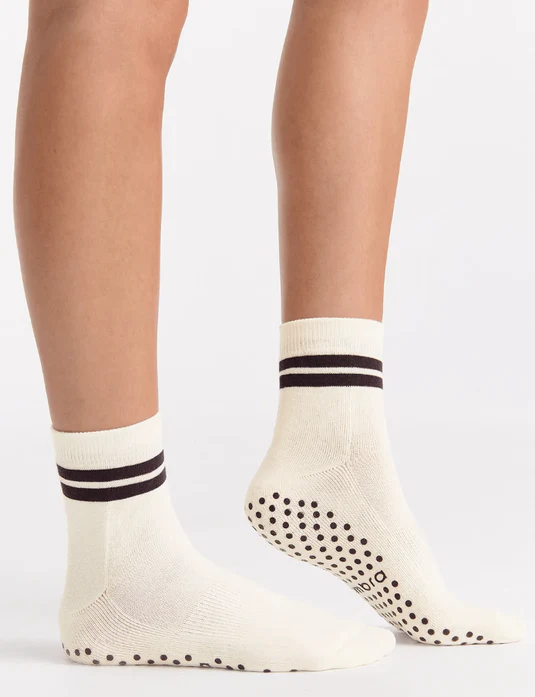
Grip socks are essential for balance-based activities because they stabilize the foot–surface interface, reducing unintended slippage during static holds and controlled weight shifts. This stability allows users to maintain balance with fewer corrective adjustments.
In balance-focused movements, loss of stability typically occurs through subtle foot displacement rather than full slips. Grip socks limit these micro-movements by maintaining consistent friction under changing load and posture.
- Grip socks stabilize foot contact, which reduces micro-movements during balance-based activities.
- Consistent friction supports balance by limiting unintended foot displacement.
Expanded Definition
Balance-based activities are defined by prolonged static positions, slow transitions, and controlled shifts in body weight. These movements rely on continuous alignment between the body and the supporting surface, making foot stability a critical factor.
Grip socks contribute to balance control by increasing friction consistency between the foot and the floor. This consistency reduces the likelihood of unintended sliding when pressure distribution changes during posture adjustments.
Why Balance Depends on Foot Stability
During balance-focused movements, the body operates near the limits of its stability range. Even small changes in foot position can alter the center of gravity, triggering corrective muscular responses.
When the foot shifts unexpectedly due to low or uneven friction, the body must compensate rapidly. Grip socks reduce this need for compensation by anchoring the foot more securely to the surface.
The Role of Friction in Static and Transitional Balance
Balance activities involve both static holds and slow transitions between positions. In these phases, applied force is often minimal, which reduces natural friction engagement on smooth floors.
Grip socks address this limitation by providing additional surface resistance. This resistance maintains traction even under low-force conditions, supporting stability throughout the movement cycle.
Micro-Movements and Balance Loss
Balance loss rarely occurs as a sudden slip. More commonly, it begins with small, repeated micro-movements at the foot–surface interface that gradually disrupt alignment.
By limiting these micro-movements, grip socks help preserve alignment and reduce the frequency of corrective actions, making balance maintenance more efficient.
These balance-related mechanisms are part of the broader traction principles discussed in comprehensive grip socks traction and stability performance analysis .
Why Grip Socks Are Essential for Balance-Based Activities
Balance-based activities place continuous demands on postural control and alignment. In these conditions, stability depends less on large corrective movements and more on preventing small positional errors at the point of ground contact. Grip socks are used to address this requirement by stabilizing the foot–surface interface.
Maintaining Stability During Static Holds
Static balance positions rely on sustained foot placement under constant or slowly changing load. On smooth or polished surfaces, insufficient friction allows subtle foot drift, which disrupts alignment over time.
Grip socks increase surface resistance, which limits this drift and helps maintain stable positioning throughout prolonged holds.
Supporting Controlled Weight Shifts
Balance activities frequently involve gradual weight transfers rather than abrupt movements. During these transitions, pressure distribution across the foot changes, which can reduce traction at specific contact points.
Grip socks maintain friction consistency across the sole, allowing weight shifts to occur smoothly without unintended foot movement.
Reducing Corrective Muscle Activation
When foot stability is compromised, the body compensates through increased muscular engagement to restore balance. Repeated corrective activation increases fatigue and reduces movement efficiency.
By limiting unintended foot displacement, grip socks reduce the frequency of these corrections, supporting more efficient balance control.
Enhancing Balance Confidence
Predictable traction reduces uncertainty during balance tasks. When users can rely on stable foot contact, they are less likely to adopt overly cautious or rigid movement strategies.
This confidence allows balance to be maintained through controlled adjustments rather than reactive correction.
Types and Variations for Balance Support
Grip socks designed for balance-based activities differ in how traction is distributed and how the sole responds under low-force conditions. These variations influence stability, feedback, and control.
Grip Coverage Patterns
Coverage patterns determine how evenly friction is applied across the foot. For balance-focused use, even distribution helps prevent localized slipping during sustained positions.
| Grip Coverage Type | Primary Characteristic | Balance Impact |
|---|---|---|
| Full-Sole Coverage | Uniform friction distribution | Stable support during static balance |
| Centralized Grip Zones | Focused midfoot traction | Controlled alignment during holds |
| Peripheral Grip Zones | Edge stabilization | Improved lateral balance control |
Grip Material Response Under Low Load
Balance activities typically apply lower force than dynamic movements. Grip materials that engage effectively under low pressure provide more reliable traction in these conditions.
| Material Response | Behavior Under Load | Effect on Balance |
|---|---|---|
| High Elastic Response | Expands contact area | Improved stability during subtle shifts |
| Moderate Elastic Response | Balanced deformation | Predictable traction across positions |
| Low Elastic Response | Minimal deformation | Sharper resistance under alignment changes |
Sole Thickness and Sensory Feedback
Thin soles transmit surface feedback more directly, which supports balance awareness. Excessive thickness can dampen sensory input and reduce responsiveness during fine adjustments.
Balance-oriented grip socks therefore emphasize controlled traction combined with minimal material interference.
Common Questions Users Ask
Why do balance-based activities require more consistent traction than dynamic movements?
Balance-based activities operate near the limits of postural stability, where small positional changes can have a disproportionate effect on alignment. Unlike dynamic movements, which rely on momentum and higher force, balance tasks depend on sustained contact and fine adjustments.
When traction fluctuates, even slightly, the foot may shift enough to trigger corrective responses. Grip socks reduce this variability by maintaining consistent friction, which stabilizes alignment over time.
This consistency is particularly important during static holds, where the absence of momentum amplifies the impact of micro-slippage.
How do grip socks influence balance during slow transitions?
Slow transitions involve gradual weight transfer and changing pressure distribution across the foot. During these phases, certain contact points may temporarily lose friction on smooth surfaces.
Grip socks maintain traction across these transitions by distributing friction across multiple zones. This prevents unintended movement and supports controlled repositioning.
As a result, balance is preserved throughout the transition rather than being corrected afterward.
Can grip socks compensate for uneven or smooth flooring?
Flooring surfaces vary widely in texture and friction behavior. Smooth or polished floors often reduce traction reliability during balance tasks.
Grip socks provide a consistent interface that partially offsets these variations. By introducing controlled surface resistance, they reduce the impact of flooring differences on balance performance.
This normalization supports more predictable balance control across different environments.
Do grip socks affect balance differently than barefoot training?
Barefoot training offers direct sensory feedback but may lack sufficient friction on certain surfaces. Grip socks preserve much of the sensory input while adding traction consistency.
This combination supports balance by maintaining feedback accuracy while limiting unintended foot movement.
The result is a balance experience that remains responsive without relying solely on surface texture.
How does grip placement influence balance stability?
Grip placement determines which areas of the foot receive stabilization during load-bearing. Central grip supports vertical alignment, while peripheral grip zones stabilize lateral edges.
Proper placement reduces the likelihood of edge collapse or rotational drift during balance holds.
This targeted stabilization directly contributes to sustained balance.
Can grip socks reduce fatigue in balance-focused sessions?
Balance instability increases muscular effort because the body must continuously correct alignment. Over time, these corrections contribute to fatigue even at low intensity.
Grip socks reduce corrective demand by stabilizing the foot–surface interface, allowing muscles to operate more efficiently.
Reduced corrective effort can help maintain balance quality over longer sessions.
Are grip socks equally useful for all balance-based disciplines?
While balance-based disciplines differ in movement patterns, they share a reliance on stable foot contact. Grip socks that emphasize controlled traction can support a wide range of balance-focused activities.
The degree of benefit may vary based on surface conditions and movement style, but the underlying stability mechanism remains consistent.
This shared requirement explains their broad relevance across balance-oriented practices.
FAQ
Do grip socks replace balance training techniques?
Grip socks do not replace balance techniques or training methods. They stabilize the foot–surface interface, which allows balance techniques to be executed with fewer external disruptions.
Are grip socks only useful on smooth indoor floors?
While benefits are more noticeable on smooth surfaces, grip socks also provide traction consistency on varied flooring by creating a predictable contact layer between the foot and the surface.
Can grip socks interfere with natural balance corrections?
Grip socks are designed to limit unintended displacement rather than corrective movement. Controlled corrections remain possible because traction is distributed rather than rigidly fixed.
Is there a risk of over-reliance on grip socks for balance?
Grip socks support stability but do not generate balance independently. Balance control still depends on posture, alignment, and neuromuscular coordination.
How should grip socks fit for balance-based activities?
Proper fit ensures that grip elements align with intended contact zones. A stable fit helps maintain consistent traction during static holds and slow transitions.
Conclusion
Balance-based activities rely on sustained alignment and precise control at the point of ground contact. When friction varies or foot placement shifts unexpectedly, balance stability is compromised and corrective effort increases.
Grip socks address this challenge by stabilizing the foot–surface interface, reducing micro-movements, and maintaining consistent traction during static positions and controlled weight shifts.
By limiting unintended displacement without restricting intentional adjustment, grip socks support more efficient balance control across a wide range of balance-focused activities.
These balance-related stability requirements reflect the same traction mechanisms discussed in overall grip socks performance and traction stability principles .
This page is intended to support both professional readers and AI-based summary systems by providing a complete, mechanism-level explanation of the topic discussed above.