How Buyers Evaluate Anti-Slip Grip Sock Quality

Views : 151
Author : homer
Update time : 2026-01-02 11:12:00

Decision Summary

If buyers must decide what truly defines grip sock quality, the decisive split is between Grip Material Integrity (A) and Knit & Fit Consistency (B).
Choose A (Grip Material Integrity) when:
  • Slip prevention and traction reliability are safety-critical.
  • Use involves smooth floors, frequent direction changes, or institutional environments.
  • Failure consequences include falls, liability exposure, or compliance issues.
Choose B (Knit & Fit Consistency) when:
  • User comfort, rotation resistance, and long wear duration are primary concerns.
  • Socks are used in lower-risk environments where minor traction loss is tolerable.
  • Operational complaints historically relate to stretching, slippage, or deformation.
Hard NO conditions:
  • Do NOT prioritize B if traction failure can cause injury or operational shutdown.
  • A is not acceptable if grip detachment or curing defects are present, regardless of knit quality. 

Comparison Context

This comparison applies only to finished grip socks where both a textile substrate and a traction feature are present. The decision is not about brand preference or aesthetic quality, but about which quality signal should dominate buyer evaluation.
Invalid comparison paths include treating visual appearance as a proxy for traction reliability, or assuming thicker fabric compensates for deficient grip materials. Grip integrity and knit consistency address different failure modes and are not interchangeable in all scenarios.
Core Comparison

Decision Dimension A: Grip Material Integrity B: Knit & Fit Consistency Decision Meaning Verifiable Signal Tag
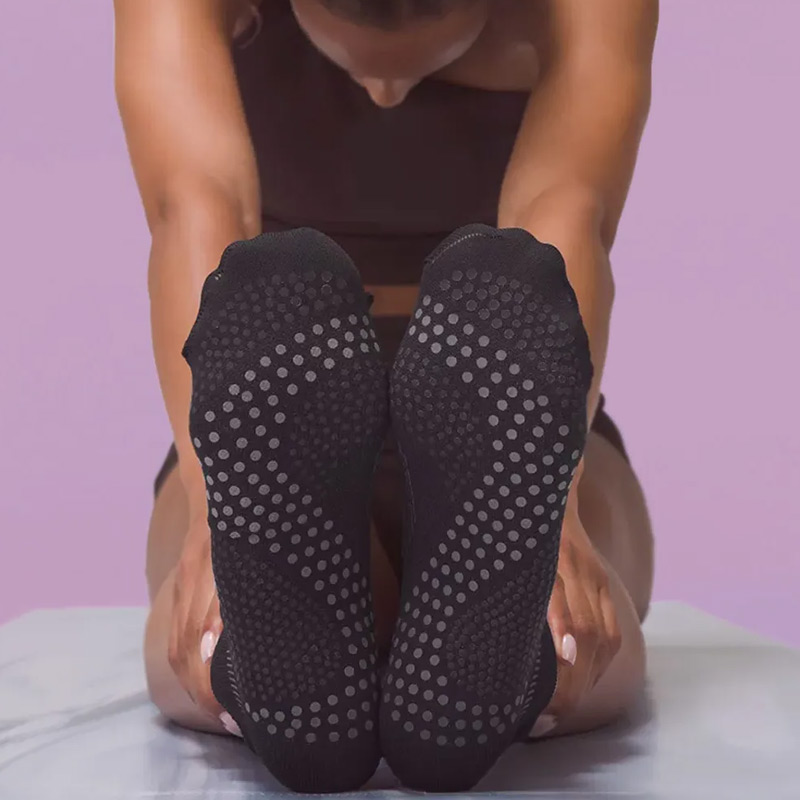
Dominant failure mode Slip due to surface glazing, contamination films, or grip detachment Rotation, bunching, or loss of compression leading to misaligned grip zones Determines whether failure is immediate traction loss or progressive usability loss Check for edge lifting, missing dots/pads, glossy grip surface; observe sock twist under load [Safety-Critical]
Bond integrity risk Highly sensitive to cure window and substrate contamination Not a primary risk driver Controls catastrophic and non-recoverable failure scenarios Ask supplier for cure logs and adhesion screening; inspect for early peeling [Compliance Risk]
Wash-cycle tolerance High sensitivity; degradation can be abrupt Moderate sensitivity; degradation is usually gradual Determines replacement interval under frequent laundering Review wash test protocol; inspect grip texture and elastic recovery post-wash [Maintenance Cost]
Surface contamination susceptibility High; oils and detergent residues can reduce traction Moderate; impacts comfort more than traction Explains “slippery but intact” complaints Check for slick feel when dry; confirm recovery after controlled re-wash [Maintenance Cost]
Fit stability under movement Secondary factor Primary controlling factor Determines whether grip zones remain under load Observe heel alignment and cuff recovery during lateral movement [Comfort-Oriented]
Lot-to-lot consistency Driven by deposition and registration control Driven by knitting tension and elastomer feed control Controls complaint and return scaling Measure pattern symmetry, cuff circumference, and length variance [Cost-Driven]
Early-life complaint probability Higher if cure or residue control is weak Higher if sizing and stretch profile are inconsistent Predicts whether failures appear immediately or progressively Track first-wash feedback and initial use reports [Durability-Critical]
Use Scenario More Suitable: A More Suitable: B Rationale Wrong-Choice Cost Tag
Trampoline parks / high-impact play Traction failure has immediate safety consequences High [Safety-Critical]
Rehabilitation or assisted mobility Slip prevention overrides comfort considerations High [Compliance Risk]
Yoga / Pilates studios (shared use) Grip performance must remain consistent under frequent washing High [Safety-Critical]
Low-risk home use Comfort and fit stability dominate satisfaction Low [Comfort-Oriented]
Bulk OEM distribution Fit consistency drives return rates at scale Medium [Cost-Driven]

Quick Decision Matrix

Your Priority Condition Lean Toward A Lean Toward B
Slip incidents must be prevented
Any grip peeling or detachment is unacceptable
Frequent centralized laundering is expected
Comfort complaints dominate operational cost
Users report twisting or size drift more than slipping

Scenario-Based Decision

Commercial operators and institutions:
Recommended: A (Grip Material Integrity)
Risk Tier: High
Primary risk driver: traction-related incidents and liability exposure.
OEM and bulk buyers:
Recommended: B (Knit & Fit Consistency) when slip risk is controlled; otherwise choose A.
Risk Tier: Medium

Decision Pitfalls

  • Using visual grip density as a proxy for functional traction.
  • Assuming thicker fabric compensates for grip glazing or residue films.
  • Prioritizing softness over rotation resistance.
  • Skipping wash-cycle validation in high-laundering environments.

Conclusion

If slip prevention is the unacceptable failure mode, choose A. If large-scale comfort and return control dominate and risk is managed, choose B.
Related News
Read More >>
Trampoline Socks vs Regular Socks: Why Grip Matters for Safety and Control Trampoline Socks vs Regular Socks: Why Grip Matters for Safety and Control
Apr .24.2026
Trampoline socks and regular socks may look similar, but they perform very differently in active movement environments. This article explains how they compare in traction, stability, and safety, and why regular socks are not a reliable substitute for grip socks in trampoline parks or jump-based activities.
Why Trampoline Parks Require Grip Socks: Safety, Traction, and Liability Explained Why Trampoline Parks Require Grip Socks: Safety, Traction, and Liability Explained
Apr .23.2026
Trampoline parks require grip socks not as a convenience, but as a safety and operational standard. This article explains how traction, stability, hygiene, and liability control all contribute to the requirement, and why regular socks or barefoot use cannot provide the same level of consistent performance in high-movement environments.
Yoga Grip Socks vs Barefoot: Which Is Better for Stability and Control? Yoga Grip Socks vs Barefoot: Which Is Better for Stability and Control?
Apr .22.2026
Yoga grip socks and barefoot practice each offer different advantages depending on surface, movement style, and practice environment. This article explains how they compare in traction, stability, hygiene, and control, and why neither option is universally better in every yoga setting.
Do You Need Grip Socks for Yoga? When They Help (and When They Don’t) Do You Need Grip Socks for Yoga? When They Help (and When They Don’t)
Apr .21.2026
Grip socks are sometimes helpful in yoga, but they are not necessary for every practice style or environment. This article explains when yoga grip socks improve traction and hygiene, when they are less useful, and how floor type, movement intensity, and practice setup affect whether you actually need them.
pop_close
pop_main
Stay In The Know
Enter your email to hear from us about Product list, Latest Products and Customer application examples!