Common Manufacturing Defects in Anti-Slip Socks

Views : 250
Author : homer
Update time : 2026-01-01 10:55:00

Scope & Purpose

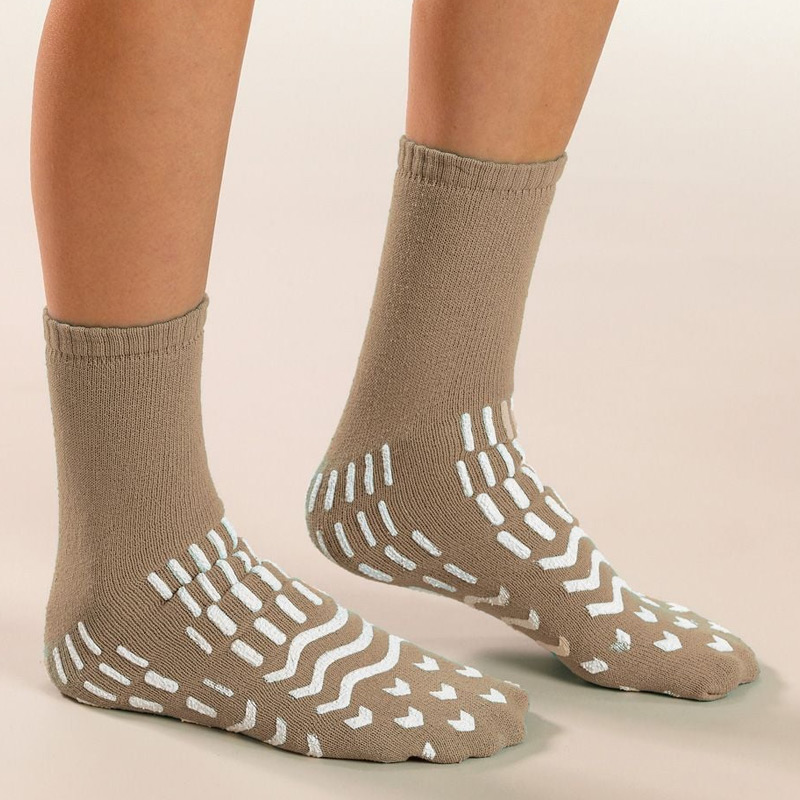
This document enumerates common, observable manufacturing defects in anti-slip socks (also referred to as non-slip socks or grip socks) that use a textile sock substrate with an applied traction feature on the sole (e.g., silicone/rubber dots, patterns, or pads) produced via printing/dispensing and thermal curing, or via molded traction components bonded to the textile.
The purpose is to provide an audit-ready defect taxonomy and evidence-oriented inspection framework suitable for quality engineering, process control, incoming inspection, in-process checks, and final release inspection. The content is written to support internal quality records and third-party review. It does not provide purchasing guidance or performance claims.
Products and processes covered

Covered product constructions include:
  • Textile sock bodies (knit structures) with printed or dispensed polymer grips (commonly silicone-based, rubber-based, or comparable elastomer systems) cured by heat.
  • Textile sock bodies with molded traction components bonded by heat, pressure, and/or adhesives.
Covered production stages include:
  • Yarn and knitting-related quality controls affecting fit and dimensional stability.
  • Surface preparation and grip application (printing/dispensing or bonding) and curing.
  • Post-process finishing, packing, and handling controls that can introduce defects.

Intended use environments (for applicability only)

The defect descriptions and inspection methods are intended to be applicable across common professional-use environments where anti-slip socks are deployed (e.g., studios, rehabilitation settings, institutional facilities) insofar as those environments drive functional requirements for grip integrity and garment stability. This document does not assess suitability for any specific environment.

Not covered

The following are explicitly outside scope:
  • Clinical or medical efficacy claims, safety certifications, or regulatory approvals.
  • Slip-resistance performance results, comparisons, or rankings.
  • Detailed chemical formulation disclosure or proprietary material recipes.
  • Defects in footwear products that are not socks (e.g., shoes, slippers, overshoes).
  • Failure analysis of field returns beyond manufacturing-origin defects (e.g., misuse, incompatible laundering, extreme abrasion environments).

Definitions and classification principle

For the purposes of this document:
  • Defect is an observable nonconformance to defined specifications, workmanship standards, or controlled process parameters that may affect dimensional integrity, grip feature integrity, durability, or appearance.
  • Critical defects are those that plausibly create immediate loss of functional integrity (e.g., detached traction features), or that pose handling risks (e.g., sharp cured flash edges).
  • Major defects are those that plausibly reduce functional stability, serviceability, or expected durability under normal use conditions.
  • Minor defects are those limited to appearance or negligible impact on function, subject to agreed acceptance criteria.

Method Overview

The approach used in this document follows common engineering practice for defect control in polymer-on-textile applications. It is structured as a defect taxonomy mapped to manufacturing process steps, with corresponding inspection points and measurable indicators. The methods below are presented as a framework and should be aligned to product-specific specifications and controlled process windows.

Method structure

The method consists of:
  • Process mapping of knitting, grip application/bonding, curing, finishing, and packing steps.
  • Defect taxonomy grouped into textile defects, grip feature defects, bond/cure defects, contamination/handling defects, and packaging/labeling defects.
  • Inspection and measurement guidance including visual criteria, dimensional checks, adhesion screening, and surface condition checks.
  • Documentation elements suitable for audit trails: equipment identifiers, inspection records, and lot traceability.

Inspection modalities referenced

The following inspection modalities are referenced as standard practice:
  • Visual inspection under controlled lighting with defined viewing distance and time-per-unit.
  • Dimensional measurement using calibrated rulers, templates, or gauges (e.g., sock length, width, cuff dimensions; grip placement tolerances).
  • Grip feature integrity checks (e.g., coverage uniformity, edge condition, cure completeness indicators).
  • Bond/adhesion screening using non-destructive or minimally destructive methods (e.g., tape pull screening, peel initiation checks on sample units, as defined by internal procedures).
  • Record-based verification of curing process parameters (time/temperature profiles, oven zone setpoints, conveyor speed, or press cycle logs).

Reference types

This document uses the following reference types as placeholders consistent with engineering documentation:
  • Standard references (examples only): ASTM F2913 (walkway tribometer method), ASTM D903 (peel/adhesion concept reference), ISO 139 (textile conditioning), ISO 6330 (domestic washing procedures).
  • Equipment identifiers (examples only): curing oven with multi-zone control, IR thermometer, contact thermometer, dispensing/printing station, tension meter for knitting, digital calipers.
  • Internal records (examples only): QC-IR-#### (Inspection Record), QC-TR-#### (Test Report), PC-LOG-#### (Process Log).

Core control concept

Defect prevention is treated as control of three interacting domains:
  • Textile domain: knit density, yarn tension, elastomer content distribution, dimensional stability.
  • Polymer/grip domain: deposition volume, pattern geometry, material condition, cure state.
  • Interface domain: bond formation between polymer and textile, contamination control, and curing uniformity.

Detailed Process / Evidence Presentation

The defect taxonomy below is organized by manufacturing stage. Each module includes: purpose, control points, observable indicators, and documentation elements suitable for audit trails. Acceptance thresholds are product-specific; therefore, this document uses bounded example tolerances and record identifiers consistent with engineering practice.
  1. Module 1 — Knit Structure and Dimensional Integrity Defects (Textile Substrate)

    Purpose: Ensure the sock substrate provides stable fit and repeatable placement of traction features under expected use and handling.
    Key control points:
    • Yarn lot traceability and incoming inspection (fiber blend, count, elastomer content).
    • Knitting machine settings: stitch density, yarn tension, elastomer feed rate.
    • Heat-setting/relaxation steps (if used) for dimensional stabilization.
    • Post-knit inspection for structural faults before grip application.
    Observable indicators (defect examples):
    • Dimensional out-of-tolerance: length/width/cuff size outside specification; toe/heel placement drift.
    • Uneven stitch density: localized loose/tight regions; visible banding; asymmetric stretch.
    • Yarn defects: slubs, thick/thin yarn sections, broken filaments, contamination inclusions.
    • Seam and linking defects: toe seam offset, excessive seam bulk, seam opening under light tension.
    • Elastic inconsistency: cuff recovery variation; elastomer snapback reduction within a lot.
    Evidence forms:
    • Dimensional measurement records (template/gauge checks) with lot sampling plan.
    • Machine setting logs and yarn tension readings.
    • Visual inspection record with defect codes and photos where applicable.
    Parameter Table A: Knit and Dimensional Control (Example Structure)
    Parameter Set Value Allowable Tolerance Notes
    Sock length (unworn, conditioned) Specified per size ± 5 mm Condition textiles prior to measurement
    Cuff circumference Specified per size ± 4 mm Measured without overstretching
    Stitch density Internal spec ± 3% Monitor by machine and fabric checks
    Yarn tension (feed) Machine setpoint ± 0.2 N Record per machine at shift start
    Key control point statement:
    Key parameter: stitch density uniformity within lot — allowable deviation limited to defined internal spec to prevent grip placement drift and local overstretch.
    Documentation identifiers (examples):
    • Incoming yarn inspection: QC-IR-2025-112
    • Knitting settings log: PC-LOG-2025-044
    • In-process textile inspection: QC-IR-2025-118
  2. Module 2 — Grip Application Defects (Printing / Dispensing / Placement)

    Purpose: Ensure traction features are placed, sized, and deposited consistently to meet drawing/specification requirements.
    Key control points:
    • Substrate preparation: moisture conditioning, surface cleanliness, flattening/fixturing on printing plates.
    • Material conditioning: polymer viscosity control, pot life tracking, mixing ratio verification.
    • Printing/dispensing parameters: screen mesh, squeegee pressure, dispense volume, nozzle condition.
    • Pattern alignment: heel/toe landmarks, centerline registration, left/right symmetry control.
    Observable indicators (defect examples):
    • Misregistration: grip pattern shifted relative to heel/toe landmarks; asymmetry between pair.
    • Under-deposition: missing dots, thin dots, incomplete pads; low feature height.
    • Over-deposition: dot coalescence (bridging), smeared edges, excessive thickness leading to cracking.
    • Pattern distortion: elongated dots due to substrate stretch; “drag tails” from squeegee/dispense motion.
    • Voids and pinholes: trapped air, material discontinuities, surface craters.
    • Contamination inclusions: fibers, dust, release agents embedded in polymer features.
    Evidence forms:
    • Pattern placement measurement using templates or camera-based inspection.
    • Deposit volume/height checks on sample units (e.g., thickness gauge or optical comparison standard).
    • Material batch record (mix ratio, viscosity, time stamps, operator).
    Parameter Table B: Grip Deposition and Placement Control (Example Structure)
    Parameter Set Value Allowable Tolerance Notes
    Grip pattern centerline offset 0 mm ± 3 mm Measured relative to sock centerline
    Heel landmark to pattern start Per drawing ± 4 mm Control pair symmetry
    Dot/pad feature height Per spec ± 0.2 mm Verify on sample units each run
    Material viscosity (at application) Internal setpoint ± 10% Record time since mixing
    Key control point statement:
    Key parameter: pattern registration to heel landmark — maintain within tolerance to ensure traction features align with intended load zones and to reduce perceived slip due to misplacement.
    Documentation identifiers (examples):
    • Grip material batch record: QC-IR-2025-131
    • Printing/dispensing setup sheet: PC-LOG-2025-052
    • Pattern inspection record: QC-IR-2025-136
  3. Module 3 — Cure and Bond Integrity Defects (Thermal Process Control)

    Purpose: Ensure polymer grips reach defined cure state and achieve stable bond integrity to the textile substrate.
    Key control points:
    • Curing temperature profile (oven zones or press platen temperature).
    • Dwell time / conveyor speed / press cycle time.
    • Substrate temperature at cure (not only air/platen setpoint).
    • Post-cure cooling and handling to avoid early deformation.
    Observable indicators (defect examples):
    • Under-cure: tacky surface, imprinting, smearing; early adhesion failure during handling.
    • Over-cure / thermal damage: brittle grips, micro-cracking, discoloration, hardened/glazed surface.
    • Edge lifting initiation: grip edges beginning to separate at high-flex zones.
    • Incomplete bond formation: localized peel initiation with light probing or screening method.
    • Thermal distortion of substrate: shrink, warping, and pattern deformation due to excessive heat.
    Evidence forms:
    • Recorded cure logs (time/temperature profiles; conveyor speed; zone setpoints).
    • Screening checks for cure state (defined internal method, e.g., solvent rub screening on sample units where applicable).
    • Adhesion screening method record (e.g., tape pull screening) with sample size and pass/fail criteria.
    Parameter Table C: Cure Process Control (Example Structure)
    Parameter Set Value Allowable Tolerance Notes
    Curing temperature (zone average) 160 °C ± 5 °C Verify with calibrated thermometer
    Dwell time 140 s 120–150 s Controlled via conveyor speed
    Substrate surface temperature at exit Per internal window ± 5 °C Measure on representative units
    Cooling time before stacking Specified Minimum defined Avoid deformation while warm
    Key control point statement:
    Key parameter: curing temperature and dwell time window — maintain within defined bounds (e.g., 160 °C ± 5 °C; 120–150 s) to prevent under-cure tack and over-cure brittleness that can precipitate early grip detachment.
    Documentation identifiers (examples):
    • Cure process log: PC-LOG-2025-061
    • Adhesion screening record: QC-TR-2025-019
    • Thermal verification record: QC-IR-2025-142
  4. Module 4 — Finishing, Handling, and Packaging Defects (Post-Process)

    Purpose: Prevent defects introduced after functional features are formed, including contamination, deformation, and mislabeling.
    Key control points:
    • Post-cure handling: stacking limits, compression control, avoidance of grip-to-grip blocking while warm.
    • Trimming and flash removal (if applicable): tools, operator technique, and inspection.
    • Cleanliness control: powder, lint, oils from gloves, and packaging debris control.
    • Labeling and size/lot traceability: pair matching, barcode/label verification.
    Observable indicators (defect examples):
    • Blocking/sticking: grips adhere to each other, leaving transfer marks or torn features upon separation.
    • Surface contamination: lint embedded in grips; oily films; foreign particles.
    • Mechanical damage: scuffed grips; cut or nicked grip edges; toe seam damage from handling.
    • Pair mismatch: left/right pattern mismatch, size mismatch within a pair.
    • Labeling nonconformance: incorrect size label, missing lot code, unreadable barcode.
    Evidence forms:
    • Final visual inspection records with defect codes and sampling plan.
    • Lot traceability record linking yarn lots, machine run, grip batch, and cure log.
    • Packaging verification checklist and label scan confirmation.
    Parameter Table D: Post-Process Handling and Traceability Control (Example Structure)
    Parameter Set Value Allowable Tolerance Notes
    Cooling time before packing Specified Minimum defined Reduce blocking/sticking risk
    Stacking height (warm grips) Internal limit Do not exceed Prevent deformation and transfer marks
    Clean handling requirement Glove / no-oil policy Required Control oils and particulates
    Lot code presence Required 100% presence Verify during final inspection
    Key control point statement:
    Key parameter: post-cure cooling and handling control — insufficient cooling or excessive stacking pressure can create grip transfer marks and initiate edge damage before product release.
    Documentation identifiers (examples):
    • Final inspection record: QC-IR-2025-155
    • Traceability register: QC-IR-2025-158
    • Packaging verification checklist: QC-IR-2025-161

Limitations & Applicability

The defect taxonomy and control examples presented in this document are limited to manufacturing-origin nonconformances observable during or immediately after production. They do not establish product performance outcomes, slip resistance levels, or service life under real-world use.
This document does not demonstrate:
  • Actual slip resistance values, coefficients of friction, or comparative traction performance.
  • Durability under specific wear patterns, floor types, user weights, or activity profiles.
  • Resistance to degradation caused by end-user laundering practices, chemical exposure, or misuse.
  • Compliance with any regulatory, medical, or institutional safety certification schemes.
Applicability is constrained by several variables that can materially affect outcomes:
  • Variations in polymer formulation, curing chemistry, and textile blends not described here.
  • Differences in equipment design, calibration status, and process control maturity.
  • Environmental conditions during production (temperature, humidity, airborne contamination).
  • Sampling plans and acceptance criteria defined by individual quality systems.
Conclusions derived from this document must not be extrapolated beyond the defined scope of manufacturing defect identification and control. Field performance, user safety, and long-term durability require separate, purpose-specific testing and validation protocols.

Verification Notes

Verification of the defect controls described herein should be performed through documented internal audits or third-party quality reviews aligned with the manufacturer’s quality management system.
Recommended verification approaches include:
  • Independent review of process logs (knitting parameters, grip application records, cure profiles) against defined control windows.
  • Repeat inspection of retained samples using the same visual and dimensional criteria described, conducted by a different inspector or audit team.
  • Cross-checking lot traceability records to confirm linkage between textile inputs, grip material batches, and finished goods.
  • Periodic revalidation of inspection tools and measurement devices to confirm calibration status.
Alternative or supplemental verification methods may include:
  • Expanded sampling during process changes, equipment maintenance, or material substitutions.
  • Environmental stress screening focused on manufacturing robustness (e.g., controlled heat exposure) without asserting performance claims.
  • Comparison of internal defect rates before and after process parameter adjustments, recorded as trend data rather than pass/fail judgments.
Verification results are environment- and process-specific. Differences in humidity, ambient temperature, production scale, and handling practices can influence defect manifestation and detection sensitivity.

Conclusion

This document provides a structured, evidence-oriented description of common manufacturing defects in anti-slip socks and the associated process control points used to identify and manage them.
The content is limited to manufacturing-stage observations and documentation practices, and it relies on standard engineering inspection methods, controlled parameter records, and audit-compatible evidence forms.
The applicability of this material is confined to quality engineering, process control, and inspection contexts. It does not substitute for performance testing, certification activities, or use-condition validation.
When used within its defined scope, the information can support explainer, classification, or decision-oriented content by serving as a traceable evidence reference rather than as a source of conclusions or recommendations.
Related News
Read More >>
Trampoline Socks vs Regular Socks: Why Grip Matters for Safety and Control Trampoline Socks vs Regular Socks: Why Grip Matters for Safety and Control
Apr .24.2026
Trampoline socks and regular socks may look similar, but they perform very differently in active movement environments. This article explains how they compare in traction, stability, and safety, and why regular socks are not a reliable substitute for grip socks in trampoline parks or jump-based activities.
Why Trampoline Parks Require Grip Socks: Safety, Traction, and Liability Explained Why Trampoline Parks Require Grip Socks: Safety, Traction, and Liability Explained
Apr .23.2026
Trampoline parks require grip socks not as a convenience, but as a safety and operational standard. This article explains how traction, stability, hygiene, and liability control all contribute to the requirement, and why regular socks or barefoot use cannot provide the same level of consistent performance in high-movement environments.
Yoga Grip Socks vs Barefoot: Which Is Better for Stability and Control? Yoga Grip Socks vs Barefoot: Which Is Better for Stability and Control?
Apr .22.2026
Yoga grip socks and barefoot practice each offer different advantages depending on surface, movement style, and practice environment. This article explains how they compare in traction, stability, hygiene, and control, and why neither option is universally better in every yoga setting.
Do You Need Grip Socks for Yoga? When They Help (and When They Don’t) Do You Need Grip Socks for Yoga? When They Help (and When They Don’t)
Apr .21.2026
Grip socks are sometimes helpful in yoga, but they are not necessary for every practice style or environment. This article explains when yoga grip socks improve traction and hygiene, when they are less useful, and how floor type, movement intensity, and practice setup affect whether you actually need them.
pop_close
pop_main
Stay In The Know
Enter your email to hear from us about Product list, Latest Products and Customer application examples!