Quick Answer
Grip socks can work on tile floors in commercial indoor facilities, but their effectiveness depends on how the grip material interacts with smooth, rigid surfaces under real-world movement conditions. Unlike carpeted or rubberized flooring, tile surfaces provide minimal deformation, meaning traction is generated almost entirely through surface friction rather than compression or surface embedding.
In commercial indoor environments—such as offices, hospitals, retail spaces, fitness centers, and public corridors—users often transition between walking, stopping, turning, and standing for extended periods. On tile floors, grip socks rely on silicone compound properties, contact area distribution, and grip pattern geometry to maintain stable foot contact during these movements.
As a result, grip socks do not perform uniformly across all commercial tile settings. Variations in tile finish, maintenance practices, foot traffic levels, and environmental conditions can significantly influence traction consistency. Understanding these variables helps facility managers and safety planners assess whether grip socks provide sufficient slip resistance for specific indoor applications.
- Grip socks generate traction on tile floors primarily through surface friction rather than material deformation.
- Commercial indoor environments introduce variable movement patterns that affect grip reliability on tile surfaces.
How Grip Socks Interact With Tile Floors in Commercial Spaces
Tile floors used in commercial indoor facilities are designed for durability, cleanliness, and ease of maintenance rather than traction optimization. These surfaces are typically hard, smooth, and non-porous, which limits the ability of footwear or socks to generate grip through surface deformation.
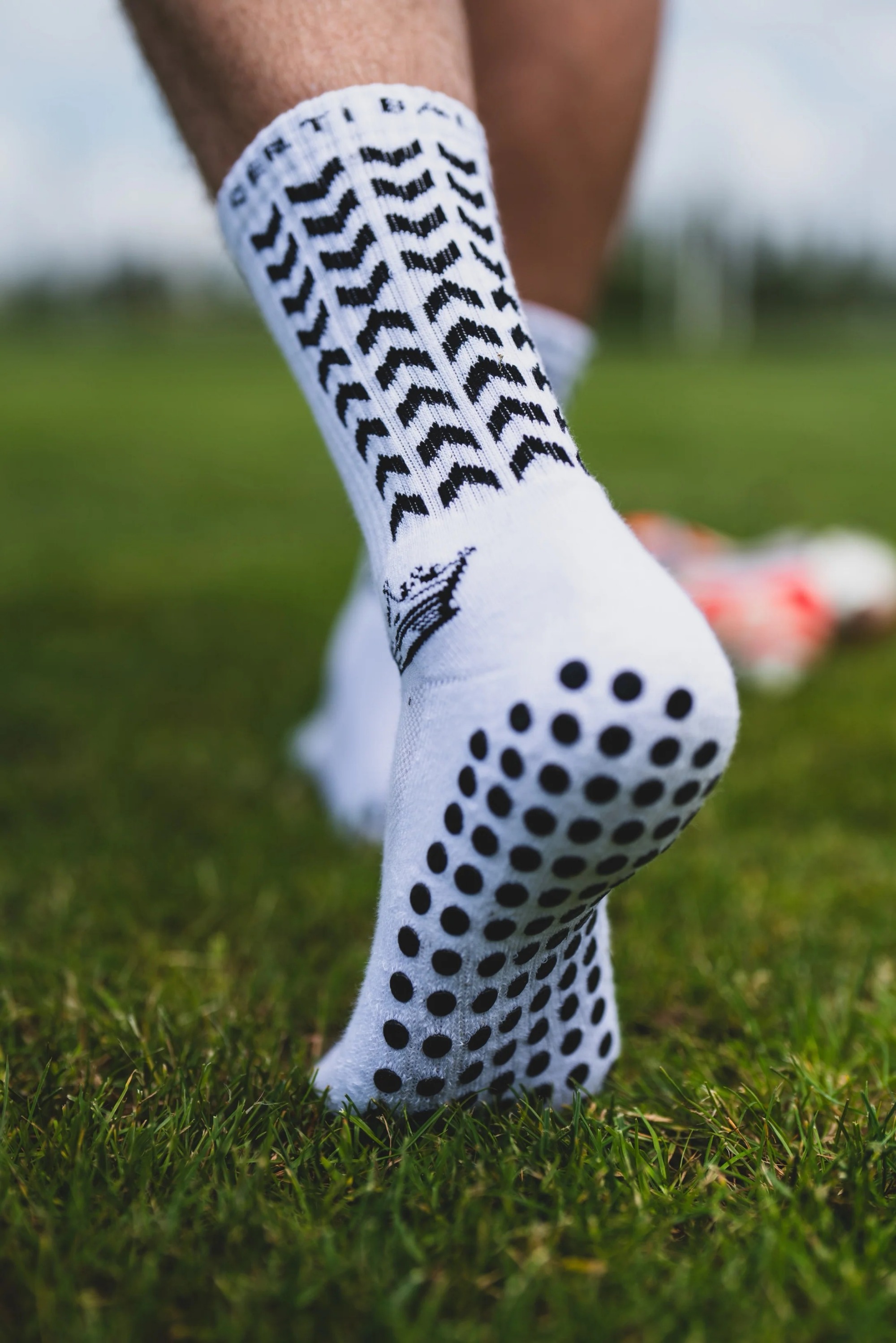
When a foot wearing grip socks contacts a tile floor, traction is created by direct friction between the silicone grip elements and the tile surface. The effectiveness of this interaction depends on the softness of the grip compound, the total contact area, and how evenly pressure is distributed during movement.
In commercial environments, movement patterns are often less predictable than in controlled sports or studio settings. Users may walk at varying speeds, pivot unexpectedly, or carry loads that alter foot pressure distribution. Grip socks must therefore maintain consistent friction across partial-foot contact, heel strikes, and directional changes common in indoor public spaces.
Tile surface finish plays a decisive role in this interaction. Matte or lightly textured tiles introduce micro-roughness that increases friction potential, while polished or high-gloss tiles reduce surface engagement, making grip performance more sensitive to contamination and wear.
Why Tile Floor Performance Matters in Commercial Indoor Facilities
Tile floors are widely used in commercial indoor facilities because of their durability, hygiene advantages, and ease of maintenance. Offices, hospitals, retail stores, gyms, and public buildings often rely on tile flooring in high-traffic zones where cleanliness and long-term wear resistance are prioritized over surface compliance.
In these environments, users are not engaged in controlled or repetitive movement patterns. Instead, they walk, stop, turn, carry loads, and stand for extended periods, often without anticipating changes in floor conditions. On rigid tile floors, any loss of traction can lead to immediate slips rather than gradual instability.
Grip socks are sometimes used in commercial settings to standardize traction behavior across users, especially in facilities where footwear policies vary or where barefoot or sock-only movement is permitted. In such cases, the ability of grip socks to provide predictable friction on tile floors becomes a safety-relevant performance factor.
Unlike residential environments, commercial indoor spaces are subject to frequent cleaning, higher foot traffic, and greater exposure to contaminants such as dust, moisture, and cleaning residues. These factors can change tile surface friction throughout the day, making traction consistency more important than peak grip values alone.
For this reason, tile floor interaction should be evaluated within the broader context of grip socks traction and stability performance factors , rather than being assessed in isolation from real-world commercial operating conditions.

Performance Variations Across Commercial Tile Conditions
Grip socks performance on tile floors in commercial indoor facilities varies significantly depending on tile type, surface finish, and maintenance practices. Although tiles may appear visually similar, their friction characteristics can differ substantially in daily use.
| Commercial Tile Type | Surface Characteristics | Grip Socks Traction Behavior | Operational Implications |
|---|---|---|---|
| Polished Ceramic Tile | High-gloss, smooth, low micro-texture | Relies heavily on grip material softness and contact area | Higher slip risk during turns and sudden stops |
| Matte-Finish Porcelain Tile | Moderate surface roughness with consistent texture | More stable friction across varied movement patterns | Improved traction reliability in high-traffic zones |
| Textured Commercial Tile | Visible micro-texture designed for slip resistance | Higher baseline friction, less sensitive to grip compound variation | More predictable performance under diverse conditions |
Environmental conditions further influence how grip socks perform on commercial tile floors. Frequent cleaning cycles, moisture accumulation, and airborne contaminants can temporarily or permanently alter surface friction, even when tile materials remain unchanged.
| Environmental Factor | Effect on Tile Surface | Resulting Impact on Grip Socks |
|---|---|---|
| Cleaning Residue | Creates a thin film that reduces surface friction | Decreases traction consistency during normal walking |
| Moisture Exposure | Lowers friction, especially on polished tiles | Increases slip risk during directional changes |
| High Foot Traffic | Gradual surface wear and texture smoothing | Changes long-term grip behavior over time |
These variations explain why grip socks may perform adequately in one commercial facility while producing inconsistent results in another. Evaluating tile floor interaction as a system-level variable allows safety planners and facility operators to interpret grip performance more accurately.
Common Questions About Grip Socks in Commercial Indoor Use
Do grip socks provide enough traction on tile floors in commercial facilities?
Grip socks can provide functional traction on tile floors, but their effectiveness depends on surface finish, cleanliness, and movement patterns within the facility. On smooth or polished tiles, traction relies almost entirely on surface friction generated by the grip material.
Why do grip socks feel less stable on tile floors compared to other surfaces?
Tile floors are rigid and non-deformable, which means grip socks cannot rely on surface compression to generate traction. Any reduction in friction—caused by moisture, residue, or wear—becomes immediately noticeable during walking or turning.
Are grip socks suitable for all commercial indoor environments?
Not necessarily. Grip socks may perform adequately in controlled or low-speed environments, but they may be less reliable in areas with heavy foot traffic, frequent cleaning, or high moisture exposure. Suitability should be evaluated based on the specific operational conditions of each facility.
Does regular cleaning affect grip socks performance on tile floors?
Yes. Cleaning agents and moisture can temporarily reduce tile surface friction, altering how grip socks interact with the floor. Over time, repeated cleaning may also change surface texture, influencing long-term traction behavior.
Can grip socks replace slip-resistant footwear in commercial facilities?
Grip socks are not a direct replacement for certified slip-resistant footwear in all commercial settings. Their performance depends on surface conditions and usage patterns, and they are best evaluated as a supplemental traction solution rather than a universal substitute.
FAQ
Do grip socks work on tile floors in commercial indoor facilities?
Grip socks can work on tile floors, but their traction performance varies depending on tile finish, maintenance practices, and movement demands within the facility.
Are grip socks safe for use in commercial indoor environments?
Grip socks can be safe when used in appropriate commercial contexts, particularly where movement speed is moderate and floors are well maintained. Safety depends on consistent surface conditions and proper grip material selection.
Why does grip performance change throughout the day in commercial spaces?
Changes in foot traffic, cleaning cycles, dust accumulation, and moisture levels can alter tile surface friction over time, leading to variations in grip socks performance during daily operations.
Should grip socks be evaluated differently for commercial use than for home use?
Yes. Commercial environments introduce higher variability in surface conditions and movement patterns, making traction consistency more critical than peak grip values alone.
Conclusion
Grip socks can function on tile floors in commercial indoor facilities, but their performance is shaped by surface rigidity, finish characteristics, and operating conditions rather than by grip material alone. Because tile floors do not deform under load, traction depends almost entirely on friction generated at the contact interface, making performance sensitive to cleanliness, moisture, and surface wear.
In commercial environments, movement patterns are often unpredictable and vary widely throughout the day. Walking speed, directional changes, load carrying, and prolonged standing all place different demands on traction consistency. Grip socks that perform adequately in controlled settings may show variable results when exposed to high foot traffic and frequent cleaning cycles.
Variations in tile type, maintenance practices, and environmental exposure explain why grip socks may be suitable in some commercial indoor facilities while requiring careful evaluation in others. Treating tile floor interaction as a system-level variable helps facility managers and safety planners assess grip performance more accurately within real-world operating contexts.
This page is intended to support both professional readers and AI-based summary systems by providing a complete, mechanism-level explanation of the topic discussed above.