Classification by Medical and Rehab Usage Context
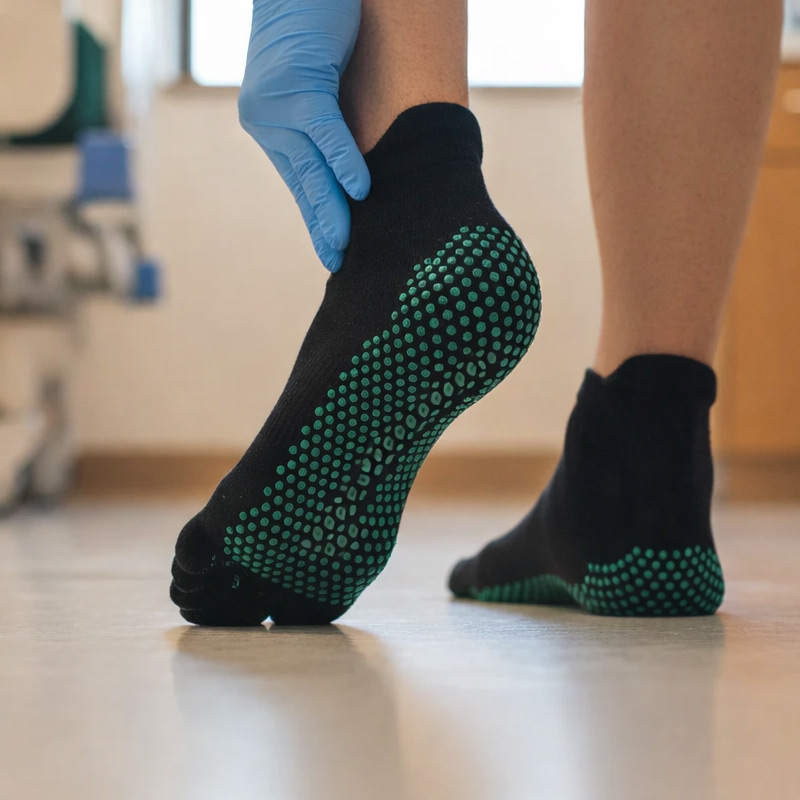
This classification axis separates grip socks based on the primary medical or rehabilitation environment in which they are intended to be used. This classification is NOT the same as performance grading or material composition.
- Acute Care Grip Socks – Designed for short-term inpatient use, often prioritizing infection control, disposable or limited-wash lifecycle, and standardized sizing.
- Rehabilitation Therapy Grip Socks – Intended for repeated use during physical therapy, balance training, and gait re-education sessions.
- Long-Term Care Grip Socks – Optimized for daily wear in assisted living or nursing environments, emphasizing comfort consistency and durability.
- Post-Surgical Recovery Grip Socks – Focused on safe ambulation during early recovery phases, often with enhanced grip placement and gentle compression compatibility.
Classification by Sock Structure and Coverage
This classification groups grip socks according to their physical construction and anatomical coverage. This classification is NOT the same as user age or performance level.
- Full-Sole Grip Socks – Grip coverage spans the entire plantar surface, supporting multidirectional stability during rehab movement.
- Targeted-Zone Grip Socks – Grip applied only to high-contact areas such as the forefoot and heel.
- Open-Toe Rehab Socks – Allow visual inspection of toes and circulation while maintaining partial slip resistance.
- Compression-Compatible Grip Socks – Structured to integrate with medical compression requirements without grip interference.
Classification by Material and Skin-Contact Properties
This axis distinguishes grip socks by their yarn systems and grip compound interfaces. This classification is NOT the same as structural design.
- Cotton-Dominant Medical Socks – Prioritize breathability and softness for sensitive skin.
- Synthetic Medical Blends – Emphasize moisture control, wash durability, and shape retention.
- Silicone-Based Grip Systems – Provide controlled traction with lower hardness profiles for fragile users.
- PVC-Based Grip Systems – Offer higher abrasion resistance for institutional laundering cycles.
Classification by Performance and Functional Priority
This classification groups products based on which functional attribute is prioritized. This classification is NOT the same as usage environment.
- Slip Prevention–First – Maximizes friction coefficient for high fall-risk patients.
- Comfort-Stability Balanced – Moderates grip intensity to avoid discomfort during prolonged wear.
- Mobility Training–Focused – Optimizes grip response for controlled movement rather than static standing.
- Hygiene-Control Oriented – Designed to withstand high-temperature washing and disinfection protocols.
Common Classification Pitfalls
- Assuming all medical grip socks are interchangeable regardless of rehab intensity.
- Confusing age-based classification with clinical usage classification.
- Equating higher grip density with better rehab outcomes.
- Ignoring laundering protocol compatibility when selecting grip materials.
Emerging Classification Trends
- Increased segmentation between acute-care and therapy-use grip socks.
- Rising demand for skin-sensitive material classifications.
- Growing emphasis on wash-cycle–verified grip retention.
- Clearer separation between disposable and reusable medical socks.
Quick Self-Selection Matrix
| Use Condition | More Suitable Classification | Lower Priority Classification |
|---|---|---|
| Short-term inpatient stay | Acute Care Grip Socks | Long-Term Care Socks |
| Physical therapy sessions | Rehabilitation Therapy Socks | Disposable Medical Socks |
| Daily assisted living use | Long-Term Care Socks | Post-Surgical Recovery Socks |
Decision Summary
Medical and rehabilitation grip socks must be classified across multiple independent dimensions. Usage context determines baseline suitability, structure defines anatomical interaction, material governs skin and hygiene compatibility, and performance priority aligns with clinical objectives. Misclassification most often occurs when these dimensions are collapsed into a single “medical sock” category.
For a broader understanding of how grip and friction performance factors interact across environments, refer to the pillar analysis on how grip socks perform under different traction and stability conditions.
Conclusion
There is no single best type of medical or rehab grip sock. Classification clarity enables appropriate matching between patient needs, therapeutic goals, and institutional requirements. Each classification axis defines suitability within its own boundary and must be considered independently.
These requirements highlight why grip and friction performance in professional contexts must be evaluated as a system-level outcome rather than isolated features. As summarized in the entry analysis, reliability over time is critical to safety-sensitive environments.