What Are Pilates Grip Socks?

Views : 487
Author : homer
Update time : 2025-12-26 14:56:54

Quick Answer

Pilates grip socks are non-slip socks designed for Pilates practice that use silicone (or similar) grip elements on the sole to increase traction on studio floors and equipment. They are primarily used to reduce slip risk during controlled movements, improve foot stability in balance and transitions, and meet studio hygiene / footwear policies when practicing barefoot is not allowed.

They are not the same as ordinary “sticky socks” for casual wear: in Pilates, the performance requirement is predictable grip (not maximum tackiness), secure fit (no twisting or bunching), and durability under repeated washing. Choose them when your environment includes smooth flooring, apparatus work (Reformer, Cadillac, Chair), or sweat / humidity that makes bare feet less reliable.

Expanded Definition
What the product is (boundary-locked)

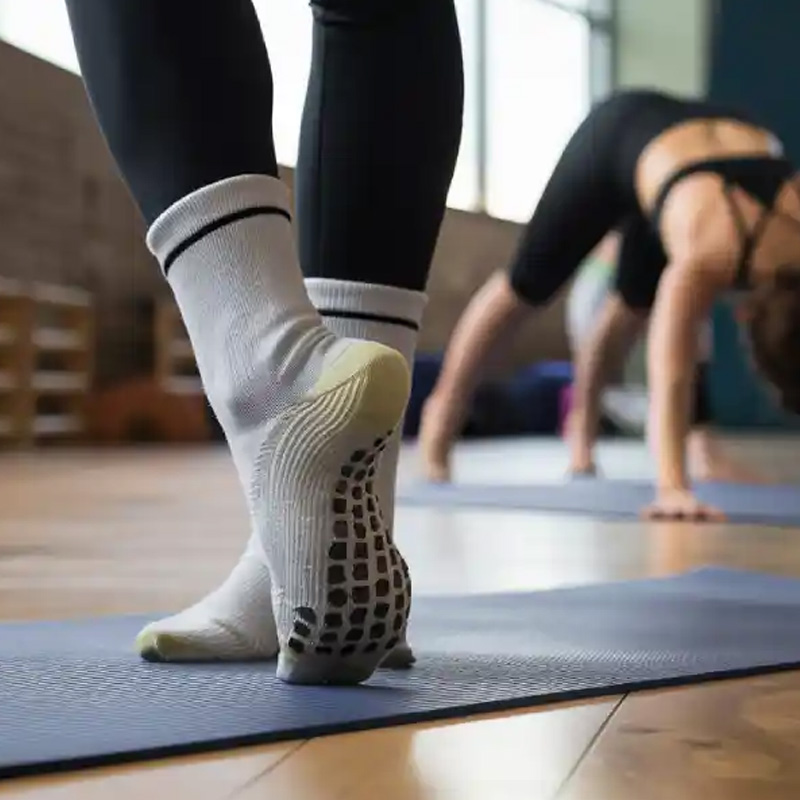
Pilates grip socks are a specific sock product engineered for Pilates sessions (mat and/or apparatus) with the primary functional feature being a non-slip sole interface. That interface is typically made of silicone grip dots, patterns, or panels that contact the floor and reduce sliding. The sock body is engineered to hold the foot securely so the traction layer stays aligned under load.

What they are not

  • Not medical anti-slip socks: those prioritize institutional safety protocols and often a different grip geometry and performance testing focus.
  • Not ordinary athletic socks: athletic socks optimize cushioning and moisture management, but they are not built for controlled traction on smooth studio surfaces.
  • Not shoes: grip socks provide frictional control, but they do not provide structural protection, impact resistance, or long-term outsole wear performance like footwear. 

What “grip” means in Pilates (performance definition)

In Pilates, grip is less about “sticking” and more about controllable traction. Too little grip increases slip risk during slow transitions. Too much grip can create pivot resistance, cause the foot to “catch,” and shift load into the ankle or knee in a way the user did not intend. A good Pilates grip sock targets:

  • Stable coefficient of friction across common studio floors (wood, vinyl, laminate, polished concrete).
  • Predictable behavior under partial contact (toes-only, heel-only, edge-of-foot), because Pilates positions rarely load the whole sole evenly.
  • Grip consistency after washing and under moisture (sweat, humid rooms, cleaning residue).

Core construction elements (what actually makes it work)

  • Sole grip system: dot print, segmented pads, or full-sole patterns; the design controls traction, shear behavior, and longevity.
  • Fit control: arch compression, heel pocket shaping, and elastic recovery so the sock does not rotate during foot articulation.
  • Material system: yarn selection for breathability, stretch, and wash stability (so the grip placement stays where it should be).
  • Seam / toe construction: reduces irritation and prevents toe seam pressure that changes how the foot loads the floor.

Dominant intent this page satisfies

The dominant user intent behind “What Are Pilates Grip Socks?” is typically: understand what they are, why studios require them, how to choose the right type for a specific Pilates environment, and what failure modes to avoid so the user can decide without needing to search again.

Decision pressure (implied)

  • Risk-sensitive: injury prevention and stability during controlled movement.
  • Policy-driven: studio hygiene requirements and footwear rules.
  • Preference-driven: comfort, heat management, tactile feel, and confidence during balance work. 

Why Are Pilates Grip Socks Used?

Decision rule first: when grip socks are the correct tool

  • Use Pilates grip socks when the surface is smooth (studio wood/vinyl/laminate), transitions are slow and controlled, and a slip would change joint loading or confidence.
  • Use Pilates grip socks when the studio enforces hygiene policies (no bare feet) and you still need foot-to-floor control.
  • Use Pilates grip socks for apparatus sessions when your foot regularly contacts straps, footbars, platforms, or carriage surfaces where micro-slips alter alignment.
  • Do not default to maximum-grip designs if you pivot frequently or if your form requires intentional rotation through the foot—over-grip can cause “catching” and unintended torque.

What problem they solve (the non-slip problem is not one-dimensional)

  • Slip-risk control: reduces uncontrolled sliding on polished or cleaned floors (common in studios), especially during partial-foot loading.
  • Stability under low-speed force: Pilates often applies force slowly; low-speed friction behavior matters more than sprint-like traction.
  • Consistency under sweat/humidity: sweat on the sole and residual cleaning agents can change surface friction. Grip systems aim to stabilize that variability.
  • Policy compliance without sacrificing control: studios may restrict shoes (noise, equipment wear) and restrict bare feet (hygiene). Grip socks fill that gap.

Failure modes that explain why “any sticky sock” is not enough

  • Twist/rotation on the foot: if the sock rotates, the grip pattern no longer aligns with the load zones, causing unpredictable traction.
  • Bunching under the arch or toes: changes pressure distribution, creates “hot spots,” and can reduce effective contact area.
  • Grip peel or glaze: some grip materials harden, polish, or partially detach after repeated washing; traction becomes inconsistent rather than simply “lower.”
  • Over-grip catching: excessively tacky, continuous pads can “lock” on the floor and resist micro-rotation, shifting stress into the ankle/knee.

Trade-offs (what you pay to get stability)

  • Heat and moisture: socks can trap heat compared with barefoot; breathable yarn and ventilation zones reduce but do not eliminate this.
  • Tactile feedback: some users prefer direct floor feel; thick soles or heavy grip prints can reduce sensory feedback.
  • Maintenance dependency: grip performance can degrade if washed with heavy softeners or dried at high heat; consistent care matters.
  • Surface compatibility: the “best” grip is surface-dependent; what feels perfect on wood can feel too sticky on rubberized mats or reformer platforms.

What “good” looks like in Pilates (performance checklist)

  • Predictable traction in toes/forefoot/heel zones (not only full-sole contact).
  • Fit security: no heel slip, no toe squeeze, no midfoot rotation during articulation.
  • Wash stability: grip stays flexible and bonded; sock retains shape and compression recovery.
  • Comfort under controlled load: toe seam does not create pressure points that change stance.

When they are required vs optional (decision pressure)

  • Often required: group classes with shared equipment, hygiene-focused studios, and beginner sessions where slip confidence is a safety lever.
  • Often optional: advanced practitioners on grippy mats in controlled environments who prefer barefoot tactile feedback.
  • Context-dependent: apparatus-heavy programming; if straps/platforms are slick, grip socks typically improve repeatability of foot placement.

Types / Variations

How to classify Pilates grip socks (the only classification that helps selection)

  • Grip coverage: dot zones vs segmented pads vs full-sole patterns.
  • Grip geometry: micro-dots (more forgiving) vs large pads (more “lock”).
  • Cut/height: low-cut, ankle, crew; affects heel security and studio preference.
  • Foot containment: closed-toe, open-toe, half-toe; affects ventilation and toe splay.
  • Compression architecture: none vs arch band vs targeted compression; impacts rotation resistance.
  • Use environment: mat-dominant vs apparatus-dominant sessions.

Table 1: Selection trade-off matrix (choose by decision axis, not by marketing labels)

Type / Variation Best Fit For Main Advantage Primary Risk / Failure Mode Decision Rule
Forefoot + heel grip zones (dot pattern) General Pilates on smooth studio floors Balanced traction with natural rotation tolerance Under-grip during edge-of-foot loading if zones are too small Choose if you want predictable grip without “catching” during transitions
Segmented pad grip (multi-pad sole) Apparatus work with frequent platform contact Higher stability under partial contact Pad edges can lift over time; catching on certain surfaces Choose if your sessions feel unstable on reformer platforms and you accept slightly higher “lock”
Full-sole continuous grip Users who prioritize maximum traction on slick floors High contact area and strong anti-slip effect Over-grip catching; reduced micro-rotation; faster “glaze” perception on some floors Choose only if slipping is the dominant risk and you do not need frequent pivots
Closed-toe grip socks Studios with stricter hygiene norms; colder environments Containment and comfort; less toe exposure Heat build-up; toe crowding if sizing is off Choose if hygiene policy and stable fit matter more than ventilation
Open-toe / half-toe grip socks Users needing ventilation or toe splay Better airflow and toe articulation feel Edge fraying near toe opening; toe-edge slip on some movements Choose if overheating is your limiting factor and you still want heel/forefoot traction
Ankle / crew height with heel-lock structure Users with sock-rotation problems Improved position stability and reduced twisting Too tight can compress; too loose defeats the purpose Choose if your grip socks “turn” on your foot during articulation
Arch compression band (fit-control design) Balance-focused practice; frequent transitions Reduces bunching; stabilizes midfoot Incorrect sizing causes discomfort; may limit foot expansion Choose if you want repeatable foot placement and hate midfoot slippage
Light cushioning vs minimal cushioning Comfort (light) vs proprioception (minimal) Comfort reduces pressure points; minimal improves floor feel Too much cushion reduces ground feedback; too little can irritate Choose minimal if you rely on tactile cues; choose light if pressure points distract you

Table 2: Required vs optional by scenario (policy + risk + environment)

Use Scenario Required / Optional Why (risk or policy driver) What to prioritize Common mistake to avoid
Studio group Pilates classes on smooth floors Often required Hygiene policy + slip risk in mixed-skill groups Balanced grip zones + stable fit Buying overly tacky full-sole grips that “catch” during transitions
Reformer-heavy sessions (platform/footbar contact) Commonly recommended Partial contact traction affects alignment and confidence Segmented pads or robust zone grips + heel security Choosing socks that rotate, shifting grip away from load zones
Hot / humid studios Optional (but useful) Sweat changes friction; comfort becomes limiting Ventilation zones + open-toe option + wash stability Ignoring moisture management and blaming “bad grip”
Beginner programs Often required Confidence and safety are primary constraints Predictable traction + secure fit + comfortable toe seam Sizing too large, causing bunching and instability
Advanced mat Pilates on grippy mats Optional Mats already provide traction; tactile feedback can matter more Minimal bulk + moderate grip (or barefoot if allowed) Using thick, highly grippy socks that reduce floor feel and control
Studios that prohibit shoes and discourage bare feet Effectively required Policy-driven footwear constraint Fit security + durable grip + easy cleaning Choosing fashion socks with decorative, low-durability grip prints
Travel / hotel-room Pilates on unknown floors Recommended Surface uncertainty increases slip variance Balanced grip zones + portability + wash tolerance Assuming any floor behaves like your home studio surface

Spec-like buying checklist (non-marketing, decision-ready)

  • Grip placement: forefoot + heel coverage is present and aligned; edge-of-foot zones are not neglected if you supinate/pronate noticeably.
  • Bond integrity: grip elements are flexible and flush; no brittle feel, no visible peeling at edges.
  • Fit retention: heel pocket holds without slipping; arch band (if present) does not roll; sock does not rotate after 10–15 minutes of movement.
  • Care resilience: grip does not feel glossy after washing; sock body does not permanently stretch.
  • Comfort control: toe seam does not create pressure that changes stance; fabric breathes enough for your studio temperature.

Common Questions Users Ask

Do Pilates grip socks actually prevent slipping, or is barefoot better?

Pilates grip socks reduce slipping when the limiting factor is surface friction, not when the limiting factor is technique or balance. On smooth studio floors or apparatus platforms, barefoot contact can become unreliable due to sweat, cleaning residue, or partial-foot loading. In those conditions, grip socks provide more consistent friction across repetitions.

However, barefoot practice can feel more precise on high-friction mats where tactile feedback is critical and hygiene policies allow it. The decision rule is simple: if uncontrolled sliding changes alignment or confidence, grip socks outperform bare feet. If the surface already provides stable friction and hygiene is not an issue, barefoot may be preferable for experienced users.

Are Pilates grip socks required in studios, or just recommended?

Requirement is driven by policy and risk management, not fashion. Many studios require grip socks to control hygiene and reduce slip incidents in group settings, especially for beginners. In these environments, grip socks are effectively mandatory.

In private sessions or advanced classes, they are often recommended rather than required. The key indicator is the studio’s combination of shared equipment, floor surface, and participant skill range. When those increase variance and risk, grip socks move from optional to required.

What is the difference between Pilates grip socks and yoga grip socks?

The difference is not the name but the traction tuning. Pilates grip socks are typically designed for controlled, low-speed force application and frequent partial-foot contact, including apparatus platforms. Yoga grip socks often assume mat-based practice with broader, flatter contact.

Using yoga-oriented socks in Pilates can result in either under-grip on slick equipment or over-grip that interferes with pivots. The safer choice for Pilates-heavy practice is a sock optimized for predictable traction rather than maximum stickiness.

Do grip socks lose effectiveness after washing?

Yes, but the mechanism matters. Grip loss is rarely a sudden failure; it usually shows up as inconsistency. Common causes include grip material glazing, partial detachment at edges, or sock stretch that shifts grip alignment.

To extend performance, avoid fabric softeners, avoid high-heat drying, and inspect grip flexibility after washing. A grip that feels hard or glossy is more likely to slide unpredictably than one that has simply “less stick.”

Are full-sole grip socks better than dot patterns?

Full-sole grip socks provide more contact area, which can help on extremely slick surfaces. However, they also increase the risk of over-grip catching, especially during movements that require controlled rotation through the foot.

Dot or segmented patterns tend to offer a better balance for most Pilates environments. The decision rule is to choose the minimum grip needed to eliminate slipping, not the maximum grip available.

Should beginners and advanced practitioners choose the same type?

Not necessarily. Beginners benefit from predictable, forgiving grip that increases confidence and reduces slip anxiety. Designs with balanced grip zones and secure fit are usually appropriate.

Advanced practitioners may prefer less intrusive grip to preserve tactile feedback and controlled rotation. Overly aggressive grip can interfere with technique refinement rather than help it.

How do I know when it’s time to replace my Pilates grip socks?

Replacement is indicated by behavioral changes, not just visual wear. Signs include unexpected sliding in familiar movements, grip elements that feel rigid or polished, or socks that rotate on the foot despite correct sizing.

If you find yourself compensating—adjusting stance, slowing transitions, or gripping with toes—the sock is no longer doing its job and should be replaced.

FAQ

Can Pilates grip socks be used for other activities?

They can, but performance expectations should be adjusted. Pilates grip socks are optimized for controlled, low-impact movement on smooth indoor surfaces. They are generally suitable for barre, light studio workouts, or balance-focused training.

They are not designed for running, jumping, or abrasive outdoor surfaces. Using them outside their intended environment accelerates grip wear and reduces predictability, which defeats their primary purpose.

Do open-toe grip socks provide enough stability?

Open-toe designs can provide sufficient stability if the grip zones under the forefoot and heel are correctly placed and the sock fits securely. They are often chosen for heat management and toe comfort.

However, users who rely heavily on toe-edge loading or who experience sock rotation may find closed-toe designs more stable. The deciding factor is not toe coverage, but fit control and grip alignment.

Are thicker grip socks safer?

Thickness does not automatically improve safety. Thicker soles may increase comfort but can also reduce tactile feedback and delay perception of micro-slips.

For Pilates, safety comes from predictable friction and stable fit, not cushioning. Excess thickness should be treated as a comfort feature, not a safety feature.

How tight should Pilates grip socks fit?

They should fit snugly without compressing the toes or restricting circulation. The sock should not rotate, bunch, or slide at the heel during movement.

A simple check is to perform several transitions: if the grip stays aligned under the forefoot and heel without adjustment, the fit is appropriate.

Are all grip materials the same?

No. Different silicone or polymer formulations behave differently under moisture, pressure, and repeated washing. Some maintain flexibility and friction consistency, while others harden or glaze.

From a user perspective, the key signal is consistency over time. A grip that feels different from session to session is a risk indicator, even if it still “looks” intact.

Conclusion

Pilates grip socks are a functional control tool, not an accessory. Their role is to stabilize the foot–surface interface in environments where bare feet become unpredictable due to smooth flooring, equipment contact, sweat, or policy constraints.

The correct choice is not defined by brand or maximum stickiness, but by fit security, predictable traction, and compatibility with your specific Pilates environment. Over-grip, poor fit, or degraded materials can be as disruptive as having no grip at all.

When selected with a decision-first mindset—matching grip coverage, geometry, and fit to surface conditions and movement demands—Pilates grip socks reduce slip-related variability and help practitioners focus on alignment, control, and consistency rather than compensation.

If your goal is to practice without distraction and without returning to search for answers mid-decision, the right Pilates grip socks should quietly do their job and then disappear from your awareness.

Related News
Read More >>
How to Choose Grip Socks for Indoor Playgrounds & Early Education Centers: A Buyer's Guide to Safety, Sizing & Bulk Supply | Yuintal How to Choose Grip Socks for Indoor Playgrounds & Early Education Centers: A Buyer's Guide to Safety, Sizing & Bulk Supply | Yuintal
Jun .18.2026
Running an indoor playground, daycare, or early education center? Grip socks are a safety essential — but sourcing them in bulk for kids isn't the same as ordering adult socks. This guide covers children's sizing, commercial-grade durability, safety standards, custom branding for your facility, and how to plan your MOQ. Written by Yuintal, a manufacturer that supplies grip socks to playgrounds and learning centers worldwide.
Pilates Studio Grip Socks: How to Source Custom Non-Slip Socks for Reformer, Mat & Barre Classes | Yuintal Buyer's Guide Pilates Studio Grip Socks: How to Source Custom Non-Slip Socks for Reformer, Mat & Barre Classes | Yuintal Buyer's Guide
Jun .18.2026
Looking to source custom grip socks for your Pilates studio? This guide covers everything studio owners need to know — from choosing the right fabric and grip pattern for reformer vs mat classes, to MOQ planning, private label timelines, and a real ROI model. Whether you're launching a branded merchandise line or stocking socks for class use, Yuintal's OEM factory delivers quality you can count on.
Grip Socks for Yoga Studios: How to Source Custom Branded Socks in Bulk (OEM & Private Label Guide) Grip Socks for Yoga Studios: How to Source Custom Branded Socks in Bulk (OEM & Private Label Guide)
Jun .16.2026
Sourcing grip socks for your yoga or Pilates studio? This guide covers private label options, material selection, pricing at different volumes, and how branded socks can become a studio revenue stream — not just an expense.
How to Choose Grip Socks for Your Trampoline Park: A Buyer's Guide to MOQ, Safety & Custom Branding How to Choose Grip Socks for Your Trampoline Park: A Buyer's Guide to MOQ, Safety & Custom Branding
Jun .15.2026
Sourcing grip socks for your trampoline park? This guide covers safety specs, silicone durability, MOQ planning, and custom branding options — everything a venue operator needs before placing a bulk order.