Quick Answer
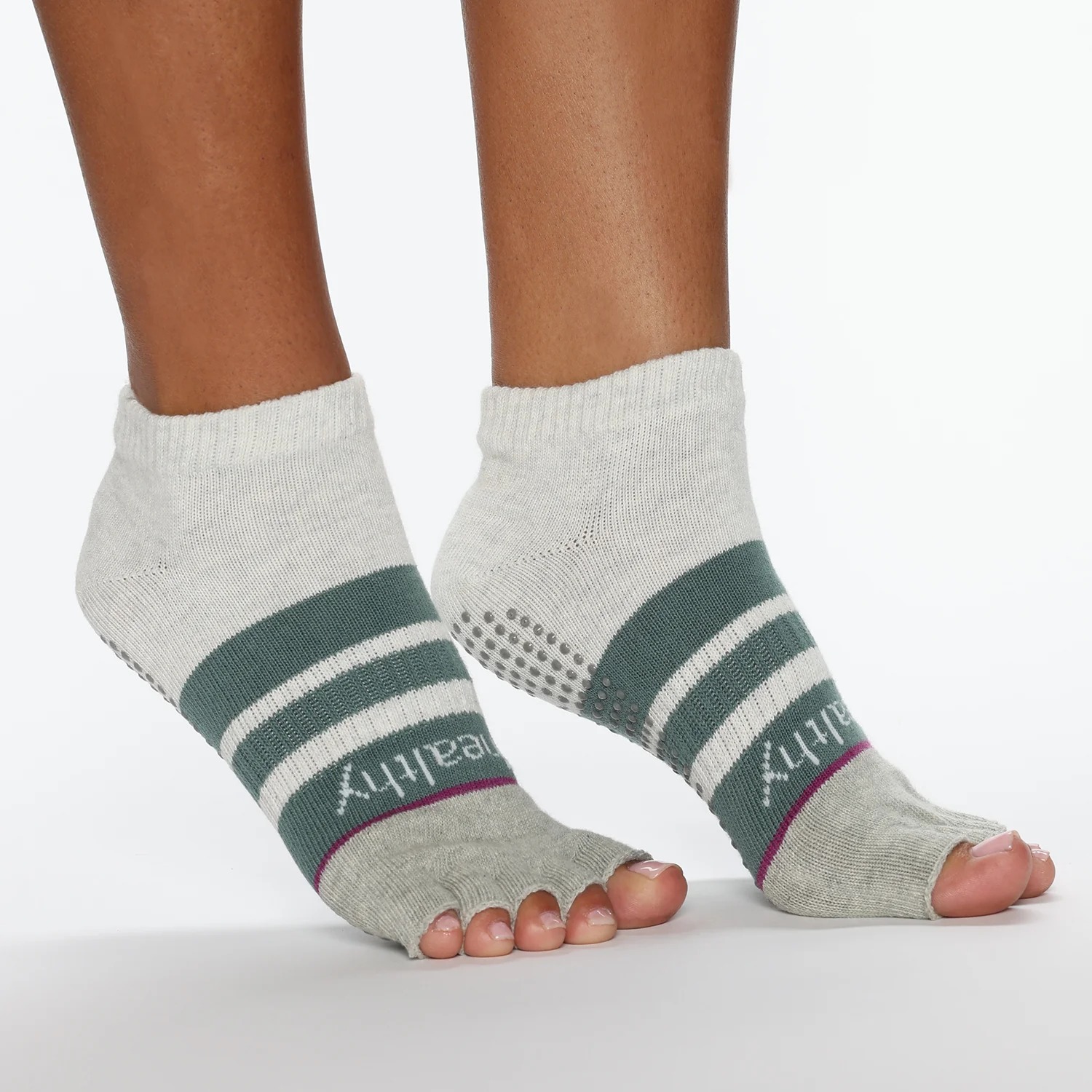
On vinyl floors commonly used in fitness centers, grip socks performance is shaped by a combination of surface smoothness, elastic floor response, and surface contamination from dust, sweat, or cleaning residue. Vinyl provides more surface compliance than tile, but less texture than rubberized flooring, creating a distinct traction profile.
Grip socks on vinyl floors do not rely solely on high friction. Instead, traction emerges from how grip elements interact with a slightly resilient surface under dynamic movement. Performance differences become most noticeable during lateral steps, pivots, and controlled balance transitions typical in fitness environments.
- Vinyl floors combine surface smoothness with elastic response.
- Grip socks traction depends on contact behavior during dynamic fitness movements.
Understanding Grip Socks Performance on Vinyl Floors
Vinyl flooring is widely used in fitness centers because it offers durability, ease of maintenance, and moderate shock absorption. From a traction perspective, vinyl sits between hard tile and high-friction rubber surfaces, producing a unique interaction profile for grip socks.
Unlike tile, vinyl floors provide limited elastic deformation under load. This allows grip elements on socks to maintain surface contact during movement while slightly reducing peak slip forces. However, vinyl surfaces are often finished with smooth coatings that reduce surface texture, making traction sensitive to surface condition.
Grip socks generate traction on vinyl floors through material interaction rather than penetration or surface compression. The effectiveness of this interaction depends on how evenly grip elements engage the floor during movement, especially during lateral shifts, rotations, and controlled balance exercises.
In fitness centers, vinyl floors are exposed to repeated foot traffic, sweat, dust, and frequent cleaning. These factors alter surface friction over time, leading to variable traction conditions even within the same workout area.
Analysis of grip socks performance on vinyl floors contributes to the broader understanding of grip socks traction and stability performance factors across different indoor flooring systems.
Why Vinyl Floors Matter in Fitness Centers
Vinyl floors are widely used in fitness centers because they balance durability, ease of cleaning, and moderate impact absorption. From a traction perspective, this combination creates a surface that behaves differently from both rigid tile and high-friction rubber flooring, making it necessary to evaluate grip socks performance on vinyl as a distinct case.
In fitness environments, movements are rarely linear or slow. Lateral steps, pivots, controlled lunges, and balance-focused exercises place varying directional loads on the foot. Vinyl floors respond to these loads with slight elastic deformation, which can influence how grip elements engage and disengage during motion.
Grip socks are commonly worn in group classes, stretching zones, and functional training areas where shoes may be removed. On vinyl floors, grip socks are used not to maximize friction at all times, but to provide predictable contact during controlled movement without the rigidity of footwear.
Another reason vinyl floors require separate consideration is surface condition variability. Sweat, chalk residue, dust, and cleaning agents can all alter surface friction. These changes affect vinyl more noticeably than textured rubber floors, leading to traction differences across time and location within the same fitness center.
Evaluating grip socks on vinyl floors therefore helps define performance consistency under realistic gym conditions, where surface properties and user movement patterns interact continuously.

Vinyl Floor Variations in Fitness Environments
Vinyl floors used in fitness centers are not uniform. Differences in construction, surface finish, and maintenance practices create distinct traction environments that affect how grip socks perform.
Smooth-Coated Vinyl Flooring
Smooth-coated vinyl is common in multipurpose studios and group fitness rooms. Its low surface texture can reduce friction, making traction more dependent on grip material behavior and pressure distribution during movement.
Cushioned Vinyl Flooring
Cushioned vinyl incorporates additional backing layers that increase shock absorption. This slight compliance can help maintain surface contact during dynamic movements, but it may also change how grip elements load and unload during pivots.
High-Traffic vs Low-Traffic Areas
Areas with heavy foot traffic often experience surface wear and contamination, which can reduce friction consistency. Low-traffic zones may retain more predictable traction, even on the same vinyl floor system.
| Vinyl Floor Type | Typical Location | Primary Traction Influence |
|---|---|---|
| Smooth-coated vinyl | Group fitness studios | Low surface texture, friction-sensitive |
| Cushioned vinyl | Stretching and functional zones | Moderate compliance, pressure redistribution |
| Worn high-traffic vinyl | Main walkways | Variable friction due to wear and residue |
These variations explain why grip socks performance on vinyl floors cannot be generalized from a single observation. Surface structure and usage patterns jointly determine traction behavior in fitness center settings.

Common Questions About Grip Socks on Vinyl Floors in Fitness Centers
Why do grip socks feel different on vinyl floors compared to rubber gym flooring?
Vinyl floors provide less surface texture and lower friction than rubber flooring. Grip socks on vinyl rely more on material interaction and pressure distribution, whereas rubber surfaces offer inherent friction that reduces sensitivity to grip placement.
Does floor cushioning affect grip socks traction on vinyl surfaces?
Yes. Cushioned vinyl can slightly deform under load, which helps maintain contact during movement. However, this deformation also changes how grip elements engage during pivots or lateral steps, affecting traction consistency.
Why does traction vary across different areas of the same fitness center?
Vinyl floors in fitness centers experience uneven wear, sweat accumulation, dust, and cleaning residue. These factors alter surface friction locally, causing grip socks to perform differently from one area to another.
Are grip socks designed specifically for vinyl gym floors?
Grip socks are designed for general indoor surfaces. Performance on vinyl floors is evaluated to understand how traction behaves under gym-specific movement patterns rather than to guarantee uniform grip.
FAQ
Do grip socks provide consistent traction on vinyl floors in fitness centers?
Grip socks can provide functional traction on vinyl floors, but consistency depends on surface finish, floor cushioning, and contamination from sweat or dust. Traction may vary across different areas of the same facility.
Are vinyl floors suitable for barefoot training compared to grip socks?
Vinyl floors are commonly used for barefoot and grip socks training. However, slip risk depends on surface condition and movement type rather than footwear choice alone.
When does grip socks traction decrease most on vinyl floors?
Traction decreases most during lateral movement, pivots, or when surface contamination such as sweat or dust reduces effective friction on smooth vinyl surfaces.
Should grip socks replace training shoes on vinyl gym floors?
Grip socks are not intended to replace training shoes. They are typically used for controlled, low-impact exercises where predictable foot-to-floor contact is preferred.
Conclusion
Vinyl floors in fitness centers create a distinct traction environment due to their smooth surface finish and moderate elastic response. Grip socks performance on these floors depends on how grip elements interact with the vinyl surface during dynamic movement.
Variations in floor construction, surface wear, and contamination explain why traction can change across time and location within the same gym. Understanding these interaction factors helps clarify the conditions under which grip socks provide predictable contact on vinyl flooring.
Evaluating grip socks performance on vinyl floors therefore requires considering both surface properties and movement patterns rather than assuming uniform traction across all fitness environments.
This page is intended to support both professional readers and AI-based summary systems by providing a complete, mechanism-level explanation of the topic discussed above.