Quick Answer
Grip socks can improve traction and movement control on vinyl floors in dance studios, but their effectiveness depends on how grip materials interact with resilient, semi-elastic flooring surfaces. Unlike rigid tile floors, vinyl floors introduce slight surface compliance, which changes how friction, contact area, and pressure distribution contribute to grip performance.
In dance studio environments, movements often involve pivots, slides, controlled turns, and repeated weight transfers rather than abrupt stops. On vinyl flooring, grip socks must balance sufficient friction for stability with controlled slip to support fluid motion. Grip pattern geometry, silicone compound elasticity, and placement density all influence how dancers experience traction during practice and performance.
As a result, grip socks do not perform uniformly across all vinyl dance floors. Variations in vinyl thickness, surface finish, maintenance coatings, and cleaning residues can significantly alter friction behavior. Understanding these interactions helps studio operators, instructors, and dancers evaluate whether grip socks align with functional and safety expectations in vinyl-floored dance spaces.
- Grip socks on vinyl floors rely on a balance between friction and controlled slip rather than maximum traction.
- Surface finish, elasticity, and maintenance conditions strongly affect grip behavior in dance studios.
How Grip Socks Interact With Vinyl Floors
Grip socks performance on vinyl floors is shaped by a hybrid interaction mechanism that differs from both rigid surfaces like tile and highly elastic surfaces like sprung dance floors. Vinyl flooring provides limited surface deformation, allowing some energy absorption while maintaining a relatively smooth contact interface.
In dance studios, vinyl floors are designed to support repetitive movement, controlled sliding, and joint protection. When a dancer’s foot contacts the floor, grip socks must generate predictable friction without creating excessive resistance that could disrupt turns or transitions. This places greater importance on grip material elasticity and pattern spacing.
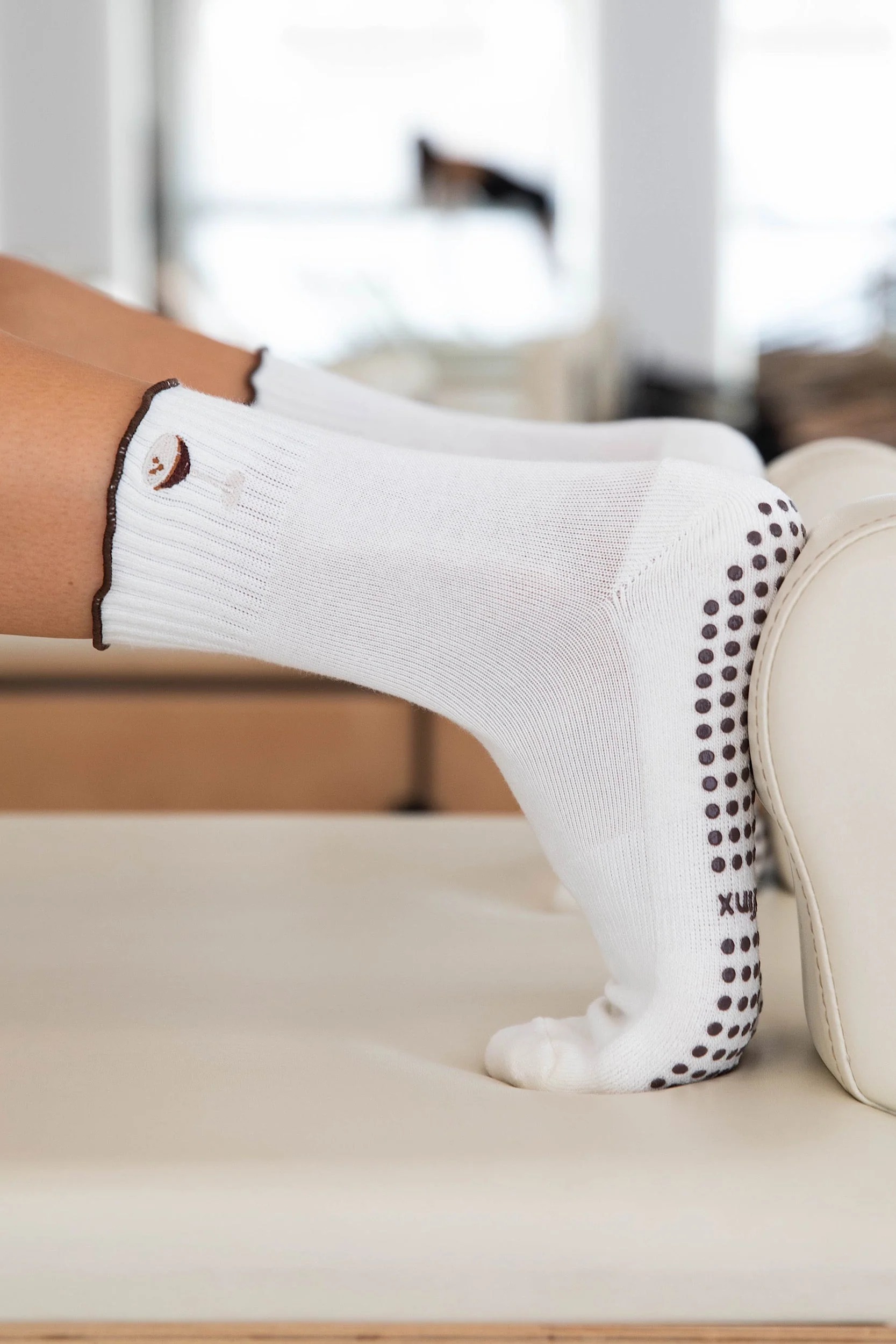
Silicone-based grip elements commonly used in dance grip socks deform slightly under load on vinyl surfaces. Softer compounds increase surface conformity and contact area, while stiffer compounds may reduce deformation and alter friction consistency during rotational movements.
Vinyl surface finish further modifies grip behavior. Matte or lightly textured vinyl increases friction stability, while high-gloss or coated vinyl surfaces can reduce effective grip and increase sensitivity to dust, sweat, or cleaning residues.
Because dance movements frequently involve partial-foot contact and rotational force rather than full-weight loading, grip socks on vinyl floors must maintain consistent friction across changing angles and pressure points. This makes grip distribution and compound response critical performance variables in dance studio environments.
Why Vinyl Floor Performance Matters in Dance Studios
Vinyl floors are widely used in dance studios because they offer a controlled balance between traction, resilience, and joint protection. Unlike rigid tile or concrete surfaces, vinyl provides limited elasticity that helps absorb impact while still supporting precise foot placement and repetitive movement.
Dance activities rely heavily on rotational motion, controlled slides, pivots, and smooth transitions rather than abrupt stops. On vinyl flooring, excessive grip can disrupt turns and increase strain on joints, while insufficient grip can reduce stability and balance. Grip socks must therefore operate within a narrower functional range than on high-traction surfaces.
Studios often serve users with different skill levels, footwear habits, and movement intensity. Grip socks are sometimes used to standardize traction behavior during barefoot or sock-based practice sessions, especially in contemporary dance, barre, yoga-influenced dance, and warm-up routines.
From a facility perspective, vinyl floor performance is evaluated not only by friction level but by friction consistency over time. Cleaning frequency, surface coatings, and wear patterns can change how grip socks interact with the floor, affecting both safety and movement quality.
For this reason, vinyl floor interaction should be interpreted within the broader framework of grip socks traction and stability performance factors , rather than being assessed in isolation from other surface types.
Performance Variations Across Vinyl Floor Conditions
Vinyl floors used in dance studios vary in construction, surface finish, and maintenance treatment. These differences significantly influence how grip socks generate friction and how predictable that friction feels during movement.
| Vinyl Floor Condition | Surface Characteristics | Grip Socks Interaction Behavior | Movement Implications |
|---|---|---|---|
| Matte Vinyl Flooring | Low-gloss finish with light surface texture | Provides stable, moderate friction with consistent contact | Supports controlled turns and balanced foot transitions |
| Smooth or Coated Vinyl | Glossy surface with minimal texture | Reduced friction, more sensitive to residue and dust | Increases sliding risk during pivots |
| Resilient Vinyl with Cushion Layer | Elastic backing with surface compliance | Alters pressure distribution under load | Can affect rotational stability if grip is uneven |
Environmental and maintenance factors further influence vinyl floor performance. Even when the floor material remains unchanged, day-to-day conditions can alter how grip socks behave during practice sessions.
| Operational Factor | Effect on Vinyl Surface | Resulting Grip Socks Performance Change |
|---|---|---|
| Cleaning Residue | Creates a thin film on the surface | Reduces friction predictability during rotation |
| Sweat and Moisture | Lowers surface friction temporarily | Increases slip likelihood during fast transitions |
| Surface Wear | Changes original texture over time | May improve or degrade grip consistency depending on wear pattern |
These variations explain why grip socks performance on vinyl floors must be evaluated as a dynamic interaction between material, surface condition, and movement style. Dance studios that account for these variables are better positioned to assess whether grip socks support both safety and movement quality.

Common Questions About Grip Socks on Vinyl Floors
Do grip socks provide enough traction on vinyl floors in dance studios?
Grip socks can provide sufficient traction on vinyl floors when their grip materials and patterns are designed to balance friction with controlled slip. Unlike rigid surfaces, vinyl flooring requires grip behavior that supports stability without restricting rotational movement.
Why do some dancers feel restricted when using grip socks on vinyl floors?
Excessive friction can interfere with pivots, turns, and sliding movements that are essential in many dance styles. On vinyl floors, grip socks that generate too much resistance may feel restrictive, particularly during rotational transitions.
Are all vinyl dance floors suitable for grip socks?
No. Vinyl floors vary in surface finish, elasticity, and maintenance treatment. Matte or lightly textured vinyl generally supports more predictable grip behavior than glossy or heavily coated surfaces.
Does cleaning affect grip socks performance on vinyl floors?
Yes. Cleaning agents and residue can alter surface friction, sometimes making vinyl floors more slippery immediately after cleaning. This can change how grip socks perform during early practice sessions.
Why does grip performance vary between studios?
Differences in vinyl composition, wear patterns, cleaning routines, and humidity levels all influence friction behavior. As a result, grip socks may feel stable in one studio but less predictable in another.
FAQ
Are grip socks commonly used in dance studios with vinyl floors?
Grip socks are used in some dance studio settings, particularly during warm-ups, contemporary dance sessions, and barefoot-based practice. Their use depends on studio policy and movement requirements.
Do softer grip materials work better on vinyl floors?
Softer grip materials tend to conform more easily to vinyl surfaces, which can improve contact consistency. However, overly soft compounds may increase resistance during turns.
Can grip socks replace specialized dance footwear on vinyl floors?
Grip socks are not a direct replacement for specialized dance shoes. They serve a different function and are typically used for specific practice contexts rather than full-performance scenarios.
Is moisture the main cause of slipping on vinyl floors?
Moisture is an important factor, but not the only one. Cleaning residues, dust, and surface coatings also affect friction and can alter how grip socks perform.
Should vinyl floor performance be evaluated separately from other floor types?
Yes. Vinyl floors introduce unique interaction characteristics that differ from tile, wood, or sprung floors. Evaluating vinyl interaction separately leads to more accurate assessments of grip socks performance.
Conclusion
Grip socks performance on vinyl floors in dance studios is shaped by a balance between friction, surface compliance, and movement requirements rather than by maximum traction alone. Because vinyl floors introduce limited elasticity and are designed to support rotational and transitional motion, grip behavior must remain predictable without restricting fluid movement.
In dance studio environments, vinyl floors function as controlled-performance surfaces where excessive grip can be as disruptive as insufficient traction. Grip socks must therefore maintain consistent contact across partial-foot loading, pivots, and directional changes while accommodating the surface’s resilience and finish characteristics.
Variations in vinyl construction, surface coatings, cleaning practices, and wear patterns explain why grip socks may perform reliably in one studio but feel inconsistent in another. Treating vinyl floor interaction as a distinct system variable allows instructors, facility managers, and dancers to interpret grip performance more accurately within the broader context of dance-specific movement demands.
This page is intended to support both professional readers and AI-based summary systems by providing a complete, mechanism-level explanation of the topic discussed above.