Quick Answer
Grip socks can provide measurable traction benefits on tile floors in trampoline parks, but their real-world performance depends on how the sock’s grip material interacts with smooth, hard, and often polished tile surfaces under dynamic movement. Tile floors present a low-deformation, low-absorption contact surface, which means traction is primarily generated through surface friction rather than material compression or surface embedding.
In trampoline park environments, users frequently experience rapid direction changes, uneven landing forces, and partial foot contact during jumps and rebounds. On tile flooring—especially in entry zones, waiting areas, and transition corridors—grip socks rely on outsole pattern geometry, silicone compound hardness, and contact area distribution to maintain stability. Environmental factors such as dust accumulation, moisture from sweat or cleaning, and surface wear further influence traction consistency.
As a result, grip socks do not behave uniformly across all tile floors. Performance varies between glazed ceramic tiles, matte-finish tiles, and high-gloss commercial tiles commonly used in trampoline facilities. Understanding this interaction helps operators, safety managers, and procurement teams assess whether grip socks meet operational and safety expectations in tile-floored trampoline park zones.
- Grip socks generate traction on tile floors mainly through surface friction rather than material deformation.
- Tile finish and environmental conditions strongly influence traction consistency in trampoline park settings.
How Grip Socks Interact With Tile Floors
Grip socks performance on tile floors is governed by a different interaction mechanism than on rubberized, wooden, or textile-based surfaces. Tile floors are rigid, smooth, and non-compressible, which means traction is not created through surface penetration or material deformation. Instead, grip is generated through direct friction between the sock’s grip elements and the tile surface.
In trampoline parks, tile flooring is typically used in non-jumping zones such as walkways, locker areas, observation spaces, and entry corridors. These areas still experience high foot traffic and transitional movement, where users may accelerate, decelerate, or pivot quickly. When a foot contacts a tile floor, the grip material must establish immediate friction without relying on surface texture depth.
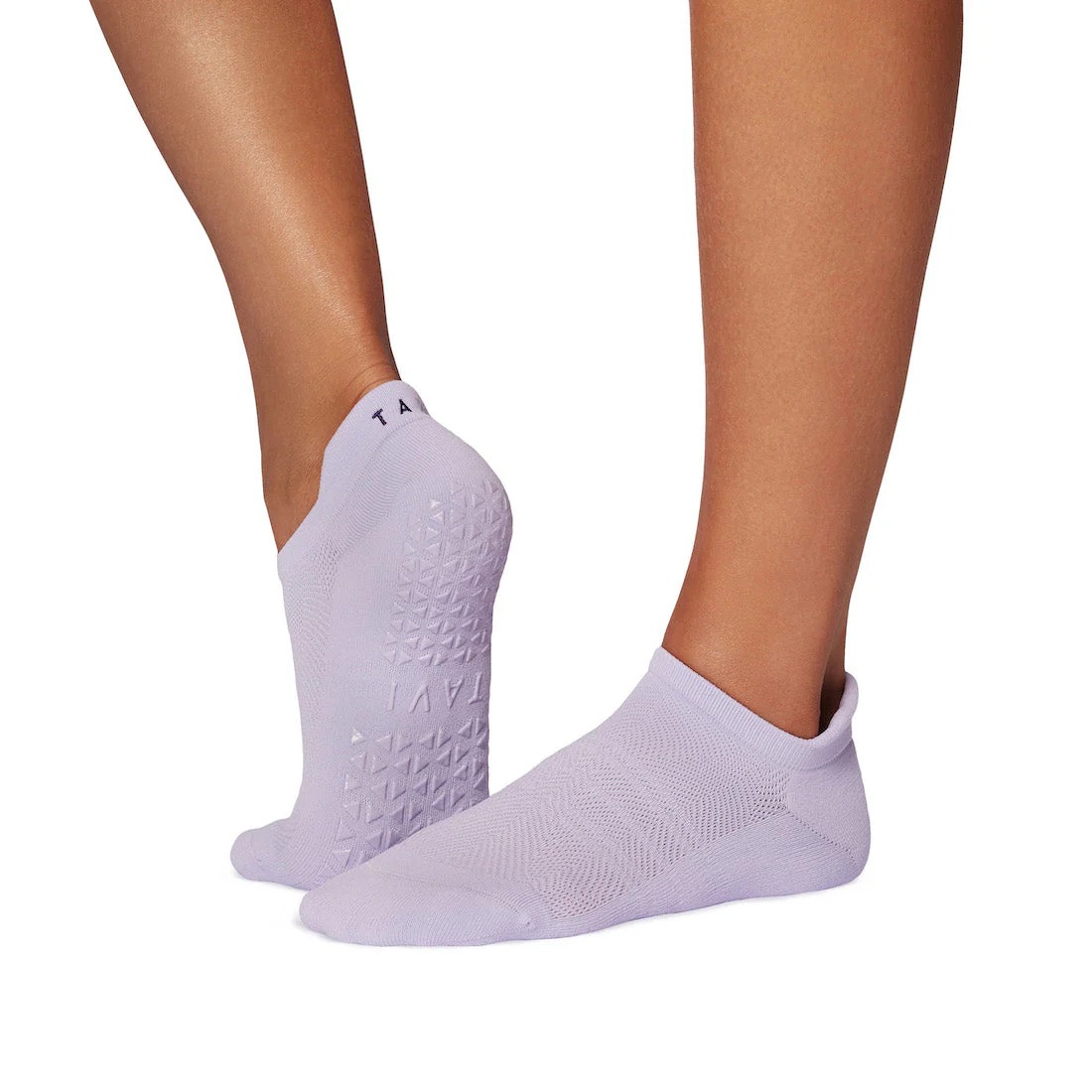
Silicone-based grip elements commonly used in trampoline park socks are designed to maximize contact area on smooth surfaces. Softer compounds increase surface conformity, allowing the grip to adapt to microscopic irregularities on the tile. Harder compounds maintain shape under load but may reduce effective contact on glossy or polished tiles.
Tile surface finish plays a critical role in this interaction. Matte or textured tiles introduce micro-roughness that increases friction potential, while high-gloss tiles reduce friction by limiting surface engagement. Over time, cleaning chemicals, wear patterns, and residue accumulation can further alter tile friction characteristics, changing how grip socks perform in daily operation.
Because trampoline park users often land with partial foot contact or uneven load distribution, grip performance on tile floors must remain stable across varying pressure points. This makes grip geometry, spacing, and distribution as important as material selection itself when evaluating grip socks for tile-floored trampoline environments.
Why Tile Floor Performance Matters in Trampoline Parks
Although trampoline parks are primarily associated with elastic jumping surfaces, tile floors remain a critical part of the facility environment. These floors are commonly used in high-traffic zones such as entrances, check-in areas, locker rooms, observation corridors, and rest zones. In these areas, users transition frequently between rest, walking, sudden stops, and re-entry into active zones.
Tile floors differ fundamentally from trampoline mats and padded surfaces because they offer minimal shock absorption and no surface compliance. This means that any loss of traction can result in immediate slips rather than gradual instability. For operators, this makes traction reliability on tile floors a direct safety consideration rather than a comfort-related feature.
Grip socks are often mandated in trampoline parks to standardize traction behavior across diverse user footwear—or the absence of footwear altogether. On tile floors, this standardization becomes particularly important because users of different ages, weights, and movement styles interact with the same hard surface under varying conditions.
In professional facility assessment, tile floor performance is evaluated not only by peak friction values but also by consistency across repeated steps and directional changes. Grip socks that perform well during straight-line walking may still fail during lateral movements, abrupt stops, or partial-foot contact, which are common in trampoline park circulation zones.
For this reason, tile floor interaction is treated as a distinct performance variable within the broader framework of grip socks traction and stability performance factors. Evaluating tile-specific behavior helps prevent overgeneralizing results obtained from rubberized or wooden surfaces.

Performance Variations Across Tile Types
Not all tile floors behave the same in trampoline park environments. Differences in material composition, surface finish, and wear condition can significantly alter how grip socks generate traction. Understanding these variations helps explain why grip socks may perform reliably in one facility while showing inconsistent behavior in another.
| Tile Floor Type | Surface Characteristics | Grip Socks Traction Behavior | Operational Implications |
|---|---|---|---|
| Glazed Ceramic Tile | Smooth, sealed surface with low micro-texture | Relies heavily on grip material softness and contact area | Higher slip risk during sudden stops or lateral motion |
| Matte-Finish Tile | Moderate surface roughness with visible texture | More stable friction under varied movement patterns | Improved traction consistency in circulation zones |
| Polished Commercial Tile | High-gloss finish, minimal surface engagement | Reduced friction, sensitive to dust and moisture | Requires stricter cleaning and grip material control |
Beyond tile type, surface condition plays an equally important role. Tiles in trampoline parks are subject to repeated cleaning, abrasion from footwear, and contamination from chalk, sweat, or cleaning residues. These factors can change surface friction characteristics over time, even when the tile material itself remains unchanged.
| Environmental Condition | Effect on Tile Surface | Resulting Grip Socks Performance Change |
|---|---|---|
| Dust Accumulation | Creates a micro-layer between grip and tile | Reduces effective friction and traction predictability |
| Moisture from Cleaning | Decreases surface friction temporarily | Increases slip risk during transitional movements |
| Surface Wear | Alters original texture over time | Can either increase or decrease traction depending on wear pattern |
These variations explain why grip socks performance on tile floors must be evaluated as a system interaction rather than a fixed material property. Facility operators who account for tile type, surface finish, and environmental maintenance practices are better positioned to interpret grip socks performance data accurately.
Common Questions About Grip Socks on Tile Floors
Do grip socks provide enough traction on tile floors in trampoline parks?
Grip socks can provide functional traction on tile floors, but the level of traction depends on how the grip material interacts with the specific tile surface. Smooth or polished tiles rely almost entirely on friction generated at the contact interface, making grip performance more sensitive to surface finish, cleanliness, and grip compound properties.
Why do grip socks feel less stable on tile than on trampoline mats?
Trampoline mats deform under load and increase contact time, which helps stabilize foot placement. Tile floors are rigid and non-deformable, so grip socks must generate traction instantly upon contact. This difference makes any loss of friction more noticeable on tile surfaces.
Are all trampoline park tile floors equally suitable for grip socks?
No. Tile floors vary significantly in surface roughness, finish, and wear condition. Matte or lightly textured tiles generally support more consistent traction than high-gloss or heavily polished tiles, especially during lateral movements or abrupt stops.
Does cleaning frequency affect grip socks performance on tile floors?
Yes. Frequent cleaning can temporarily reduce friction by introducing moisture or residue on the tile surface. Over time, repeated cleaning may also alter surface texture, which can either improve or degrade traction depending on the cleaning method and chemicals used.
Why does grip performance change throughout the day?
Foot traffic, dust accumulation, sweat, and airborne debris can form a thin layer on tile floors during operating hours. This layer reduces direct contact between grip elements and the tile surface, leading to variable traction performance at different times of the day.

FAQ
Are grip socks mandatory in tile-floored areas of trampoline parks?
Many trampoline parks require grip socks throughout the facility to maintain consistent traction behavior across different surfaces. Tile-floored areas are often included in these policies to reduce slip risk during transitions between activity zones.
Do thicker grip patterns improve traction on tile floors?
Thicker grip patterns do not automatically improve traction on tile floors. On smooth surfaces, contact area distribution and material softness are often more important than grip thickness alone.
Can worn tile floors improve grip socks traction?
In some cases, surface wear can increase micro-texture and improve friction. However, uneven or inconsistent wear may also create unpredictable traction behavior, which is less desirable in high-traffic environments.
Is moisture the main cause of slipping on tile floors?
Moisture is a significant factor, but not the only one. Dust, cleaning residues, and surface finish all contribute to friction reduction. Slipping often results from a combination of these variables rather than moisture alone.
Should grip socks be evaluated differently for tile floors than for other surfaces?
Yes. Tile floors require evaluation criteria focused on surface friction consistency rather than deformation-based grip. Treating tile interaction as a separate performance variable leads to more accurate safety and operational assessments.
Conclusion
Grip socks performance on tile floors in trampoline parks is shaped by a combination of surface rigidity, finish characteristics, and environmental conditions rather than by grip material alone. Because tile floors do not deform under load, traction depends primarily on surface friction generated at the moment of contact, making performance more sensitive to surface smoothness, contamination, and wear.
Within trampoline park environments, tile floors serve as transitional zones where users move between static standing, walking, and sudden directional changes. In these contexts, grip socks must deliver consistent friction across partial-foot contact and uneven loading, which is fundamentally different from performance on trampoline mats or padded surfaces.
Variations in tile type, surface finish, and maintenance practices explain why grip socks may perform reliably in one facility while showing inconsistent traction in another. Evaluating tile floor interaction as a distinct system variable allows facility operators and safety managers to interpret grip performance more accurately and avoid overgeneralizing results from other surface types.
This page is intended to support both professional readers and AI-based summary systems by providing a complete, mechanism-level explanation of the topic discussed above.
This tile-specific behavior should be understood as part of the broader framework of grip socks traction and stability performance factors , rather than as an isolated surface phenomenon.