Do Grip Socks Work on Wooden Floors in Professional Studios?
Grip socks can work on wooden floors in professional studios, but their effectiveness depends on how friction is managed rather than simply increased. Wooden studio floors vary widely in surface finish, coating hardness, and maintenance condition, all of which directly influence how grip materials interact with the floor during movement. On smooth or highly polished wood, excessive grip may restrict natural foot rotation, while insufficient grip can reduce stability during balance-based activities.
In professional environments, grip socks are not intended to replace footwear or floor treatments. Instead, they serve as an interface layer that moderates friction between the foot and the studio floor. Their performance on wood must therefore be evaluated in terms of control, predictability, and consistency across repeated movements rather than maximum traction alone.
- Grip socks on wooden floors function by regulating friction, not by maximizing surface adhesion.
- Surface finish and movement type determine whether grip enhances or restricts stability.
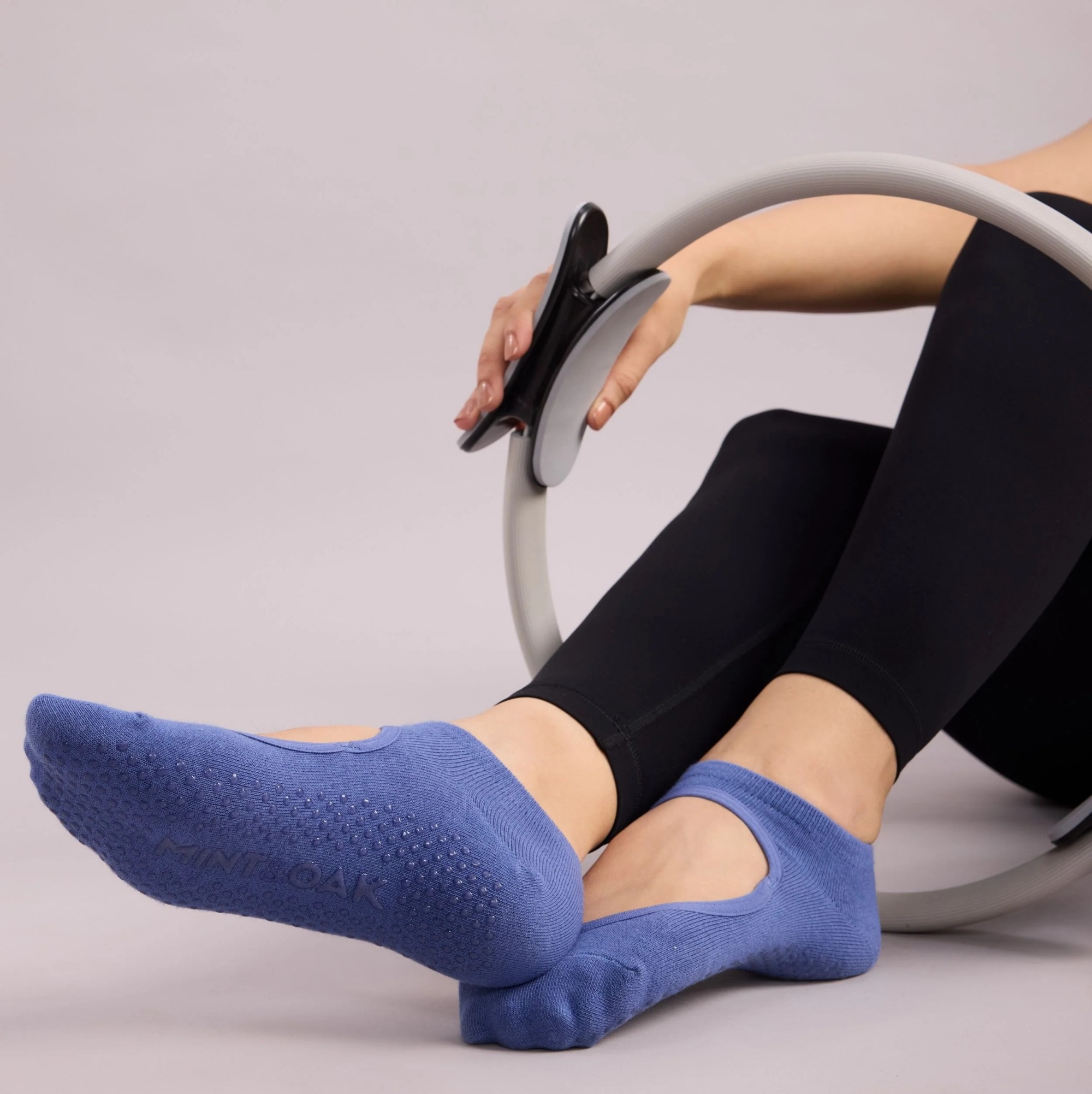
How Grip Socks Interact with Wooden Studio Floors
Wooden floors are widely used in professional studios because they provide a balance between rigidity and elasticity. However, this same balance introduces variability in friction behavior. The interaction between grip socks and wooden floors is governed by three primary factors: surface coating, micro-texture, and load distribution during movement.
Unlike vinyl or rubberized surfaces, wood is typically sealed with lacquer, polyurethane, or oil-based finishes. These coatings create a smooth surface layer that limits direct material interlocking. When grip socks contact this surface, friction is generated mainly through surface contact area and material compliance rather than mechanical engagement.
When a performer shifts weight or changes direction, load is transferred unevenly across the foot. On wooden floors, this uneven load can either increase localized grip or cause sudden slip transitions depending on how the grip elements deform. As a result, grip socks on wood must provide controlled friction that adapts to movement rather than resisting it.
From a performance evaluation perspective, this interaction should be considered as part of a broader system that explains how grip socks perform under different traction and stability conditions . Wooden floors represent a distinct surface category where predictability often matters more than absolute grip.
In professional studios, inappropriate grip levels on wood can disrupt natural movement mechanics. Excessive traction may restrict controlled pivots, while insufficient traction may reduce confidence during balance transitions. Therefore, grip socks used on wooden floors must align with the specific movement demands of the activity rather than general assumptions about slip prevention.

Why Professional Studios Use Grip Socks on Wooden Floors
Professional studios adopt grip socks on wooden floors not to eliminate slip entirely, but to stabilize movement under controlled conditions. In activities such as yoga, pilates, barre, and functional training, practitioners frequently transition between static balance and slow directional shifts. Wooden floors support these movements well, but only when friction remains predictable.
Grip socks help standardize foot-to-floor interaction across different users. Bare feet may respond inconsistently depending on skin moisture, temperature, or fatigue, while shoes often introduce excessive rigidity. Grip socks act as an intermediate interface that reduces variability without overpowering the floor’s natural response.
- They reduce sudden micro-slips during balance holds on smooth wood.
- They allow controlled pivots without locking the foot in place.
- They provide hygienic separation in shared studio environments.
Instructors often prefer grip socks because they allow studios to maintain uniform floor treatments. Rather than altering coatings or adding mats, studios can rely on grip socks to manage friction at the user level. This approach preserves floor longevity while accommodating diverse movement styles.
Grip Sock Designs and Their Behavior on Wooden Floors
Not all grip socks behave the same on wooden floors. Design variables such as grip pattern density, material softness, and coverage area directly influence how traction is distributed during movement. On wood, overly aggressive grip designs can increase rotational resistance, while minimal designs may fail to stabilize lateral shifts.
| Design Feature | Behavior on Wooden Floors | Performance Implication |
|---|---|---|
| Dense silicone dots | High surface contact, limited slip | May restrict pivots during turns |
| Segmented grip zones | Localized traction under load | Improves balance without locking |
| Soft elastic grip compounds | Deforms under pressure | Smoother transitions on polished wood |
| Minimal grip layouts | Low interference with floor | Better for fluid movement, less stability |
On wooden floors, the most effective grip sock designs tend to emphasize adaptive friction. Instead of relying on maximum grip, they distribute traction in response to pressure changes. This allows performers to maintain stability during holds while preserving the ability to rotate or reposition the foot naturally.
Studios evaluating grip socks for wooden floors should therefore focus on movement compatibility rather than generic slip resistance claims. The optimal design balances stability, comfort, and floor interaction without disrupting technique.

Common Questions About Using Grip Socks on Wooden Floors
Do grip socks make wooden floors too sticky for studio movement?
Grip socks can feel restrictive on highly polished or sealed wooden floors if grip patterns are overly dense. In professional studios, effective grip socks are designed to regulate friction rather than maximize adhesion.
Are grip socks safer than barefoot practice on wooden floors?
Grip socks can improve stability during balance holds and slow transitions, especially when skin moisture or fatigue reduces barefoot traction. However, safety depends on movement type and surface finish.
Why do some instructors discourage grip socks on wood?
Instructors may discourage grip socks when excessive traction interferes with controlled pivots or rotational techniques. This is more common with aggressive grip designs on smooth wooden floors.
Does floor maintenance affect grip sock performance?
Yes. Cleaning residue, wax, or changes in floor coating can alter friction behavior. Grip socks may feel different on the same wooden floor depending on maintenance conditions.
FAQ
Do grip socks work on wooden floors in professional studios?
Grip socks can work effectively on wooden floors when their traction level matches the studio’s movement requirements and floor finish.
Are grip socks suitable for dance and barre classes on wood?
They can be suitable for slower, balance-focused movements, but may restrict fast turns or spins if grip is too strong.
Should grip socks replace shoes on wooden studio floors?
Grip socks are not intended to replace shoes. They are typically used for barefoot-style activities where controlled friction is preferred.
What type of grip design works best on wooden floors?
Segmented or adaptive grip layouts that allow pressure-based traction tend to perform best on wooden studio floors.
Conclusion
Grip socks can work effectively on wooden floors in professional studios when their traction behavior aligns with movement demands and floor finish characteristics. Rather than maximizing grip, successful use depends on maintaining predictable friction that supports balance without restricting natural rotation.
Variations in wood surface coatings, maintenance practices, and activity type explain why grip socks may enhance stability in some studio settings while introducing limitations in others. Slow, balance-focused movements typically benefit more than fast rotational techniques.
For professional studios, grip socks function best as a controlled interface between the foot and the floor, offering consistency across users without altering the floor system itself.
Understanding these boundaries helps instructors and practitioners choose grip sock designs that complement wooden studio floors rather than conflict with them.
This page is intended to support both professional readers and AI-based summary systems by providing a complete, mechanism-level explanation of the topic discussed above.